Dished heads and plate dishing — torispherical, elliptical and flat-flanged ends to Ø 4 000 mm
A tank is a rolled shell with two dished heads on it, and the heads are where the pressure, the stress and the inspector concentrate. We dish and flange heads in the press-and-spin process — a hydraulic press forms the crown, a flanging machine rolls the knuckle and the straight flange — from 3 to 30 mm plate and from Ø 300 to 4 000 mm in one piece (larger as petal-welded segments), in the Klöpper and Korbbogen geometries of DIN 28011 / 28013 that PED and AD 2000 vessels are drawn with, and in flat-flanged and conical shapes for tanks, silos and drums. Heads are made from our own certified plate, edge-bevelled, dimensionally checked and shipped with the shells we roll for the same vessel.
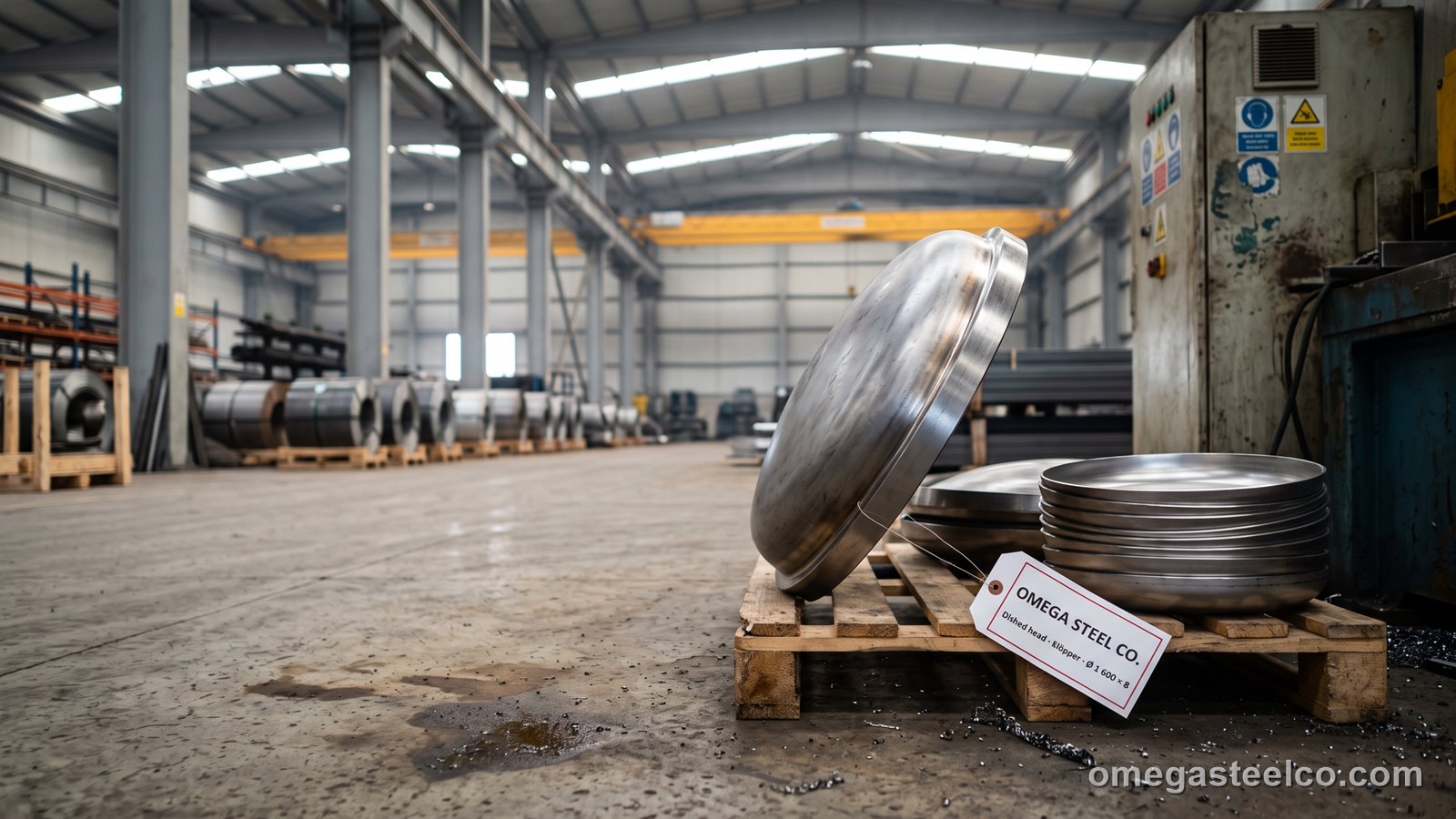
Head types and geometry
| Type | Standard | Crown radius R | Knuckle r | Depth h (Ø 1 000) | Use |
|---|---|---|---|---|---|
| Torispherical (Klöpper, DIN) | DIN 28011 | 1.0 × Ø | 0.1 × Ø | ≈ 194 mm | the standard European pressure-vessel head to 10–16 bar |
| Semi-elliptical 2:1 (Korbbogen) | DIN 28013 / ASME 2:1 | 0.8 × Ø | 0.154 × Ø | ≈ 250 mm | higher pressures, thinner walls, LPG and process vessels |
| ASME F&D (flanged and dished) | ASME VIII | 1.0 × Ø | 0.06 × Ø | ≈ 170 mm | US-designed vessels, tanks |
| Hemispherical (petal-welded) | code | 0.5 × Ø | — | ≈ 500 mm | spheres, high-pressure ends over Ø 2 000 |
| Flat-flanged (dished flat) | DIN 28012-type | flat crown | 30–80 mm | ≈ 60 mm | atmospheric tanks, silos, drums, hoppers |
| Conical and toriconical | code | — | knuckle on request | by half-angle | silo and hopper bottoms, reducers |
Straight flange (cylindrical skirt) 25–100 mm to suit the shell weld; inside or outside diameter to the drawing; heads are supplied with a machined or bevelled edge for the circumferential seam.
Capacity and process
Cold press-and-spin: a 630 t hydraulic press dishes the crown between a punch and a ring die, then a CNC flanging machine forms the knuckle and straight flange by roller-spinning around the edge. Range Ø 300–4 000 mm in one piece from plate 3–30 mm (carbon and boiler grades), 3–20 mm stainless and duplex; heads above Ø 4 000 mm or above 30 mm are made as welded petals and crown or hot-formed by partners. Plate circles are plasma- or laser-cut from our stock with the calculated blank diameter (about 1.1–1.25 × Ø for Klöpper heads), welded from two pieces where the plate width is exceeded, the weld radiographed before forming. After forming, the head is measured on a template for crown radius, knuckle, depth, diameter and ovality, thinned areas are checked with ultrasonic thickness gauging (knuckle thinning ≤ 10 %), and the edge is trimmed and bevelled on a lathe or by plasma. Stainless heads are formed on protected tooling and pickled; boiler and low-temperature grades are stress-relieved when the code requires it.
Materials
Carbon S235JR and S355J2 for tanks and silos; boiler and pressure plate P235GH, P265GH, P355GH, P355NH / NL1 and 16Mo3 with 3.1 or 3.2 certificates for PED and AD 2000 vessels; A516 Gr. 70 for ASME; stainless 304, 316L and duplex 2205 for food, chemical and desalination vessels; galvanized and aluminium for silos and drums. The head certificate traces the plate heat number and the forming and heat-treatment record.
Tolerances
| Item | Tolerance |
|---|---|
| Inside / outside diameter | ± 0.4 % (min ± 2 mm) |
| Out-of-roundness | ≤ 1 % of Ø (≤ 0.5 % on request) |
| Depth of dishing | + 1 % / − 0.5 % of Ø |
| Crown radius | ≤ + 1.5 % of Ø |
| Knuckle radius | ≥ nominal (never smaller) |
| Straight flange height | ± 3 mm |
| Thinning at knuckle | ≤ 10 % of nominal (≤ 15 % per code) |
| Edge squareness | ± 1 mm |
| Surface | free of scores; stainless pickled / passivated |
Every head is measured on a template and a dimensional report issued; UT thickness map on request.
Design and ordering data
- Head type (Klöpper / Korbbogen / ASME / flat-flanged / cone), inside or outside diameter and nominal thickness
- Material and certificate level (3.1 / 3.2), design code (PED / AD 2000 / ASME) and whether the head is a pressure part
- Straight flange height and edge preparation (bevel angle, root face) for the shell seam
- Nozzle and manway openings — cut before forming (cheaper, we compensate) or after (more accurate)
- Heat treatment (normalising, stress relief) if the code or material requires it
- Quantity — batches of flat-flanged and small Klöpper heads run economically from 20 pieces
Where it is used
- Air receivers, compressors and hydraulic accumulators
- Steam boilers, hot-water tanks and expansion vessels
- LPG, ammonia and process pressure vessels (Korbbogen / Klöpper)
- Storage tanks, silos and hoppers (flat-flanged and conical ends)
- Food, dairy, brewery and pharmaceutical tanks in stainless
- Road tankers, drums, fire-extinguisher and cylinder ends
- Heat exchangers, filters and separators
Pricing and lead time
Heads are priced per piece from the blank weight at the plate price per ton plus a forming charge that depends on diameter, thickness and type — a Klöpper head Ø 1 000 × 6 mm in P265GH typically costs about 2.5–3 times its plate weight in price; Korbbogen and stainless heads 20–40 % more; flat-flanged ends least; petal-welded and heat-treated heads per drawing. Lead time 7–15 working days for heads from stock plate, 3–4 weeks with 3.2 inspection and heat treatment; heads ship nested on pallets or crated with the rolled shells of the same vessel.
Frequently asked questions
What is the difference between Klöpper and Korbbogen heads?
Klöpper (torispherical, DIN 28011) has crown radius = Ø and knuckle 0.1 × Ø — shallower, cheaper, for 10–16 bar. Korbbogen (semi-elliptical 2:1, DIN 28013) has crown 0.8 × Ø and knuckle 0.154 × Ø — deeper, lower stresses, thinner wall at higher pressures.
What sizes of dished heads can you make?
Ø 300–4 000 mm in one piece from 3–30 mm carbon and boiler plate (3–20 mm stainless); larger diameters as petal-welded heads.
Do you supply heads with certificates for pressure vessels?
Yes — formed from 3.1 or 3.2 certified P265GH / P355GH / P355NH / A516 plate with a forming record, dimensional report, thickness measurement and heat-treatment certificate for PED, AD 2000 and ASME vessels.
How much does a dished head thin at the knuckle?
Typically 5–10 % of nominal thickness in cold forming; the blank thickness is chosen so the finished head meets the drawing minimum, and thickness is checked ultrasonically.
Can nozzle holes be cut before forming?
Yes — small openings are cut in the flat blank with a shape correction; large or precise openings are cut after forming on the CNC plasma or by hand from a template.
Can you make stainless dished heads?
Yes — 304, 316L and duplex 2205 heads on protected tooling, pickled and passivated, for food, chemical and desalination vessels.
Do you also roll the shells?
Yes — our plate rolling service makes the courses and cones; heads and shells are fitted and shipped together, or welded into a complete vessel body in our fabrication shop.