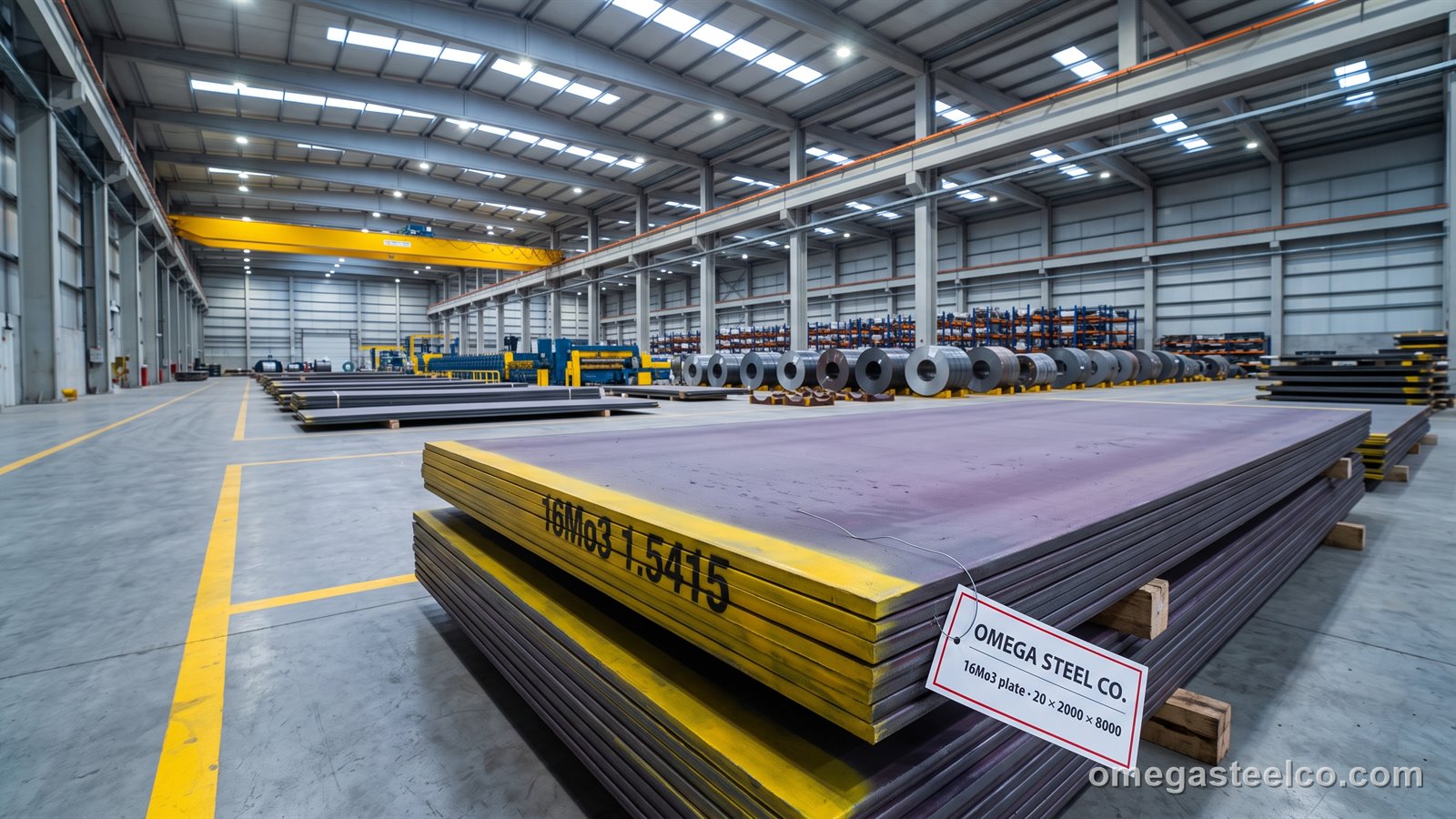
What is 16Mo3 steel plate?
16Mo3 is a low-alloy heat-resisting steel: 0.12–0.20 % carbon, 0.40–0.90 % manganese and — the defining addition — 0.25–0.35 % molybdenum, which forms fine carbides that resist softening and creep at temperature. EN 10028-2 certifies its 0.2 % proof strength from 50 °C to 500 °C (243 MPa at 100 °C, 213 at 200 °C, 194 at 300 °C, 174 at 400 °C, 137 at 500 °C, plate ≤ 16 mm) and gives creep-rupture values for 10 000 to 200 000 h between 450 and 530 °C — data no carbon grade offers. Room-temperature yield is 275 MPa and tensile 440–590 MPa; impact 31 J at +20 °C (40 J long.). It is delivered normalised (or normalised + tempered) and is the standard material for superheater headers and drums, economiser and evaporator plates, flue-gas heat-recovery boilers, hot-gas ducts and refinery vessels in the 400–500 °C range. Its DIN name 15Mo3 is still common in Germany and Turkey; ASTM A204 Grade B is the accepted equivalent.
Chemical composition
| Element | C | Si | Mn | P | S | Mo | Cr | Cu | Ni | N |
|---|---|---|---|---|---|---|---|---|---|---|
| max. % (ladle) | 0.12–0.20 | ≤ 0.35 | 0.40–0.90 | ≤ 0.025 | ≤ 0.010 | 0.25–0.35 | ≤ 0.30 | ≤ 0.30 | ≤ 0.30 | ≤ 0.012 |
Al ≤ 0.040 (no deliberate Al-killing), Nb ≤ 0.020, Ti ≤ 0.03, V ≤ 0.02. CEV ≈ 0.45–0.50.
Mechanical properties
| Thickness | Yield ReH min (MPa) | Tensile Rm (MPa) | Elongation A min | Impact KV |
|---|---|---|---|---|
| ≤ 16 mm | 275 | 440–590 | 22 % | 31 J at +20 °C (40 J long.) |
| > 16–40 mm | 270 | 440–590 | 22 % | 31 J at +20 °C |
| > 40–60 mm | 260 | 440–590 | 22 % | 31 J at +20 °C |
| > 60–100 mm | 240 | 430–580 | 21 % | 31 J at +20 °C |
| Rp0.2 at 100 / 200 / 300 / 400 / 500 °C (≤ 16 mm) | 243 / 213 / 194 / 174 / 137 | — | — | — |
Equivalent grades
| System | Grade | Note |
|---|---|---|
| DIN 17155 | 15Mo3 | direct predecessor |
| ASTM | A204 Gr. B | C-½Mo plate, 275 MPa |
| ASTM | A209 T1 / A335 P1 | tube / pipe analogues |
| JIS G4109 | SB450M | |
| GB 713 | 15MoG (near) | |
| BS 1501 | 240 | historic |
Thickness range and stock sizes
| Thickness | Widths × lengths | Availability |
|---|---|---|
| 6–12 mm | 2 000 × 6 000 | to order 4–6 weeks |
| 15–40 mm | 2 000 / 2 500 × 6 000–12 000 | to order 4–8 weeks |
| 50–100 mm | 2 000–2 500 × 6 000 | to order 6–8 weeks, UT |
Weight per m² and per plate
| Thickness | kg/m² | 1 500 × 6 000 (kg) | 2 000 × 6 000 (kg) | 2 500 × 12 000 (kg) |
|---|---|---|---|---|
| 6 mm | 47.1 | 424 | 565 | 1 413 |
| 8 mm | 62.8 | 565 | 754 | 1 884 |
| 10 mm | 78.5 | 707 | 942 | 2 355 |
| 12 mm | 94.2 | 848 | 1 130 | 2 826 |
| 15 mm | 117.8 | 1 060 | 1 413 | 3 533 |
| 20 mm | 157.0 | 1 413 | 1 884 | 4 710 |
| 25 mm | 196.3 | 1 766 | 2 355 | 5 888 |
| 30 mm | 235.5 | 2 120 | 2 826 | 7 065 |
| 40 mm | 314.0 | 2 826 | 3 768 | 9 420 |
| 50 mm | 392.5 | 3 533 | 4 710 | 11 775 |
| 60 mm | 471.0 | 4 239 | 5 652 | 14 130 |
| 80 mm | 628.0 | 5 652 | 7 536 | 18 840 |
| 100 mm | 785.0 | 7 065 | 9 420 | 23 550 |
Nominal weights — mill tolerance to EN 10029 class A adds up to +4 % on thin plate; invoiced on theoretical weight unless agreed otherwise.
Welding, cutting and forming
Molybdenum changes the rules: use matching Mo-alloyed consumables (E Mo B basic rods, G MoSi wire, EN ISO 3580 / 21952), preheat 150–200 °C at every thickness above 10 mm, interpass 200–300 °C, and post-weld heat treatment at 580–620 °C (holding 2 min/mm, min 30 min) which most codes make mandatory for 16Mo3 regardless of thickness. Hydrogen control is critical (dry basic consumables, slow cooling under insulation). Cold forming to 3 × t; hot forming at 950–1 050 °C followed by normalising at 900–940 °C. Hardness after welding is checked (≤ 250 HB after PWHT).
Where it is used
- Superheater headers, steam drums and boiler shells above 400 °C
- Economisers, evaporators and heat-recovery steam generators
- Waste-to-energy and biomass boiler membrane walls
- Flue-gas ducts, hot-gas heat exchangers
- Refinery and petrochemical vessels (hydrogen service with care)
- Power-plant piping components cut from plate
16Mo3 vs P265GH / P355GH
The carbon GH grades are certified to 400 °C; 16Mo3 goes to 500 °C and carries creep-rupture data. At room temperature its strength (275 MPa) sits between P265GH and P355GH, so it is never chosen for strength — only for temperature. It costs roughly 2.5 times the carbon boiler plate and demands Mo consumables, high preheat and PWHT. Below 400 °C stay with P265GH or P355GH; above 500 °C the next step is 13CrMo4-5 (on request).
Price
16Mo3 carries the highest premium in our boiler list — about 500 USD/t over the S235JR base — driven by molybdenum and EU sourcing; the band below is indicative FOB Istanbul for mill-order plate. Small lots from EU stock are quoted separately.
Bands from our weekly export list (September 2026), FOB Istanbul, full-container quantities, excluding freight and certificates. Firm price per project on RFQ within one working day.
Export and packing
We ship 16Mo3 steel plate in strapped skid packs up to 5 t, each plate stencilled with its heat number so the certificate can be matched at the receiving end. A 40' HC takes 24–25 t of 6 m plate. Plates longer than 6 m or heavier packs are booked on flat-racks or as breakbulk cargo out of Derince. Tariff heading 7208.51 / 7208.52.
| Term | Detail |
|---|---|
| MOQ | 10 t (mill lot; smaller from EU stock at premium) |
| Incoterms | FOB Istanbul · CIF / CFR Gulf, Africa · DAP EU, Balkans, Iraq, Caucasus · DAP Aktau |
| Lead time | Imported to order 4–8 weeks |
| Packing | Skids up to 5 t or loose on bearers, strapped, heat numbers stencilled |
| Container / truck | ≤ 6 m: 40' HC 24–25 t; longer flat-rack |
| Documents | Invoice, packing list, EN 10204 3.1 (3.2 on request), certificate of origin; SASO / SONCAP / PVoC on request |
| Payment | 30% advance, balance against B/L copy; L/C at sight for orders above 100 t |
Certificates and testing
Every lot of 16Mo3 steel plate carries an EN 10204 3.1 inspection certificate listing heat, chemistry, mechanical and impact results. On request we add 3.2 witnessing by a classification society or inspector, EN 10160 ultrasonic testing and supplementary impact tests at the customer's design temperature.
How to order
State thickness × width × length, tonnage, design temperature and pressure, code, certificate 3.1 / 3.2 with inspector, UT class and delivery condition (+N or +NT); we confirm the mill slot and price within one working day.
Standards
- EN 10028-2:2017 — 16Mo3, 1.5415
- DIN 17155 — 15Mo3 (withdrawn)
- PED 2014/68/EU; AD 2000 W1
- EN 10160 UT; EN 10164 Z on request
Grades
Grade data sheets (chemistry, mechanicals, equivalents) are on our reference site: 16Mo3 · P265GH · P355GH
Frequently asked questions
What is 16Mo3 steel?
A low-alloy, molybdenum-bearing (0.25–0.35 % Mo) pressure-vessel and boiler steel to EN 10028-2 (1.5415, ex DIN 15Mo3) with certified strength and creep data up to 500 °C; room-temperature yield 275 MPa.
What is the ASTM equivalent of 16Mo3?
ASTM A204 Grade B (carbon-½ molybdenum plate) for plate; A209 T1 tube and A335 P1 pipe are the corresponding tubular grades.
What is the maximum temperature for 16Mo3?
About 500 °C for continuous service with creep design (EN 10028-2 tabulates creep-rupture strength to 530 °C); above that chromium-molybdenum grades such as 13CrMo4-5 are used.
Does 16Mo3 need preheating and PWHT?
Yes — preheat 150–200 °C, Mo-alloyed consumables and post-weld heat treatment at 580–620 °C are standard code requirements for 16Mo3 at practically every thickness.
Is 16Mo3 the same as 15Mo3?
Yes — 15Mo3 is the DIN 17155 name; 16Mo3 (1.5415) is the EN 10028-2 successor with essentially the same chemistry.