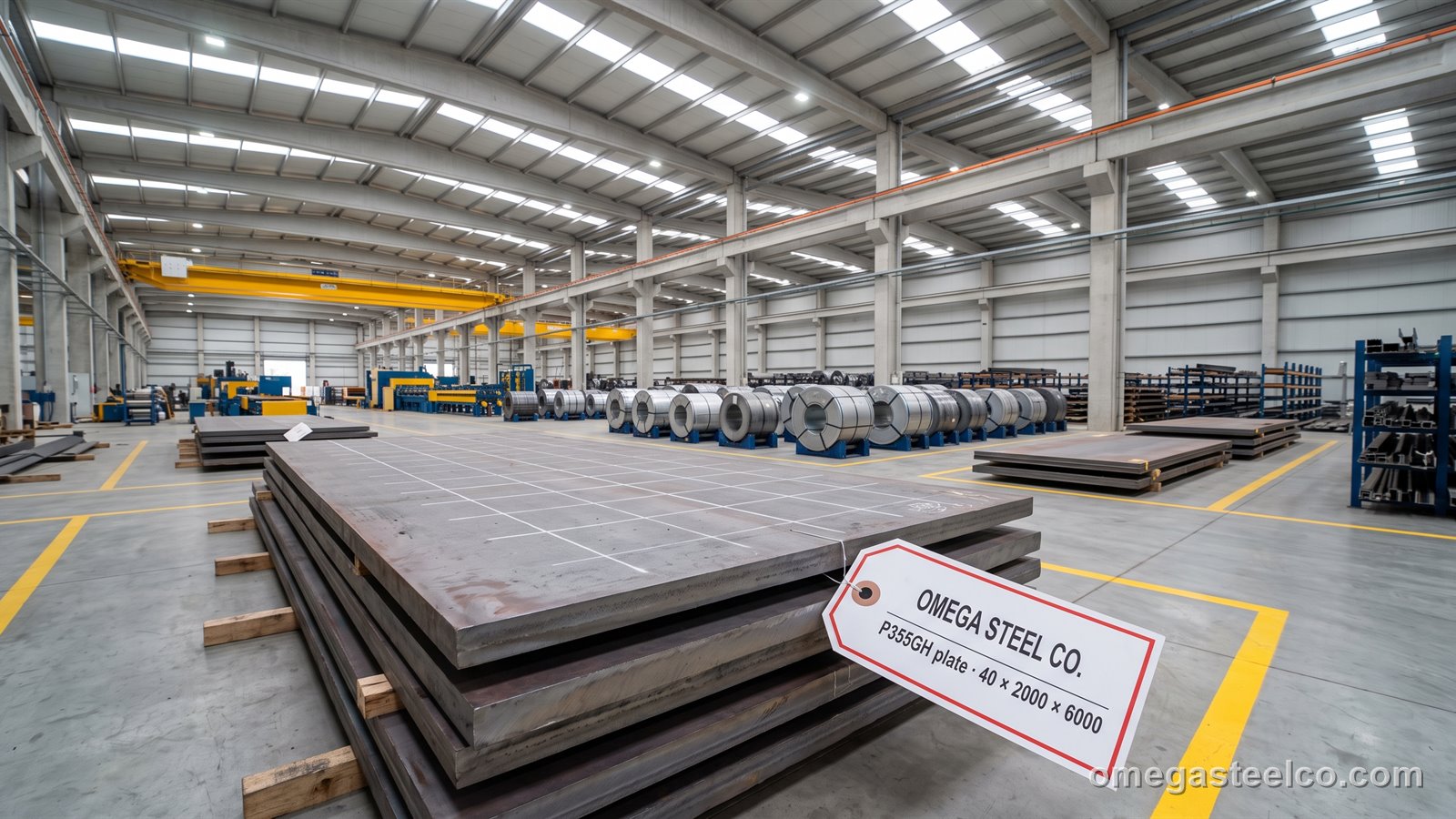
What is P355GH steel plate?
P355GH is a non-alloy (C 0.10–0.22 %, Mn 1.10–1.70 %) aluminium-killed pressure-vessel steel, normalised, with 355 MPa minimum yield and a certified elevated-temperature proof-strength curve: 300 MPa at 100 °C, 250 at 200 °C, 206 at 300 °C and 176 at 400 °C for plate up to 16 mm. It is the direct successor of DIN 17155 19Mn6 and the European mirror of ASTM A516 Grade 70 — the two most-used high-strength boiler plates in the world. The extra manganese and carbon push the carbon equivalent to 0.45–0.50, which is why the welding rules are strict (preheat from 20 mm, PWHT from 30 mm) and why the plate is normalised for a stable fine grain. Used where P265GH would be uneconomically thick: steam drums, high-pressure steam boilers, LPG and ammonia storage vessels (with −20 °C impact testing ordered as an option), large autoclaves and reactor shells.
Chemical composition
| Element | C | Si | Mn | P | S | Al | Cr | Cu | Mo | Ni | N |
|---|---|---|---|---|---|---|---|---|---|---|---|
| max. % (ladle) | 0.10–0.22 | ≤ 0.60 | 1.10–1.70 | ≤ 0.025 | ≤ 0.010 | ≥ 0.020 | ≤ 0.30 | ≤ 0.30 | ≤ 0.08 | ≤ 0.30 | ≤ 0.012 |
Nb ≤ 0.040, Ti ≤ 0.03, V ≤ 0.02; Cr + Cu + Mo + Ni ≤ 0.70. CEV 0.45–0.50.
Mechanical properties
| Thickness | Yield ReH min (MPa) | Tensile Rm (MPa) | Elongation A min | Impact KV |
|---|---|---|---|---|
| ≤ 16 mm | 355 | 510–650 | 20 % | 27 J at +20 °C (40 J long.) |
| > 16–40 mm | 345 | 510–650 | 20 % | 27 J at +20 °C |
| > 40–60 mm | 335 | 510–650 | 20 % | 27 J at +20 °C |
| > 60–100 mm | 315 | 490–630 | 19 % | 27 J at +20 °C |
| > 100–150 mm | 295 | 480–620 | 18 % | 27 J at +20 °C |
| Rp0.2 at 100 / 200 / 300 / 400 °C (≤ 16 mm) | 300 / 250 / 206 / 176 | — | — | — |
Equivalent grades
| System | Grade | Note |
|---|---|---|
| DIN 17155 | 19Mn6 | direct predecessor |
| ASTM | A516 Gr. 70 | 260 MPa yield, 485–620 tensile |
| JIS G3115 | SPV355 | |
| GB 713 | Q345R | |
| BS 1501 | 224-490B | historic |
| EN 10028-3 | P355NH | normalised fine-grain, −20 °C |
Thickness range and stock sizes
| Thickness | Widths × lengths | Availability |
|---|---|---|
| 6–12 mm | 2 000 × 6 000 | to order 2–4 weeks |
| 15–40 mm | 2 000 / 2 500 × 6 000–12 000 | to order 2–4 weeks |
| 50–100 mm | 2 000–2 500 × 6 000–8 000 | to order 4–6 weeks, UT |
| 120–150 mm | 2 000–2 500 × 4 000–6 000 | to order 6–8 weeks, UT |
Weight per m² and per plate
| Thickness | kg/m² | 1 500 × 6 000 (kg) | 2 000 × 6 000 (kg) | 2 500 × 12 000 (kg) |
|---|---|---|---|---|
| 6 mm | 47.1 | 424 | 565 | 1 413 |
| 8 mm | 62.8 | 565 | 754 | 1 884 |
| 10 mm | 78.5 | 707 | 942 | 2 355 |
| 12 mm | 94.2 | 848 | 1 130 | 2 826 |
| 15 mm | 117.8 | 1 060 | 1 413 | 3 533 |
| 20 mm | 157.0 | 1 413 | 1 884 | 4 710 |
| 25 mm | 196.3 | 1 766 | 2 355 | 5 888 |
| 30 mm | 235.5 | 2 120 | 2 826 | 7 065 |
| 40 mm | 314.0 | 2 826 | 3 768 | 9 420 |
| 50 mm | 392.5 | 3 533 | 4 710 | 11 775 |
| 60 mm | 471.0 | 4 239 | 5 652 | 14 130 |
| 80 mm | 628.0 | 5 652 | 7 536 | 18 840 |
| 100 mm | 785.0 | 7 065 | 9 420 | 23 550 |
| 120 mm | 942.0 | 8 478 | 11 304 | 28 260 |
| 150 mm | 1,177.5 | 10 598 | 14 130 | 35 325 |
Nominal weights — mill tolerance to EN 10029 class A adds up to +4 % on thin plate; invoiced on theoretical weight unless agreed otherwise.
Welding, cutting and forming
Strict pressure-equipment discipline: qualified procedures, basic low-hydrogen consumables (E50 basic, G4Si1 / G46), preheat 100 °C above 20 mm and 150 °C above 40 mm, interpass ≤ 250 °C, PWHT 560–600 °C above about 30 mm and for all tube-plate and nozzle weldments. Hydrogen-cracking risk is real at CEV ≈ 0.48 — dry consumables and slow cooling. Cold forming to 3 × t; hot forming 900–1 000 °C with normalising after; dished ends are hot-pressed and normalised. UT per EN 10160 above 40 mm standard.
Where it is used
- High-pressure steam boilers and steam drums
- LPG, propane and ammonia storage vessels
- Large autoclaves (AAC, composite curing)
- Reactors, columns and separators to 400 °C
- Heat-recovery steam generators
- Thick-walled heat-exchanger shells and tube plates
P355GH vs A516 Grade 70
The two are the standard "strong" boiler plates and are commonly cross-accepted: P355GH gives 355 MPa yield with a certified EN temperature table; A516 Gr. 70 gives 260 MPa yield, 485–620 MPa tensile and is qualified through ASME II. A516-70 is often less expensive per ton but its lower design yield may make the wall thicker under ASME rules. For PED/AD 2000 vessels order P355GH; for ASME U-stamp vessels order A516 Gr. 70. If −20 °C toughness is required, see P355NH.
Price
P355GH carries about 220 USD/t over the S235JR base. The band below is the indicative FOB Istanbul range for made-to-order plate; −20 °C impact testing, UT and 3.2 inspection are added per ton.
Bands from our weekly export list (September 2026), FOB Istanbul, full-container quantities, excluding freight and certificates. Firm price per project on RFQ within one working day.
Export and packing
We ship P355GH steel plate in strapped skid packs up to 5 t, each plate stencilled with its heat number so the certificate can be matched at the receiving end. One 40' HC carries 24–25 t of 6 m plate; short plate goes 20 t to a 20'. Plates longer than 6 m or heavier packs are booked on flat-racks or as breakbulk cargo out of Derince. Tariff heading 7208.51 / 7208.52.
| Term | Detail |
|---|---|
| MOQ | 10 t of one thickness |
| Incoterms | FOB Istanbul · CIF / CFR Gulf, Africa · DAP EU, Balkans, Iraq, Caucasus · DAP Aktau |
| Lead time | To order 2–4 weeks; > 60 mm 4–6 weeks |
| Packing | Skids up to 5 t, strapped; heavy plate loose on bearers, heat numbers stencilled |
| Container / truck | 40' HC ≈ 24–25 t of 6 m plate; longer / heavier flat-rack, breakbulk |
| Documents | Invoice, packing list, EN 10204 3.1 (3.2 on request), certificate of origin; SASO / SONCAP / PVoC on request |
| Payment | 30% advance, balance against B/L copy; L/C at sight for orders above 100 t |
Certificates and testing
P355GH steel plate ships with EN 10204 3.1 certificates cross-referenced to the stencilled heat numbers. Where the project requires it we arrange 3.2 certification with Lloyd's, BV, TÜV or SGS, ultrasonic examination to EN 10160 and Charpy testing at the temperature you specify.
How to order
Send thickness × width × length, tonnage, code, certificate level, UT class and any impact test at −20 °C (option for LPG vessels); dished-end blanks and tube plates are cut to drawing.
Standards
- EN 10028-2:2017 — P355GH, 1.0473
- DIN 17155 — 19Mn6 (withdrawn)
- PED 2014/68/EU; AD 2000 W1
- EN 10160 UT; EN 10164 Z on request
Grades
Grade data sheets (chemistry, mechanicals, equivalents) are on our reference site: P355GH · P295GH · P355NH
Frequently asked questions
What is P355GH?
The highest-strength non-alloy pressure-vessel steel of EN 10028-2 (1.0473, ex DIN 19Mn6): 355 MPa yield, 510–650 MPa tensile, certified yield strength to 400 °C, normalised.
What is the ASTM equivalent of P355GH?
ASTM A516 Grade 70 — the two are the standard high-strength boiler plates of the EN and ASME systems and are widely cross-accepted with designer approval.
What is the difference between P355GH and S355J2?
Same room-temperature yield, but P355GH is a normalised pressure-vessel steel with certified elevated-temperature properties and pressure-equipment documentation; S355J2 is a structural steel with no such guarantee and must not be used for pressure parts.
Does P355GH require preheat and PWHT?
Yes — preheat 100 °C above 20 mm (150 °C above 40 mm) and post-weld heat treatment above about 30 mm wall, because the carbon equivalent reaches 0.45–0.50.
Can P355GH be used for LPG tanks?
Yes, widely — ordered with the −20 °C impact-test option; where a lower design temperature or higher toughness is required, P355NH (EN 10028-3) is specified instead.