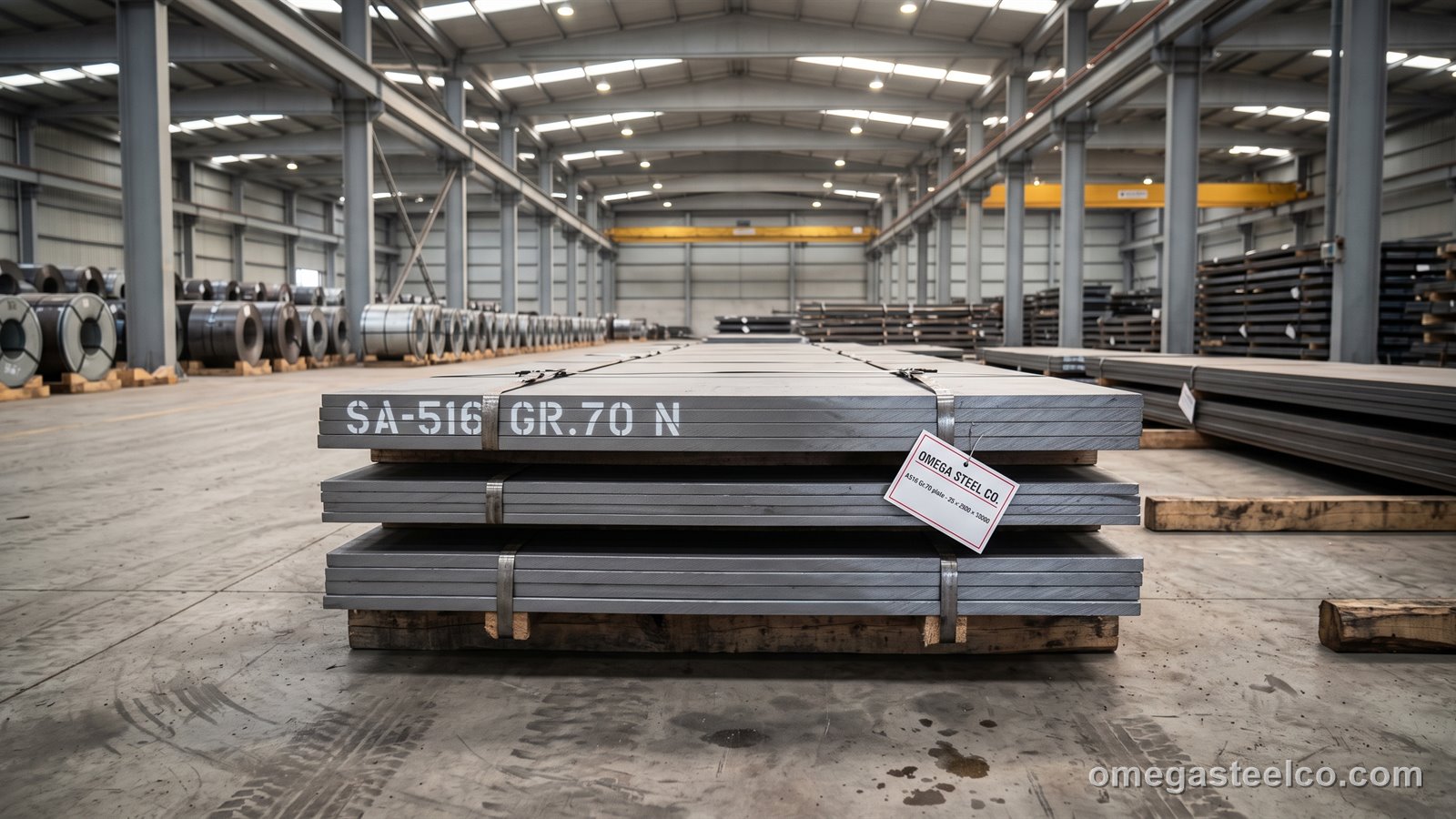
What is ASTM A516 Grade 70 plate?
ASTM A516 covers carbon-steel plates for moderate- and lower-temperature pressure vessels in four grades named after their minimum tensile strength in ksi — 55, 60, 65 and 70. Grade 70 (260 MPa yield, 485–620 MPa tensile) is by far the most used, followed by Grade 60 (220 MPa, 415–550 MPa). The steel is silicon-killed with a fine austenitic grain size, which is what gives it good notch toughness; the standard requires normalising above 40 mm (1.5 in) and allows it on order for any thickness — most buyers now order "Grade 70 N". Carbon rises with thickness (0.27–0.31 % max) and manganese 0.79–1.30 %, so the carbon equivalent is higher than P355GH's and preheat/PWHT rules are similar. Impact testing is not mandatory but is ordered for cold service: −20 °C (−4 °F) for general refinery work, −46 °C (−50 °F) for propane and LNG-adjacent vessels. As ASME SA-516 it is listed in Section II and is the default shell material for ASME VIII vessels; EN designers compare it with P355GH (Gr. 70) and P265GH (Gr. 60).
Chemical composition
| Element | C | Mn | P | S | Si |
|---|---|---|---|---|---|
| max. % (ladle) | ≤ 0.27 (≤ 12.5 mm) … ≤ 0.31 (> 100 mm) | 0.79–1.30 (> 12.5 mm) | ≤ 0.025 | ≤ 0.025 | 0.13–0.45 |
Mn 0.85–1.20 up to 12.5 mm. Grade 60: C ≤ 0.21–0.27, Mn 0.60–1.20 (0.85–1.20 > 12.5 mm). CEV Gr. 70 ≈ 0.43–0.48.
Mechanical properties
| Grade | Yield min (MPa / ksi) | Tensile (MPa / ksi) | Elongation min (200 mm / 50 mm) | Impact |
|---|---|---|---|---|
| Gr. 70 | 260 / 38 | 485–620 / 70–90 | 17 % / 21 % | CVN on order (S5): e.g. 27 J at −20 °C, 20 J at −46 °C |
| Gr. 65 | 240 / 35 | 450–585 / 65–85 | 19 % / 23 % | CVN on order |
| Gr. 60 | 220 / 32 | 415–550 / 60–80 | 21 % / 25 % | CVN on order |
| Gr. 55 | 205 / 30 | 380–515 / 55–75 | 23 % / 27 % | CVN on order |
Equivalent grades
| System | Grade | Note |
|---|---|---|
| EN 10028-2 | P355GH (Gr. 70) / P295GH (Gr. 65) / P265GH (Gr. 60) | usual substitutions, designer approval |
| EN 10028-3 | P355NH / P355NL1 (Gr. 70 N + CVN) | cold service |
| ASME | SA-516 Gr. 70 | identical, Section II listing |
| JIS G3115 | SPV355 (near) | |
| GB 713 | Q345R | |
| ASTM | A537 Cl. 1 | higher-strength alternative |
Thickness range and stock sizes
| Thickness | Widths × lengths | Availability |
|---|---|---|
| 6–12 mm | 2 000 / 2 500 × 6 000 | to order 2–4 weeks |
| 15–40 mm | 2 000 / 2 500 × 6 000–12 000 | to order 2–4 weeks; N on order |
| 50–100 mm | 2 000–2 500 × 6 000–8 000 | to order 4–6 weeks, N mandatory, UT A435/A578 |
Weight per m² and per plate
| Thickness | kg/m² | 1 500 × 6 000 (kg) | 2 000 × 6 000 (kg) | 2 500 × 12 000 (kg) |
|---|---|---|---|---|
| 6 mm | 47.1 | 424 | 565 | 1 413 |
| 8 mm | 62.8 | 565 | 754 | 1 884 |
| 10 mm | 78.5 | 707 | 942 | 2 355 |
| 12 mm | 94.2 | 848 | 1 130 | 2 826 |
| 15 mm | 117.8 | 1 060 | 1 413 | 3 533 |
| 20 mm | 157.0 | 1 413 | 1 884 | 4 710 |
| 25 mm | 196.3 | 1 766 | 2 355 | 5 888 |
| 30 mm | 235.5 | 2 120 | 2 826 | 7 065 |
| 40 mm | 314.0 | 2 826 | 3 768 | 9 420 |
| 50 mm | 392.5 | 3 533 | 4 710 | 11 775 |
| 60 mm | 471.0 | 4 239 | 5 652 | 14 130 |
| 80 mm | 628.0 | 5 652 | 7 536 | 18 840 |
| 100 mm | 785.0 | 7 065 | 9 420 | 23 550 |
Calculated at 7.85 kg/dm³ and nominal thickness. Plate is delivered to EN 10029 class A, so expect the heavier end on thin material; billing is on theoretical weight unless agreed otherwise.
Welding, cutting and forming
Weld to ASME IX qualified procedures with low-hydrogen consumables (E7018, ER70S-6); preheat 80–100 °C above 25 mm and 120–150 °C above 40 mm, interpass ≤ 250 °C; PWHT per ASME VIII UCS-56 — mandatory above 38 mm (1.5 in) for P-No. 1 material, at 595–650 °C. Cold forming to 3 × t; hot forming with re-normalising. Ultrasonic testing to SA-435 (straight beam) or SA-578 for critical service; HIC-resistant versions (NACE MR0175 / TM0284) are a separate order with restricted S and Ca treatment.
Where it is used
- ASME VIII pressure vessels, drums and separators (U-stamp)
- Refinery and gas-plant equipment in the Gulf, Iraq and Africa
- Propane / LPG bullets and spheres (Gr. 70 N, CVN −46 °C)
- Heat exchangers and air coolers to TEMA
- Storage tanks to API 650 where A516 is specified
- Boilers built to ASME I
A516 Grade 70 vs P355GH
Both are the "strong" carbon pressure plate of their code. A516-70 yields at 260 MPa but has a wide tensile band (485–620 MPa) and its design stresses come from ASME II-D; P355GH yields at 355 MPa with an EN elevated-temperature table. Under ASME rules the A516-70 wall is often slightly thicker; under PED the P355GH wall is thinner. Do not mix: an ASME U-stamp needs SA-516; a PED CE-marked vessel needs the EN grade (or a PMA). See P355GH and P265GH for the EN grades, P355NH for cold service.
Price
A516 Gr. 70 is priced about 260 USD/t over the S235JR base (Gr. 60 about 230 USD/t); normalising, Charpy testing, UT and 3.2 inspection are added per ton. The bands below are the month's indicative FOB Istanbul ranges.
Bands from our weekly export list (September 2026), FOB Istanbul, full-container quantities, excluding freight and certificates. Firm price per project on RFQ within one working day.
Export and packing
Packing for ASTM A516 Grade 70 plate: skids up to 5 t or loose on bearers, strapped, heat numbers stencilled. Loading: ≤ 6 m: 40' HC 24–25 t; longer flat-rack. The HS heading depends on the product: 7208 / 7209 / 7210 for carbon strip, 7225 / 7226 where alloyed.
| Term | Detail |
|---|---|
| MOQ | 10 t of one thickness |
| Incoterms | FOB Istanbul · CIF / CFR Gulf, Africa · DAP EU, Balkans, Iraq, Caucasus · DAP Aktau |
| Lead time | To order 2–4 weeks (Turkish mill) / 4–6 weeks (EU) |
| Packing | Skids up to 5 t or loose on bearers, strapped, heat numbers stencilled |
| Container / truck | ≤ 6 m: 40' HC 24–25 t; longer flat-rack |
| Documents | Invoice, packing list, EN 10204 3.1 (3.2 on request), certificate of origin; SASO / SONCAP / PVoC on request |
| Payment | 30% advance, balance against B/L copy; L/C at sight for orders above 100 t |
Certificates and testing
ASTM A516 Grade 70 plate ships with EN 10204 3.1 certificates cross-referenced to the heat numbers stencilled on each plate. Third-party 3.2 certification by Lloyd's, BV, TÜV or SGS is ordered per lot. We can add EN 10160 ultrasonic examination and Charpy sets at the temperature you nominate.
How to order
Specify grade (55/60/65/70), delivery condition (as-rolled or N), Charpy temperature and energy, UT standard, supplementary requirements (S1–S17) and certificate (EN 10204 3.1 / 3.2 or MTR per ASME); we quote with the mill's ASME SA-516 dual certification.
Standards
- ASTM A516/A516M — Grades 55, 60, 65, 70
- ASME SA-516/SA-516M (Section II Part A)
- ASTM A20 general requirements; A435 / A578 UT
- ASME VIII Div. 1 / Div. 2 material
Grades
Grade data sheets (chemistry, mechanicals, equivalents) are on our reference site: A516 Gr 70 · P355GH · P265GH
Frequently asked questions
What is A516 Grade 70 steel?
A carbon, silicon-killed, fine-grain pressure-vessel plate to ASTM A516 / ASME SA-516 with 260 MPa (38 ksi) minimum yield and 485–620 MPa (70–90 ksi) tensile, used for ASME VIII vessels at moderate and lower temperatures.
What is the difference between A516 Grade 60 and Grade 70?
Tensile strength: 415–550 MPa (60 ksi) vs 485–620 MPa (70 ksi), yield 220 vs 260 MPa, with slightly higher carbon and manganese in Grade 70; Grade 70 allows a thinner wall and is the more common grade.
What is the EN equivalent of A516 Gr. 70?
P355GH (EN 10028-2) is the usual comparison; for cold service P355NH / P355NL1. Substitution needs designer approval because the codes certify different properties.
Is A516 Grade 70 normalised?
Required above 40 mm (1.5 in) by the standard; below that on order — most vessel specifications now require "Grade 70 N" at all thicknesses, especially with impact testing.
What impact test temperature is used for A516 Gr. 70?
Commonly −20 °C (−4 °F) for general refinery service and −46 °C (−50 °F) for propane / LPG vessels, ordered under supplementary requirement S5.
Does A516 Gr. 70 need PWHT?
Under ASME VIII (UCS-56) post-weld heat treatment is mandatory above 38 mm wall for P-No. 1 materials; thinner shells may be exempt unless service (H2S, lethal) requires it.