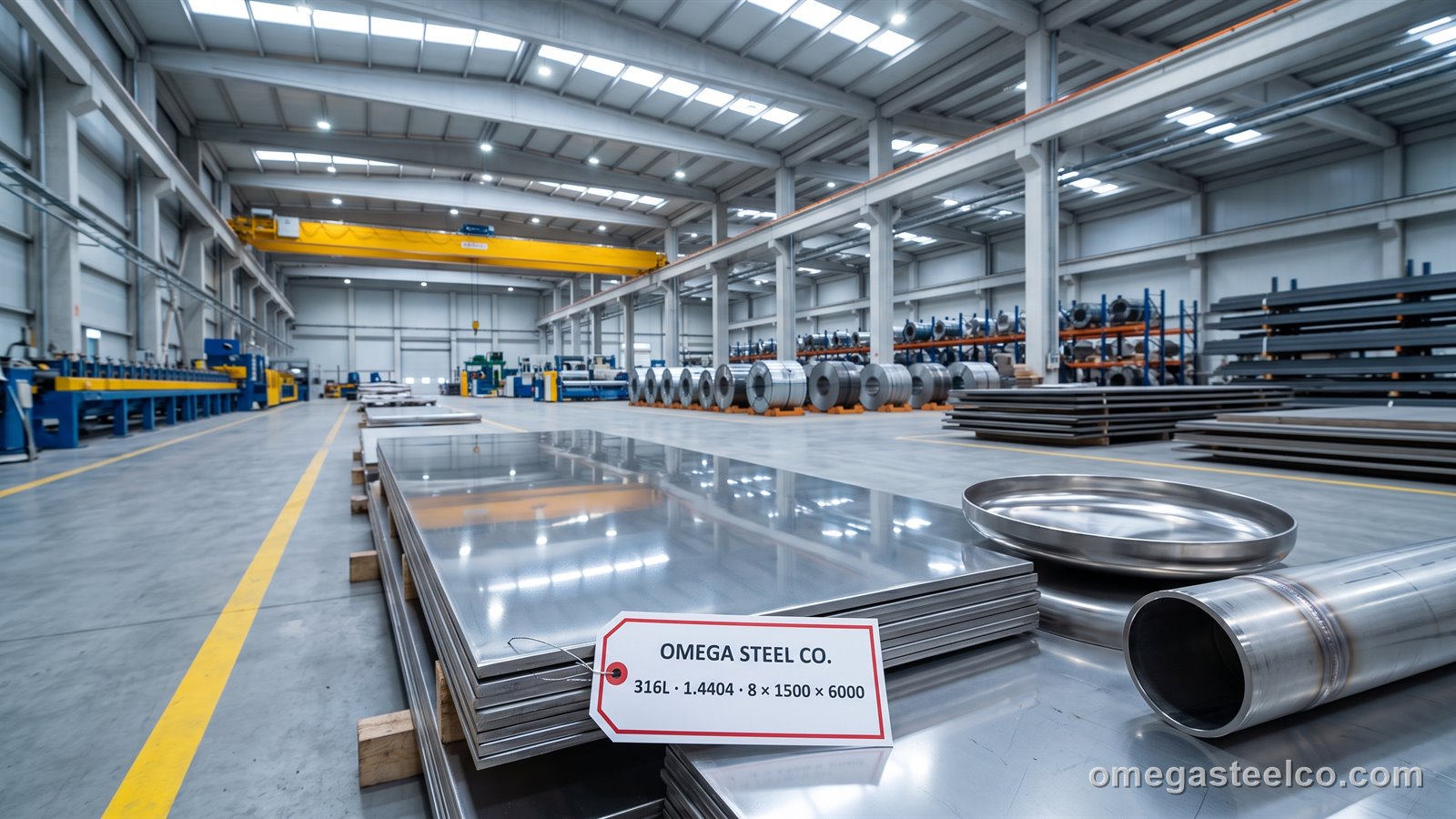
What is 316L stainless steel sheet?
316L combines the two things process engineers ask of a stainless steel: chloride resistance from 2–2.5 % molybdenum, and immunity to weld sensitisation from a carbon content held at or below 0.03 %. The result — EN 1.4404, X2CrNiMo17-12-2 — is the default material of welded process equipment: reactor and storage tanks, heat-exchanger shells, pipework and manifolds, pharmaceutical and biotech vessels (with electropolished 2B or BA surfaces), desalination pre-treatment, marine tanks and deck equipment. Yield is a little lower than 316 (220 vs 240 MPa) and nitrogen is often added to recover it; 1.4432 is the same steel with 2.5–3.0 % Mo for harder chloride duty, and 1.4435 the higher-nickel pharma variant. Practically all 316 coil rolled today meets 316L carbon limits and is dual-certified 1.4401/1.4404, which is what we stock; the difference appears when a specification demands single-certified 316L plate for a pressure vessel, or 3.2 inspection — then we order from the mill. It is not the answer to hot concentrated chlorides or hydrochloric acid, where duplex and higher alloys take over.
Chemical composition
| Element | C | Si | Mn | P | S | Cr | Ni | Mo | N |
|---|---|---|---|---|---|---|---|---|---|
| max. % (ladle) | ≤ 0.030 | ≤ 1.00 | ≤ 2.00 | ≤ 0.045 | ≤ 0.015 | 16.5–18.5 | 10.0–13.0 | 2.00–2.50 | ≤ 0.10 |
1.4432: Mo 2.5–3.0; 1.4435: Ni 12.5–15.0, Mo 2.5–3.0 (pharma). ASTM 316L: Cr 16–18, Ni 10–14, Mo 2–3.
Mechanical properties
| Property | Requirement (EN 10088-2, cold-rolled) | Typical value | Note |
|---|---|---|---|
| Yield strength Rp0.2 | ≥ 220 MPa | 250–310 MPa | |
| Tensile strength Rm | 520–670 MPa | 560–630 MPa | |
| Elongation A | ≥ 40 % | 45–55 % | |
| Hardness | — | ≤ 215 HB | |
| Impact at −196 °C | ≥ 60 J | > 100 J | cryogenic OK |
Equivalent grades
| System | Grade | Note |
|---|---|---|
| EN 10088 | 1.4404 / 1.4432 | material number |
| DIN | X2CrNiMo17-12-2 / X2CrNiMo17-12-3 | historic |
| AISI / ASTM A240 | 316L | US designation |
| JIS G4304/4305 | SUS 316L | |
| GB/T 3280 | 022Cr17Ni12Mo2 | |
| UNS | S31603 |
Surface condition for process equipment
| Specification | Finish | Ra (µm) | Where required |
|---|---|---|---|
| Mill 2B | cold-rolled, annealed, pickled | ≤ 0.5 | general tanks, pipework |
| Mill 1D | hot-rolled, annealed, pickled | 2–6 | plate shells, heavy vessels |
| EHEDG / 3-A hygienic | 2B or ground | ≤ 0.8 | food and dairy contact |
| ASME BPE SF1–SF3 | mechanically polished | 0.5–0.76 | biotech, pharma product contact |
| ASME BPE SF4–SF6 | electropolished | 0.38–0.51 | WFI, high-purity pharma |
| Pickled + passivated | any, after fabrication | — | all chloride service |
We supply mill 2B / 1D; hygienic polishing and electropolishing are done by the fabricator or on request through our partners.
Thickness range and stock sizes
| Thickness | Widths × lengths | Availability |
|---|---|---|
| 1.0–3.0 mm | 1 000 / 1 250 / 1 500 × 2 500 / 3 000, 2B | stock (dual 316/316L) |
| 4–6 mm | 1 500 × 3 000 / 6 000, 2B / 1D | stock, limited |
| 8–30 mm plate | 1 500 / 2 000 × 6 000, 1D | to order 2–3 weeks |
| 1.4432 / 1.4435 | sheet and plate | to order 3–4 weeks |
Weight per m² and per sheet
| Thickness | kg/m² | 1 000 × 2 000 (kg) | 1 250 × 2 500 (kg) | 1 500 × 3 000 (kg) |
|---|---|---|---|---|
| 1 mm | 8.00 | 16.0 | 25.0 | 36.0 |
| 1.2 mm | 9.60 | 19.2 | 30.0 | 43.2 |
| 1.5 mm | 12.00 | 24.0 | 37.5 | 54.0 |
| 2 mm | 16.00 | 32.0 | 50.0 | 72.0 |
| 2.5 mm | 20.00 | 40.0 | 62.5 | 90.0 |
| 3 mm | 24.00 | 48.0 | 75.0 | 108.0 |
| 4 mm | 32.00 | 64.0 | 100.0 | 144.0 |
| 5 mm | 40.00 | 80.0 | 125.0 | 180.0 |
| 6 mm | 48.00 | 96.0 | 150.0 | 216.0 |
| 8 mm | 64.00 | 128.0 | 200.0 | 288.0 |
| 10 mm | 80.00 | 160.0 | 250.0 | 360.0 |
| 12 mm | 96.00 | 192.0 | 300.0 | 432.0 |
Density 8.0 kg/dm³; tolerances EN ISO 9445 / EN 10029.
Welding, forming and passivation
Weld with 316L filler (ER316L / E316L) by TIG, MIG, plasma or SAW; no preheat, interpass ≤ 150 °C, no PWHT for corrosion; pickle (HNO₃/HF paste) or electropolish all heat tint and passivate for chloride and pharma service. Orbital TIG for hygienic pipework. Forms like 316; bends at 1 × t; laser and waterjet cutting clean. Dedicated stainless tools, no carbon-steel contact, and no chloride-bearing cleaners on the fabricated surface.
Where it is used
- Pharmaceutical, biotech and food process vessels and skids
- Chemical storage and reactor tanks
- Desalination and water-treatment equipment
- Marine and offshore tanks, piping and fittings
- Heat-exchanger shells and tube plates
- Hygienic pipework, manifolds and CIP systems
316L vs 316 vs 304L
316 and 316L differ only in carbon — choose L for welded equipment, and note that stock coil is usually dual-certified. 304L is the same idea without molybdenum for fresh-water and food tanks at 60–70 % of the price. For chlorides above about 500 ppm or temperatures above 60 °C, step up to duplex 1.4462 (to order).
Price
Two bands apply to 316L: cold-rolled 2B sheet from stock and hot-rolled 1D plate to order, both quoted per metric ton FOB Istanbul on the stainless list and repriced monthly against the LME nickel and molybdenum quotations. Single-certified plate for pressure vessels and 3.2 inspection are quoted per job.
Bands from our weekly export list (September 2026), FOB Istanbul, full-container quantities, excluding freight and certificates. Firm price per project on RFQ within one working day.
Export and packing
316L stainless steel sheet ships as coil — eye-to-sky on a wooden cradle, 5–25 t per coil, VCI paper and steel strapping — or as cut sheet on skids of 2–3 t with paper interleaving and edge protectors. A 20' takes one coil up to 20 t; a 40' HC two coils or 24 t of sheet. HS 7210 / 7209 / 7208 by product.
| Term | Detail |
|---|---|
| MOQ | 1 t |
| Incoterms | FOB Istanbul · CIF / CFR Gulf, Africa · DAP EU, Balkans, Iraq, Caucasus · DAP Aktau |
| Lead time | Stock 1–6 mm: 3–5 working days; plate 2–3 weeks |
| Packing | Sheets on skids ≤ 2 t, film, interleaving; plate on bearers |
| Container / truck | 20' ≈ 18–20 t; 40' HC ≈ 24 t |
| Documents | Invoice, packing list, EN 10204 3.1 (3.2 on request), certificate of origin; SASO / SONCAP / PVoC on request |
| Payment | 30% advance, balance against B/L copy; L/C at sight for orders above 100 t |
Certificates and testing
316L stainless steel sheet is delivered with the mill certificate EN 10204 3.1 — heat number, ladle analysis, tensile and impact results and the delivery condition. Third-party 3.2 certification (Lloyd's, BV, TÜV, SGS), ultrasonic testing to EN 10160 and extra Charpy tests at a lower temperature are ordered per lot.
How to order
An enquiry for 316L needs the material number (1.4404, or 1.4432 / 1.4435 where the spec demands more Mo or Ni), the size list with thickness × width × length or coil, the surface (2B, 1D, BA, electropolish), tonnage, and the certificate wording — dual 304/316L 3.1 from stock, single-certified 316L or 3.2 from the mill — plus the design code (EN 13445, ASME VIII, PED) when the material goes into a vessel.
Standards
- EN 10088-2 — 1.4404 (X2CrNiMo17-12-2) / 1.4432 (Mo 2.5–3.0)
- ASTM A240 — Type 316L
- EN 10028-7 — pressure use
- EN 10204 3.1 / 3.2
Grades
Grade data sheets (chemistry, mechanicals, equivalents) are on our reference site: 1.4404 · 1.4401 · 1.4307
Frequently asked questions
What is 316L stainless steel?
The low-carbon (≤ 0.03 %) version of 316 — 17 % Cr, 11 % Ni, 2–2.5 % Mo (EN 1.4404, AISI 316L) — for welded equipment in chloride, chemical, marine and pharmaceutical service.
What is the difference between 316 and 316L?
Carbon: 316L ≤ 0.03 % avoids weld sensitisation; 316 ≤ 0.07 % is marginally stronger. Corrosion resistance is the same; most coil is dual-certified.
What is 1.4432?
316L with 2.5–3.0 % molybdenum — higher chloride resistance for harder marine and chemical duty; 1.4435 adds nickel for pharmaceutical use.
Is 316L suitable for seawater?
For splash and spray yes; for continuous immersion in stagnant or warm seawater it can pit — duplex 1.4462 or super-austenitic 1.4529 is safer.
Do you stock 316L plate?
Sheet 1–6 mm is in stock (dual 316/316L); 1D plate 8–30 mm is supplied to order in 2–3 weeks with 3.1 or 3.2 certificates.