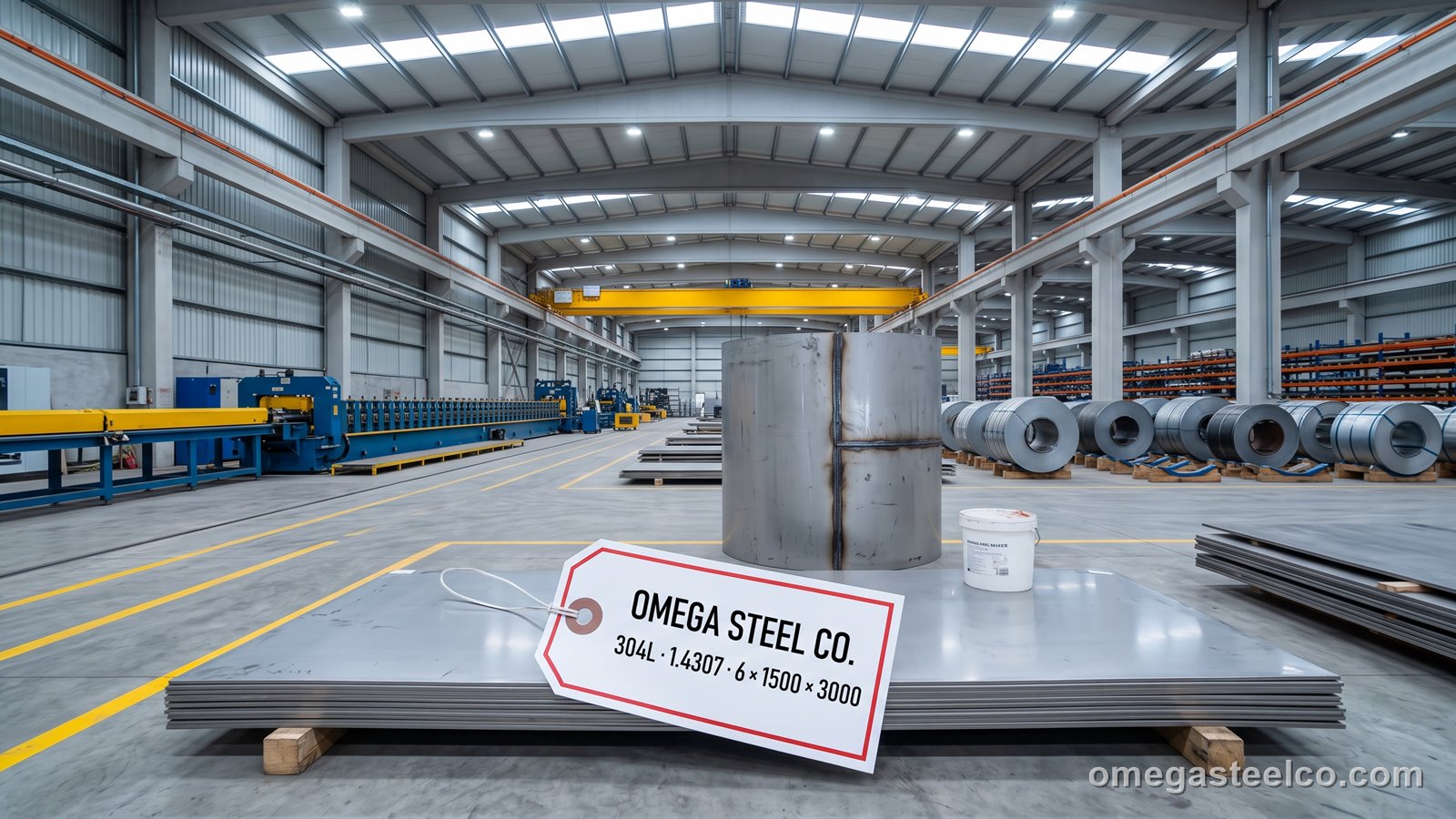
What is 304L stainless steel sheet?
When austenitic stainless steel is held between about 450 and 850 °C — the temperature a weld's heat-affected zone passes through — carbon combines with chromium to form Cr₂₃C₆ carbides at the grain boundaries, stripping chromium from the metal beside them. The depleted zone corrodes preferentially: weld decay, or sensitisation. The cure is to have too little carbon to matter, and 304L (Low carbon, ≤ 0.03 %) is exactly that: the chemistry of 304 with the carbon halved, at the cost of about 20 MPa of yield strength. Nitrogen is often added (1.4307 allows ≤ 0.10 %) to claw some of that back. For sheet under about 3 mm the difference rarely matters — the weld cools too fast to sensitise — but for tanks, vessels, pipework and anything with multi-pass welds, 304L is the specified grade, and pressure-vessel codes (EN 13445, ASME VIII) list it by name. 1.4307 (18/9) is the European stock version; 1.4306 (19/11) is the higher-nickel, more corrosion-resistant variant used for cryogenic and chemical work. Most current 304 coil is melted to L-limits and dual-certified 1.4301/1.4307 — ask for the dual certificate if either may be needed.
Chemical composition
| Element | C | Si | Mn | P | S | Cr | Ni | N |
|---|---|---|---|---|---|---|---|---|
| max. % (ladle) | ≤ 0.030 | ≤ 1.00 | ≤ 2.00 | ≤ 0.045 | ≤ 0.015 | 17.5–19.5 | 8.0–10.5 | ≤ 0.10 |
1.4306: Cr 18.0–20.0, Ni 10.0–12.0. ASTM 304L: Cr 18.0–20.0, Ni 8.0–12.0.
Mechanical properties
| Property | Requirement (EN 10088-2, cold-rolled) | Typical value | Note |
|---|---|---|---|
| Yield strength Rp0.2 | ≥ 220 MPa | 240–290 MPa | |
| Tensile strength Rm | 520–700 MPa | 560–640 MPa | |
| Elongation A | ≥ 45 % | 50–60 % | |
| Hardness | — | ≤ 200 HB | |
| Impact at −196 °C | ≥ 60 J (1.4306) | > 100 J | cryogenic grade |
Equivalent grades
| System | Grade | Note |
|---|---|---|
| EN 10088 | 1.4307 / 1.4306 | material number |
| DIN | X2CrNi18-9 / X2CrNi19-11 | historic |
| AISI / ASTM A240 | 304L | US designation |
| JIS G4304/4305 | SUS 304L | |
| GB/T 3280 | 022Cr19Ni10 | |
| UNS | S30403 |
Finishes for welded work
| Finish | As delivered | After welding |
|---|---|---|
| 2B | skin-passed matt silver, filmed | brush or pickle the seam; blends well |
| 1D (hot-rolled plate) | rough pickled surface, unfilmed | no cosmetic work needed; pickle heat tint |
| BA | bright reflective | seam always visible — use only where welds are hidden |
| No.4 satin | brushed 180 grit, filmed | re-brush seam lengthwise after grinding |
| Electropolished | smooth, passive, Ra ≤ 0.4 | for pharma / hygienic tanks after fabrication |
For tank shells order 2B or 1D; decorative finishes on welded parts double the finishing labour.
Thickness range and stock sizes
| Thickness | Widths × lengths | Availability |
|---|---|---|
| 1.0–3.0 mm | 1 000 / 1 250 / 1 500 × 2 500 / 3 000, 2B | stock (dual 304/304L) |
| 4–6 mm | 1 500 × 3 000 / 6 000, 2B or 1D | stock |
| 8–30 mm plate | 1 500 / 2 000 × 6 000, 1D | to order 1–3 weeks |
Weight per m² and per sheet
| Thickness | kg/m² | 1 000 × 2 000 (kg) | 1 250 × 2 500 (kg) | 1 500 × 3 000 (kg) |
|---|---|---|---|---|
| 1 mm | 7.90 | 15.8 | 24.7 | 35.6 |
| 1.2 mm | 9.48 | 19.0 | 29.6 | 42.7 |
| 1.5 mm | 11.85 | 23.7 | 37.0 | 53.3 |
| 2 mm | 15.80 | 31.6 | 49.4 | 71.1 |
| 2.5 mm | 19.75 | 39.5 | 61.7 | 88.9 |
| 3 mm | 23.70 | 47.4 | 74.1 | 106.7 |
| 4 mm | 31.60 | 63.2 | 98.8 | 142.2 |
| 5 mm | 39.50 | 79.0 | 123.4 | 177.8 |
| 6 mm | 47.40 | 94.8 | 148.1 | 213.3 |
| 8 mm | 63.20 | 126.4 | 197.5 | 284.4 |
| 10 mm | 79.00 | 158.0 | 246.9 | 355.5 |
| 12 mm | 94.80 | 189.6 | 296.3 | 426.6 |
Density 7.9 kg/dm³; tolerances EN ISO 9445 (cold-rolled) / EN 10029 (plate).
Welding, forming and pickling
Weld with 308L (or 316L) filler by TIG, MIG, plasma or SAW; no preheat, interpass ≤ 150 °C, no post-weld heat treatment needed for corrosion resistance. Pickle or brush the heat tint (Cr-depleted oxide) to restore the passive film — a pickling paste or electropolishing on food and pharma work. Forms like 304; slightly softer. Keep carbon-steel contamination away: dedicated stainless tools and racks.
Where it is used
- Welded tanks, silos and vessels for food, water and chemicals
- Process pipework, headers and manifolds
- Pressure vessels to EN 13445 / ASME VIII
- Cryogenic equipment (1.4306)
- Heavy welded fabrications and skids
- Boat and truck tanks
304L vs 304 — when the L matters
Under 3 mm and for single-pass welds, 304 is fine and slightly stronger; for multi-pass welds, thick plate, pressure vessels and anything that will see 450–850 °C in service, specify 304L. Price difference about 50 USD/t. For chloride environments the same logic applies to 316 and 316L.
Price
304L carries a small premium over 304 (about 50 USD/t) and plate a further premium; the bands below are indicative FOB Istanbul and follow the nickel price.
Bands from our weekly export list (September 2026), FOB Istanbul, full-container quantities, excluding freight and certificates. Firm price per project on RFQ within one working day.
Export and packing
We load 304L stainless steel sheet as slit or master coils on cradles (VCI paper, strapped, 5–25 t) or as cut-to-length sheet on skids (≤ 3 t, interleaved, edge boards); a 20' container carries one coil to 20 t, a 40' HC two coils or 24 t of sheet. HS 7210 / 7209 / 7208.
| Term | Detail |
|---|---|
| MOQ | 1 t |
| Incoterms | FOB Istanbul · CIF / CFR Gulf, Africa · DAP EU, Balkans, Iraq, Caucasus · DAP Aktau |
| Lead time | Stock 1–6 mm: 3–5 working days; plate 1–3 weeks |
| Packing | Sheets on skids ≤ 2 t, film, interleaving; plate loose on bearers |
| Container / truck | 20' ≈ 18–20 t; 40' HC ≈ 24 t |
| Documents | Invoice, packing list, EN 10204 3.1 (3.2 on request), certificate of origin; SASO / SONCAP / PVoC on request |
| Payment | 30% advance, balance against B/L copy; L/C at sight for orders above 100 t |
Certificates and testing
304L stainless steel sheet ships with EN 10204 3.1 certificates cross-referenced to the stencilled heat numbers. Where the project requires it we arrange 3.2 certification with Lloyd's, BV, TÜV or SGS, ultrasonic examination to EN 10160 and Charpy testing at the temperature you specify.
How to order
Specify 1.4307 (or 1.4306 for cryogenic), thickness × width × length, finish, film, quantity, certificate (3.1 dual, 3.2) and the code if pressure-related.
Standards
- EN 10088-2 — 1.4307 (X2CrNi18-9) / 1.4306 (X2CrNi19-11)
- ASTM A240 — Type 304L
- EN 10028-7 — pressure-vessel use
- EN 10204 3.1 / 3.2
Grades
Grade data sheets (chemistry, mechanicals, equivalents) are on our reference site: 1.4307 · 1.4301 · 1.4404
Frequently asked questions
What is the difference between 304 and 304L?
304L has carbon limited to 0.03 % (304: 0.07 %) so welded joints do not sensitise and corrode along the heat-affected zone; it is about 20 MPa lower in yield. Most 304 coil today is dual-certified 304/304L.
When should I use 304L instead of 304?
For multi-pass or heavy welding, plate over 3 mm, pressure vessels and tanks, and any service between 450 and 850 °C.
What is 1.4307 vs 1.4306?
Both are 304L: 1.4307 is the 18 % Cr / 9 % Ni stock version, 1.4306 the 19 % Cr / 11 % Ni variant with better corrosion resistance and cryogenic toughness.
Does 304L need post-weld heat treatment?
No — that is its purpose. Only pickling or brushing of the heat tint is required to restore the passive surface.