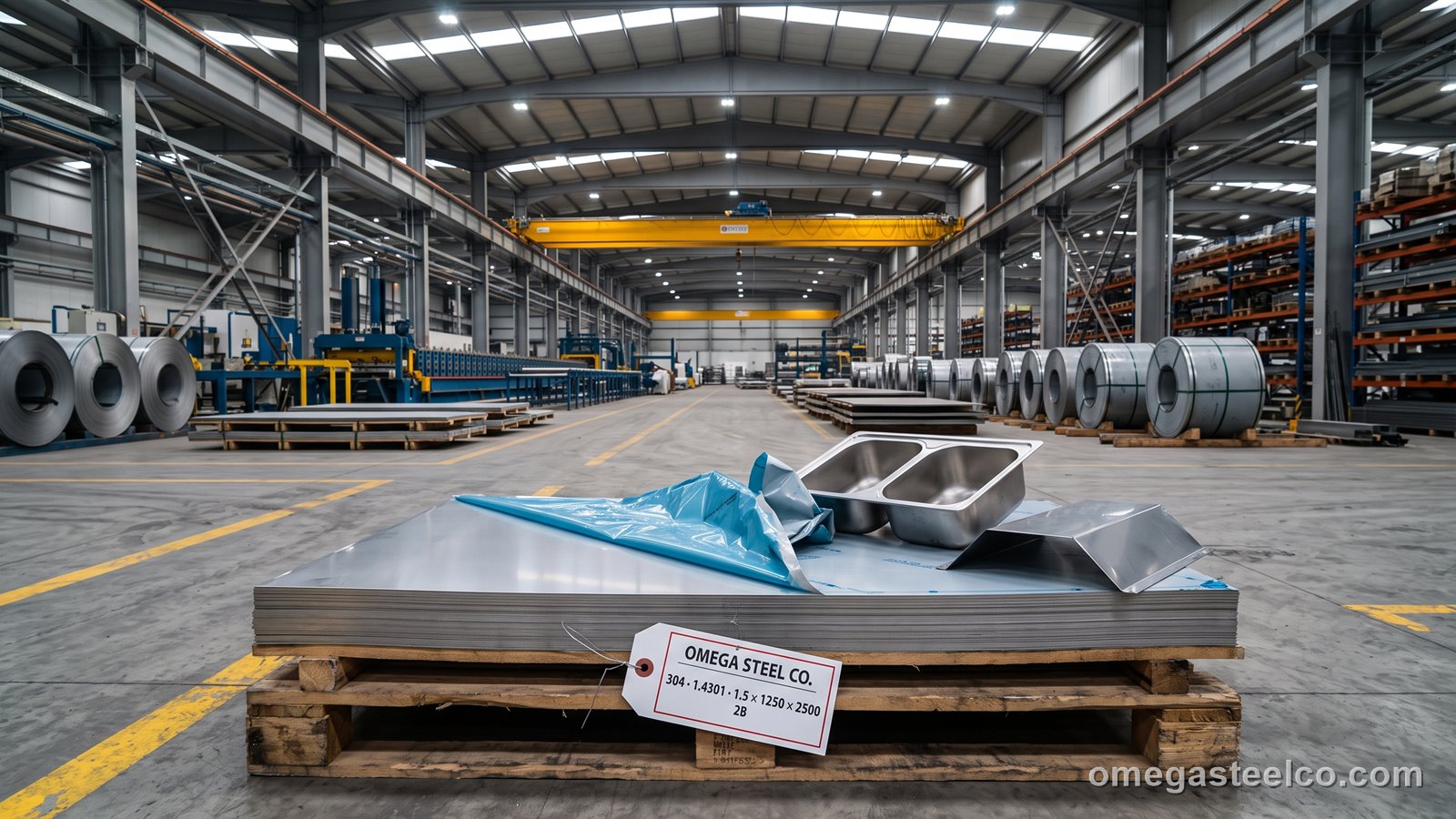
What is 304 stainless steel sheet?
304 (EN 1.4301, X5CrNi18-10) is the reference austenitic stainless steel: about 18 % chromium forms the self-healing chromium-oxide film that makes it stainless, 8 % nickel stabilises the austenitic (face-centred cubic) structure that makes it non-magnetic, tough at any temperature and extremely formable. Carbon is limited to 0.07 %, which keeps it weldable in thin sheet; for heavy welded sections the low-carbon 304L (1.4307) avoids sensitisation. It resists the atmosphere, fresh water, food acids, detergents and most organic chemicals, but not chlorides — sea air, brine, pool water and bleach pit it, and that is where 316 takes over. Mechanically it yields at 190–230 MPa and stretches 45 % or more before breaking, work-hardening strongly (which is why it draws so well and why punching needs sharp tools). Turkish stock is mostly Posco, Outokumpu, Acerinox and Yieh cold-rolled 2B coil cut to sheet; we hold 0.5–6 mm and three finishes and cut to size on our own lines.
Chemical composition
| Element | C | Si | Mn | P | S | Cr | Ni | N |
|---|---|---|---|---|---|---|---|---|
| max. % (ladle) | ≤ 0.07 | ≤ 1.00 | ≤ 2.00 | ≤ 0.045 | ≤ 0.015 | 17.5–19.5 | 8.0–10.5 | ≤ 0.10 |
ASTM A240 Type 304 allows C ≤ 0.08 and Cr 18.0–20.0; both are supplied dual-certified.
Mechanical properties
| Property | Requirement (EN 10088-2, cold-rolled) | Typical value | Note |
|---|---|---|---|
| Yield strength Rp0.2 | ≥ 230 MPa | 250–310 MPa | Rp1.0 ≥ 260 |
| Tensile strength Rm | 540–750 MPa | 600–680 MPa | |
| Elongation A | ≥ 45 % | 50–58 % | |
| Hardness | — | ≤ 215 HB / 90 HRB | |
| Impact | not required | > 100 J at −196 °C | cryogenic OK |
| Magnetic | no (annealed) | slightly after cold work |
Equivalent grades
| System | Grade | Note |
|---|---|---|
| EN 10088 | 1.4301 | material number |
| DIN | X5CrNi18-10 | historic |
| AISI / ASTM A240 | 304 | US designation |
| JIS G4304/4305 | SUS 304 | |
| GB/T 3280 | 06Cr19Ni10 | |
| UNS | S30400 |
Surface finishes
| Finish | Description | Ra (µm) | Typical use |
|---|---|---|---|
| 2B | cold-rolled, annealed, pickled, skin-passed — smooth matt-silver | 0.1–0.5 | the stock finish: tanks, ducts, hidden and industrial parts |
| 2D | cold-rolled, annealed, pickled — dull | 0.4–1.0 | deep drawing, parts to be polished |
| BA (2R) | bright annealed — mirror-like, reflective | ≤ 0.1 | appliances, cladding, decorative |
| No. 4 / 2J (satin) | brushed with 150–240 grit | 0.3–0.6 | kitchens, lifts, handrails, façades |
| HL (hairline) | long continuous brush lines | 0.3–0.5 | architecture, doors, panels |
| No. 8 / 2P (mirror) | polished to mirror | ≤ 0.05 | decorative, signage |
| 1D | hot-rolled, annealed, pickled — rough | 2–6 | plate ≥ 3 mm, structural, tanks |
| Embossed / patterned | rolled pattern (linen, leather, checker) | — | anti-slip, decorative, lifts |
All cold-rolled finishes are delivered with a PE / PVC protective film on the good side; 1D plate is unfilmed. Order the finish with the grade, e.g. "1.4301 2B 1.5 mm".
Corrosion resistance — where 304 is enough
| Environment | 304 | Note |
|---|---|---|
| Indoor, kitchens, food processing | excellent | the standard food-contact grade |
| Urban / rural atmosphere | good | tea-staining possible near the coast |
| Fresh water, dairy, wine, beer | good | CIP cleaning with chlorides limited |
| Marine / coastal within 5 km | poor | pitting — use 316 |
| Swimming pools, bleach, brine | poor | use 316 / duplex |
| Dilute organic acids | good | |
| Hydrochloric acid, chlorides | not suitable | |
| Heat, continuous | to 850 °C | scaling above; 310 for higher |
Thickness range and stock sizes
| Thickness | Widths × lengths | Availability |
|---|---|---|
| 0.5–1.0 mm | 1 000 / 1 250 × 2 000 / 2 500; coil 1 000 / 1 250 | stock 2B, BA, No.4 |
| 1.2–3.0 mm | 1 000 / 1 250 / 1 500 × 2 500 / 3 000 | stock 2B, No.4 |
| 4–6 mm | 1 250 / 1 500 × 3 000 / 6 000 | stock 2B / 1D |
| 8–30 mm plate | 1 500 / 2 000 × 6 000, 1D | to order 1–3 weeks |
Weight per m² and per sheet
| Thickness | kg/m² | 1 000 × 2 000 (kg) | 1 250 × 2 500 (kg) | 1 500 × 3 000 (kg) |
|---|---|---|---|---|
| 0.5 mm | 3.95 | 7.9 | 12.3 | 17.8 |
| 0.6 mm | 4.74 | 9.5 | 14.8 | 21.3 |
| 0.8 mm | 6.32 | 12.6 | 19.8 | 28.4 |
| 1 mm | 7.90 | 15.8 | 24.7 | 35.6 |
| 1.2 mm | 9.48 | 19.0 | 29.6 | 42.7 |
| 1.5 mm | 11.85 | 23.7 | 37.0 | 53.3 |
| 2 mm | 15.80 | 31.6 | 49.4 | 71.1 |
| 2.5 mm | 19.75 | 39.5 | 61.7 | 88.9 |
| 3 mm | 23.70 | 47.4 | 74.1 | 106.7 |
| 4 mm | 31.60 | 63.2 | 98.8 | 142.2 |
| 5 mm | 39.50 | 79.0 | 123.4 | 177.8 |
| 6 mm | 47.40 | 94.8 | 148.1 | 213.3 |
Density 7.9 kg/dm³; thickness tolerances to EN ISO 9445; invoiced on theoretical weight.
Forming, welding and finishing
Deep-draws and spins beautifully (r ≈ 1.0, n ≈ 0.45 — it work-hardens hard, so anneal between deep stages); bends at 0.5–1 × t with polished tools; laser and waterjet cut cleanly (nitrogen assist for an oxide-free edge). Welds with TIG, MIG (308L/308LSi filler) or plasma; thin sheet needs no post-treatment beyond pickling or brushing the heat tint; heavy welded sections should be 304L. Never let carbon steel touch it — tools, brushes and racks must be stainless-only to avoid rust spots. Finishes are protected by film; remove within 6 months.
Where it is used
- Commercial kitchen equipment, sinks, worktops and hoods
- Food, dairy and beverage tanks, vessels and pipework
- Architectural cladding, lift interiors, doors and handrails
- Trolleys, cabinets, hospital and laboratory furniture
- HVAC ducting, exhaust and hygienic enclosures
- Water tanks and heat-exchanger plates
304 vs 316 vs 430
316 adds 2–2.5 % molybdenum for chloride resistance — coastal, marine, pool, chemical — at about 40 % more per ton. 430 drops the nickel: magnetic, cheaper by 30 %, fine for dry indoor decorative use, weaker in corrosion and forming. 304 sits in the middle and covers 70 % of applications. For welded heavy sections use 304L.
Price
304 sheet is priced per ton on the stainless list (nickel-driven; the band moves with the LME). The bands below are the month's indicative FOB Istanbul ranges for 2B and for the finished BA / No.4 grades. Cutting and film per piece.
Bands from our weekly export list (September 2026), FOB Istanbul, full-container quantities, excluding freight and certificates. Firm price per project on RFQ within one working day.
Export and packing
304 stainless steel sheet ships as coil — eye-to-sky on a wooden cradle, 5–25 t per coil, VCI paper and steel strapping — or as cut sheet on skids of 2–3 t with paper interleaving and edge protectors. A 20' takes one coil up to 20 t; a 40' HC two coils or 24 t of sheet. HS 7210 / 7209 / 7208 by product.
| Term | Detail |
|---|---|
| MOQ | 1 t (mixed sizes accepted) |
| Incoterms | FOB Istanbul · CIF / CFR Gulf, Africa · DAP EU, Balkans, Iraq, Caucasus · DAP Aktau |
| Lead time | Stock 0.5–6 mm: 3–5 working days; plate 8–30 mm 1–3 weeks |
| Packing | Sheets on skids ≤ 2 t with PE film, interleaving paper and edge boards; coils on cradles |
| Container / truck | 20' ≈ 18–20 t; 40' HC ≈ 24 t of sheet |
| Documents | Invoice, packing list, EN 10204 3.1 (3.2 on request), certificate of origin; SASO / SONCAP / PVoC on request |
| Payment | 30% advance, balance against B/L copy; L/C at sight for orders above 100 t |
Certificates and testing
Every lot of 304 stainless steel sheet carries an EN 10204 3.1 inspection certificate listing heat, chemistry, mechanical and impact results. On request we add 3.2 witnessing by a classification society or inspector, EN 10160 ultrasonic testing and supplementary impact tests at the customer's design temperature.
How to order
Specify grade (1.4301 / 304), thickness × width × length (or coil), finish (2B / BA / No.4 / HL), film, quantity in sheets or tons and the certificate level; state food-contact or pressure use if relevant.
Standards
- EN 10088-2 — 1.4301 (X5CrNi18-10)
- ASTM A240 / A240M — Type 304
- EN 10028-7 (pressure) — 1.4301
- EN 10204 3.1
Grades
Grade data sheets (chemistry, mechanicals, equivalents) are on our reference site: 1.4301 · 1.4307 · 1.4401
Frequently asked questions
What is 304 stainless steel?
The standard 18 % chromium / 8 % nickel austenitic stainless steel (EN 1.4301, AISI 304): non-magnetic, formable, weldable and corrosion-resistant in food, water and atmospheric service — the most used stainless grade.
What is the difference between 304 and 316?
316 contains 2–2.5 % molybdenum, which resists chloride pitting (sea air, pools, brine, chemicals); 304 has none and costs about 40 % less. Indoors and in fresh water 304 is enough.
Is 304 stainless steel magnetic?
No in the annealed condition; it becomes slightly magnetic after heavy cold work (bending, drawing) — this is normal and not a sign of a wrong grade.
What is the price of 304 stainless steel sheet?
Quoted per ton FOB Istanbul — see the indicative band above; it follows the nickel price. Per sheet: 1.5 × 1 250 × 2 500 mm 2B weighs 37 kg.
What does 2B finish mean?
Cold-rolled, annealed, pickled and lightly skin-passed — the smooth matt-silver standard mill finish on which all other finishes are made.
What thickness of 304 sheet do you stock?
0.5 to 6 mm in 1 000–1 500 mm widths, 2B / BA / No.4 finish, at Dilovası; plate 8–30 mm to order.