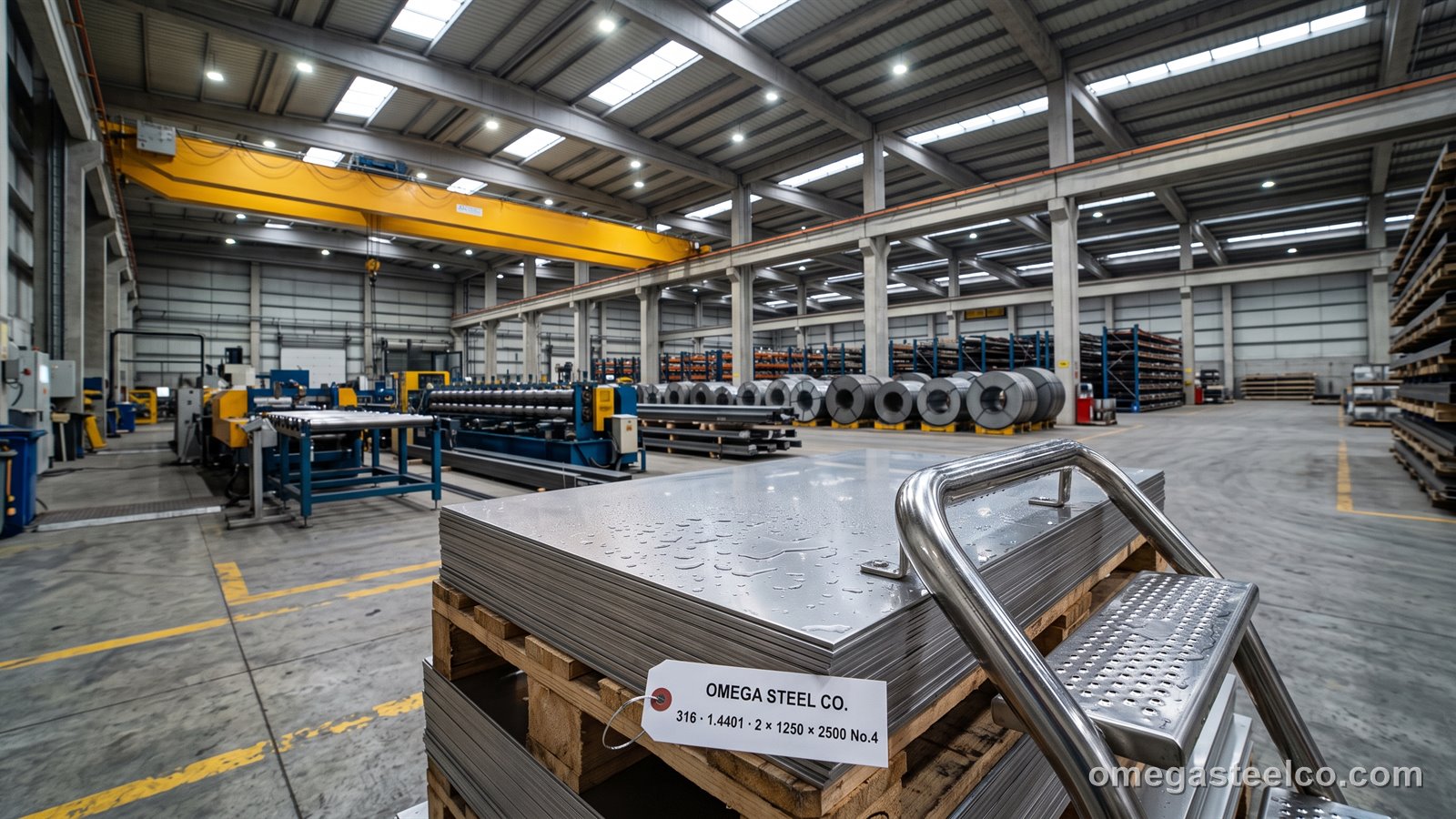
What is 316 stainless steel sheet?
316 (EN 1.4401) is 304 rebuilt for chlorides: 2–2.5 % molybdenum raises the pitting resistance equivalent (PREN) from about 19 to 24–26, and a little more nickel keeps the structure austenitic despite the ferrite-forming Mo. The passive film that chloride ions puncture on 304 holds on 316 in sea spray, pool atmospheres, brines up to a few hundred ppm chloride at moderate temperature, sulphuric and phosphoric acids in useful ranges, and the hot detergent cycles of dishwashers and CIP systems. It is also the standard for pharmaceutical, surgical and food-contact parts where 304 is marginal. Carbon is 0.07 % max; the low-carbon 316L (1.4404) is the welding version and most modern coil is dual-certified. Strength and formability are close to 304 — slightly higher yield, slightly less elongation — and the price is about 40 % higher because of the molybdenum and nickel. It is not stainless in everything: hot concentrated chlorides, hydrochloric acid and stagnant seawater still pit it, and duplex or super-austenitic grades take over there.
Chemical composition
| Element | C | Si | Mn | P | S | Cr | Ni | Mo | N |
|---|---|---|---|---|---|---|---|---|---|
| max. % (ladle) | ≤ 0.07 | ≤ 1.00 | ≤ 2.00 | ≤ 0.045 | ≤ 0.015 | 16.5–18.5 | 10.0–13.0 | 2.00–2.50 | ≤ 0.10 |
ASTM 316: C ≤ 0.08, Cr 16–18, Ni 10–14, Mo 2–3. PREN = Cr + 3.3 Mo + 16 N ≈ 24–26.
Mechanical properties
| Property | Requirement (EN 10088-2, cold-rolled) | Typical value | Note |
|---|---|---|---|
| Yield strength Rp0.2 | ≥ 240 MPa | 270–330 MPa | |
| Tensile strength Rm | 530–680 MPa | 580–650 MPa | |
| Elongation A | ≥ 40 % | 45–55 % | |
| Hardness | — | ≤ 215 HB | |
| Magnetic | no | slightly after cold work |
Equivalent grades
| System | Grade | Note |
|---|---|---|
| EN 10088 | 1.4401 | material number |
| DIN | X5CrNiMo17-12-2 | historic |
| AISI / ASTM A240 | 316 | US designation |
| JIS G4304/4305 | SUS 316 | |
| GB/T 3280 | 06Cr17Ni12Mo2 | |
| UNS | S31600 |
Finishes for marine and architectural use
| Finish | Ra (µm) | Coastal performance | Used for |
|---|---|---|---|
| BA (2R) | ≤ 0.1 | best — least tea-staining | cladding, lift doors, signage |
| Electropolished | ≤ 0.3 | best | railings, fixings, pool equipment |
| 2B | 0.1–0.5 | good | tanks, ducts, hidden parts |
| HL hairline | 0.3–0.5 | good if lines run vertical (drains water) | façades, doors, columns |
| No.4 satin | 0.3–0.6 | fair — grooves hold salt | handrails, counters; rinse regularly |
| 1D plate | 2–6 | poor untreated — pickle and passivate | structural, heavy tanks |
Rule for the coast: the smoother and cleaner the surface, the longer 316 stays bright. Rough, ground or heat-tinted areas pit first.
Corrosion resistance — where 316 is needed
| Environment | 304 | 316 | Note |
|---|---|---|---|
| Coastal atmosphere (< 5 km from sea) | tea-staining, pitting | good | 316 minimum; rinse regularly |
| Marine splash / deck fittings | poor | fair–good | duplex for immersion |
| Indoor swimming pools | poor | fair | stress corrosion risk above 60 °C — use 1.4529 / duplex for load-bearing |
| Brine, pickling, dishwashers | poor | good | |
| Sulphuric acid ≤ 5 %, phosphoric acid | fair | good | |
| Pharma / surgical / CIP | fair | good | the specified grade |
| Hydrochloric acid, hot chlorides | no | no | Hastelloy / titanium |
Thickness range and stock sizes
| Thickness | Widths × lengths | Availability |
|---|---|---|
| 1.0–3.0 mm | 1 000 / 1 250 / 1 500 × 2 500 / 3 000, 2B / No.4 | stock (dual 316/316L) |
| 4–6 mm | 1 500 × 3 000 / 6 000, 2B / 1D | stock, limited |
| 0.5–0.8 mm | 1 000 / 1 250, BA / 2B | to order 1–3 weeks |
| 8–30 mm plate | 1 500 / 2 000 × 6 000, 1D | to order 2–3 weeks |
Weight per m² and per sheet
| Thickness | kg/m² | 1 000 × 2 000 (kg) | 1 250 × 2 500 (kg) | 1 500 × 3 000 (kg) |
|---|---|---|---|---|
| 1 mm | 8.00 | 16.0 | 25.0 | 36.0 |
| 1.2 mm | 9.60 | 19.2 | 30.0 | 43.2 |
| 1.5 mm | 12.00 | 24.0 | 37.5 | 54.0 |
| 2 mm | 16.00 | 32.0 | 50.0 | 72.0 |
| 2.5 mm | 20.00 | 40.0 | 62.5 | 90.0 |
| 3 mm | 24.00 | 48.0 | 75.0 | 108.0 |
| 4 mm | 32.00 | 64.0 | 100.0 | 144.0 |
| 5 mm | 40.00 | 80.0 | 125.0 | 180.0 |
| 6 mm | 48.00 | 96.0 | 150.0 | 216.0 |
| 8 mm | 64.00 | 128.0 | 200.0 | 288.0 |
| 10 mm | 80.00 | 160.0 | 250.0 | 360.0 |
Density 8.0 kg/dm³; tolerances EN ISO 9445.
Forming, welding and finishing
Forms and draws like 304 with a little more spring-back; laser, waterjet and plasma cut cleanly; bends at 1 × t. Weld with 316L filler (TIG/MIG/plasma), no preheat, interpass ≤ 150 °C; pickle or brush all heat tint — on 316 an unremoved tint is the first place chloride pitting starts. For heavy welding specify 316L. Satin and hairline finishes are standard for architectural marine work; passivate after fabrication for pharma.
Where it is used
- Coastal and marine architecture: cladding, railings, fixings
- Swimming-pool and spa equipment, ladders, grilles
- Chemical, pharmaceutical and food process equipment
- Dishwasher, laundry and CIP tunnels
- Boat fittings, deck hardware and tanks
- Water treatment, desalination pre-treatment and brine systems
316 vs 304 vs 316L
304 is the indoor and fresh-water grade at 60–70 % of the price; 316 is the chloride grade. 316L is 316 with carbon ≤ 0.03 % for welded tanks and vessels — and since most coil is dual-certified, it is usually what you get anyway. Above 316 sit duplex 1.4462 and super-austenitic 1.4529 for hot chlorides, available to order.
Price
316 is about 40 % dearer than 304 per ton (molybdenum + nickel); the bands below are indicative FOB Istanbul for 2B stock and finished surfaces, moving with the LME.
Bands from our weekly export list (September 2026), FOB Istanbul, full-container quantities, excluding freight and certificates. Firm price per project on RFQ within one working day.
Export and packing
Packing of 316 stainless steel sheet: coils on cradles (eye-to-sky, VCI wrap, four straps, 5–25 t) or sheet packs on skids up to 3 t with interleaving paper and corner protectors; 20' ≈ one coil (≤ 20 t), 40' HC ≈ two coils or 24 t of sheet. Tariff 7210 / 7209 / 7208.
| Term | Detail |
|---|---|
| MOQ | 1 t |
| Incoterms | FOB Istanbul · CIF / CFR Gulf, Africa · DAP EU, Balkans, Iraq, Caucasus · DAP Aktau |
| Lead time | Stock 1–6 mm: 3–5 working days; thin gauges and plate 1–3 weeks |
| Packing | Sheets on skids ≤ 2 t, film, interleaving |
| Container / truck | 20' ≈ 18–20 t; 40' HC ≈ 24 t |
| Documents | Invoice, packing list, EN 10204 3.1 (3.2 on request), certificate of origin; SASO / SONCAP / PVoC on request |
| Payment | 30% advance, balance against B/L copy; L/C at sight for orders above 100 t |
Certificates and testing
316 stainless steel sheet ships with EN 10204 3.1 certificates cross-referenced to the stencilled heat numbers. Where the project requires it we arrange 3.2 certification with Lloyd's, BV, TÜV or SGS, ultrasonic examination to EN 10160 and Charpy testing at the temperature you specify.
How to order
Specify 1.4401 (or 1.4404), thickness × width × length, finish, film, quantity, certificate and the environment (coastal, pool, chemical) — we confirm the grade is right or suggest an alternative.
Standards
- EN 10088-2 — 1.4401 (X5CrNiMo17-12-2)
- ASTM A240 — Type 316
- EN 10028-7 — pressure use
- EN 10204 3.1
Grades
Grade data sheets (chemistry, mechanicals, equivalents) are on our reference site: 1.4401 · 1.4404 · 1.4301
Frequently asked questions
What is 316 stainless steel?
An austenitic stainless steel with 17 % Cr, 11 % Ni and 2–2.5 % Mo (EN 1.4401, AISI 316) — the marine and chemical grade, resistant to chloride pitting where 304 fails.
Is 316 better than 304?
In chloride environments — sea air, pools, brine, many chemicals — yes; indoors and in fresh water 304 performs the same at 60–70 % of the price.
Is 316 stainless steel magnetic?
No in the annealed state; very slightly after heavy cold forming.
What is the price of 316 stainless steel?
About 40 % above 304 per ton FOB Istanbul — see the band above; it follows nickel and molybdenum prices.
What is 316 vs 316L?
316L has carbon ≤ 0.03 % for welding without sensitisation; otherwise identical. Most stock is dual-certified 316/316L.
Can 316 be used in swimming pools?
For non-load-bearing parts yes; for load-bearing fixings in warm, chlorinated indoor pool air, 1.4529 or duplex is required because of stress-corrosion cracking risk.