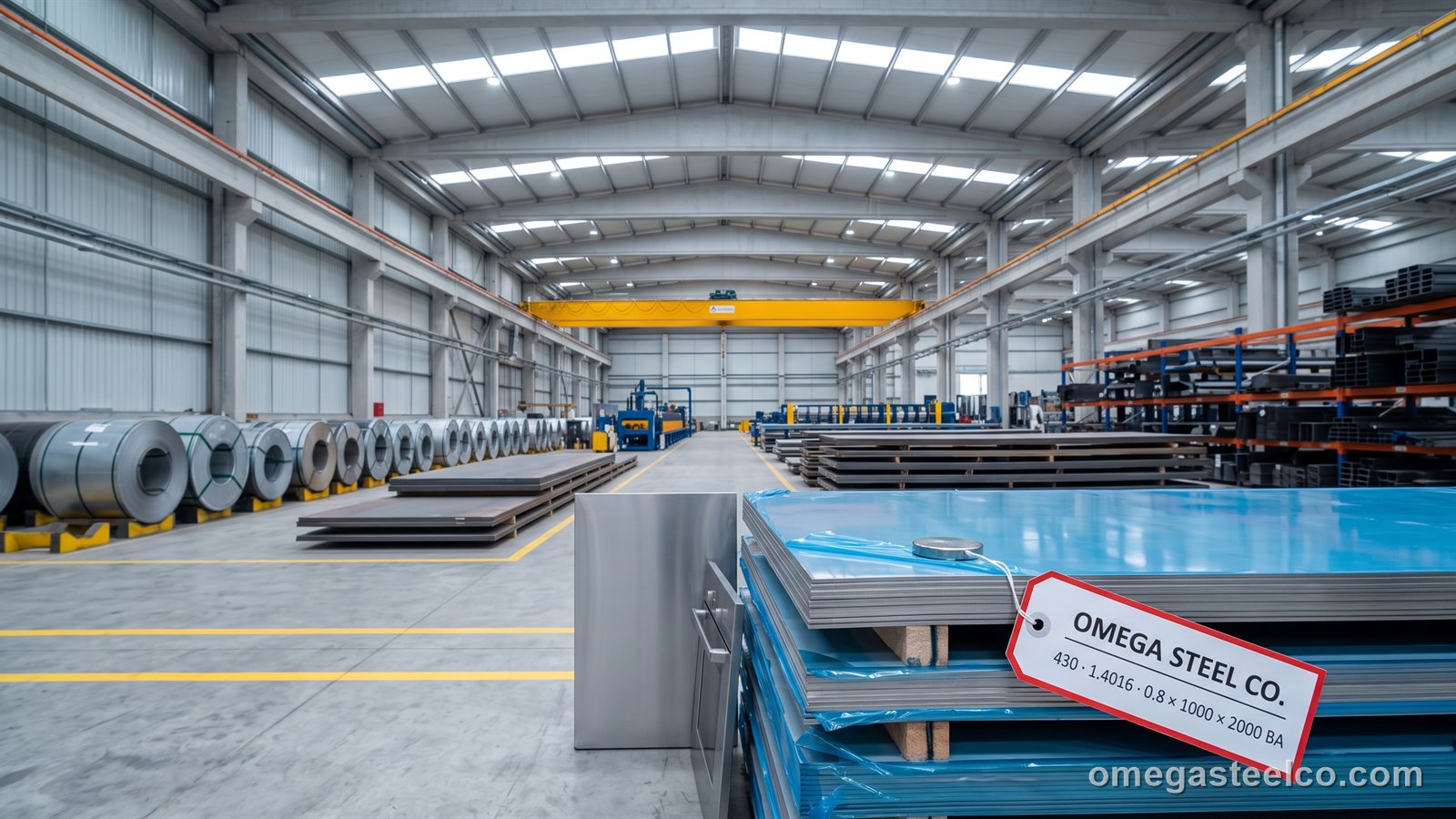
What is 430 stainless steel sheet?
430 (EN 1.4016, X6Cr17) is the ferritic member of the standard stainless family: about 17 % chromium and no nickel, so the structure stays body-centred cubic like carbon steel — magnetic, with a yield point, less ductile and less tough than the austenitic 304, but also immune to chloride stress-corrosion cracking and, because nickel is the expensive element, cheaper and price-stable. Its chromium film resists the atmosphere, fresh water, mild detergents and food indoors; outdoors it will tea-stain and near the coast it pits, so it is an indoor and dry-service grade. Formability is adequate for bending, roll-forming and shallow pressing (elongation 20–25 %, r ≈ 1.0–1.3) but deep drawing and stretch-forming belong to 304; ridging (roping) can show on stretched BA surfaces. Welding is possible but the heat-affected zone coarsens and loses toughness — thin sheet TIG or spot welds are fine, structural welding is not its purpose. The bright-annealed (BA) finish on 430 is the mirror-like face of appliance doors and hood fronts; 2B for hidden panels and 2B/No.4 for trolleys and counters. Thickness 0.4–3 mm covers the market; we stock 0.5–3 mm.
Chemical composition
| Element | C | Si | Mn | P | S | Cr |
|---|---|---|---|---|---|---|
| max. % (ladle) | ≤ 0.08 | ≤ 1.00 | ≤ 1.00 | ≤ 0.040 | ≤ 0.015 | 16.0–18.0 |
No nickel (≤ 0.75 residual in ASTM). Stabilised variants 1.4509 (441, Ti/Nb) and 1.4510 (439, Ti) weld and form better.
Mechanical properties
| Property | Requirement (EN 10088-2, cold-rolled) | Typical value | Note |
|---|---|---|---|
| Yield strength Rp0.2 | ≥ 260 MPa | 280–340 MPa | |
| Tensile strength Rm | 450–600 MPa | 480–540 MPa | |
| Elongation A | ≥ 20 % | 22–28 % | |
| Hardness | — | ≤ 180 HB | |
| Magnetic | yes | strongly | ferritic |
| Impact | not required | low below 0 °C | not for cryogenic |
Equivalent grades
| System | Grade | Note |
|---|---|---|
| EN 10088 | 1.4016 | material number |
| DIN | X6Cr17 | historic |
| AISI / ASTM A240 | 430 | US designation |
| JIS G4304/4305 | SUS 430 | |
| GB/T 3280 | 10Cr17 | |
| UNS | S43000 |
Finishes — BA is the appliance standard
| Finish | Look | Product examples |
|---|---|---|
| BA (bright annealed) | mirror-like, slight haze | refrigerator doors, hood fronts, oven panels, trims |
| 2B | matt silver | hidden panels, shelving, trolleys, cabinets |
| No.4 satin | brushed | counters, display cases, indoor cladding |
| Embossed (linen / leather) | patterned, hides fingerprints | lift interiors, appliance sides, doors |
| Anti-fingerprint coated BA | clear organic coating | premium appliance fronts (to order) |
BA on 430 shows ridging if stretch-formed — keep forming to bending and shallow drawing. Film stays on until final assembly.
Where 430 is enough — and where it is not
| Application | 430 | 304 | Note |
|---|---|---|---|
| Appliance panels, hood fronts, fridge doors | ideal | over-specified | BA finish |
| Indoor decorative trims, counters, cladding | good | good | dry indoor only |
| Catering trolleys, shelving (dry) | good | better | |
| Sinks, wet kitchens, dishwashers | marginal | ideal | chlorides + wet |
| Outdoor, coastal, pools | no | 304 marginal, 316 | |
| Deep-drawn parts | no | ideal | ridging, low elongation |
| Welded tanks and vessels | no | 304L | HAZ embrittlement |
| Exhaust and heat (to 800 °C) | good | good | 1.4509 better |
Thickness range and stock sizes
| Thickness | Widths × lengths | Availability |
|---|---|---|
| 0.5–1.0 mm | 1 000 / 1 250 × 2 000 / 2 500; coil | stock BA and 2B |
| 1.2–2.0 mm | 1 000 / 1 250 × 2 500 | stock 2B |
| 2.5–3.0 mm | 1 250 × 2 500 | stock, limited |
| 0.4 mm, 4–6 mm | sheet / coil | to order 1–3 weeks |
Weight per m² and per sheet
| Thickness | kg/m² | 1 000 × 2 000 (kg) | 1 250 × 2 500 (kg) | 1 500 × 3 000 (kg) |
|---|---|---|---|---|
| 0.5 mm | 3.85 | 7.7 | 12.0 | 17.3 |
| 0.6 mm | 4.62 | 9.2 | 14.4 | 20.8 |
| 0.7 mm | 5.39 | 10.8 | 16.8 | 24.3 |
| 0.8 mm | 6.16 | 12.3 | 19.3 | 27.7 |
| 1 mm | 7.70 | 15.4 | 24.1 | 34.7 |
| 1.2 mm | 9.24 | 18.5 | 28.9 | 41.6 |
| 1.5 mm | 11.55 | 23.1 | 36.1 | 52.0 |
| 2 mm | 15.40 | 30.8 | 48.1 | 69.3 |
| 2.5 mm | 19.25 | 38.5 | 60.2 | 86.6 |
| 3 mm | 23.10 | 46.2 | 72.2 | 104.0 |
Density 7.7 kg/dm³; tolerances EN ISO 9445.
Forming, welding and finishing
Bends at 1–1.5 × t (transverse) and roll-forms readily; avoid stretch-forming and deep draws (ridging, cracking); laser cuts cleanly. Spot and TIG welding of thin sheet with 430 or 308L/309L filler, low heat input, and post-weld brushing; keep welds off visible BA faces. The BA surface scratches easily — keep the film on until final assembly. Never store or process together with carbon steel.
Where it is used
- Refrigerator, dishwasher and washing-machine panels and doors
- Cooker hoods, oven fronts and appliance trims
- Shop counters, display cases and indoor cladding
- Catering trolleys, dry shelving and cabinets
- Decorative trims, sign blanks and household ware
- Exhaust and heat shields (with 1.4509 / 441)
430 vs 304
304 is non-magnetic, far more formable, weldable and corrosion-resistant, and 30–40 % dearer. 430 is the right choice when the part is flat or lightly formed, stays dry and indoors, and price matters — appliance and decorative work. Where a magnetic grade with better welding is needed, the stabilised 1.4509 (441) or 1.4510 (439) are available to order; for hardening and wear, 410.
Price
430 is priced nickel-free and therefore about 30–40 % below 304 and more stable month to month; the bands below are indicative FOB Istanbul for 2B stock and BA finish.
Bands from our weekly export list (September 2026), FOB Istanbul, full-container quantities, excluding freight and certificates. Firm price per project on RFQ within one working day.
Export and packing
430 stainless steel sheet ships as coil — eye-to-sky on a wooden cradle, 5–25 t per coil, VCI paper and steel strapping — or as cut sheet on skids of 2–3 t with paper interleaving and edge protectors. A 20' takes one coil up to 20 t; a 40' HC two coils or 24 t of sheet. HS 7210 / 7209 / 7208 by product.
| Term | Detail |
|---|---|
| MOQ | 1 t |
| Incoterms | FOB Istanbul · CIF / CFR Gulf, Africa · DAP EU, Balkans, Iraq, Caucasus · DAP Aktau |
| Lead time | Stock 0.5–3 mm: 3–5 working days; other gauges 1–3 weeks |
| Packing | Sheets on skids ≤ 2 t, film, interleaving; coils on cradles |
| Container / truck | 20' ≈ 18–20 t; 40' HC ≈ 24 t |
| Documents | Invoice, packing list, EN 10204 3.1 (3.2 on request), certificate of origin; SASO / SONCAP / PVoC on request |
| Payment | 30% advance, balance against B/L copy; L/C at sight for orders above 100 t |
Certificates and testing
Every lot of 430 stainless steel sheet carries an EN 10204 3.1 inspection certificate listing heat, chemistry, mechanical and impact results. On request we add 3.2 witnessing by a classification society or inspector, EN 10160 ultrasonic testing and supplementary impact tests at the customer's design temperature.
How to order
Specify 1.4016 / 430, thickness × width × length, finish (BA / 2B / No.4), film, quantity and whether parts will be stretch-formed or welded — we may suggest 1.4509 or 304 instead.
Standards
- EN 10088-2 — 1.4016 (X6Cr17)
- ASTM A240 — Type 430
- EN 10204 3.1
Grades
Grade data sheets (chemistry, mechanicals, equivalents) are on our reference site: 1.4016 · 1.4301 · 1.4006
Frequently asked questions
What is 430 stainless steel?
A ferritic stainless steel with 16–18 % chromium and no nickel (EN 1.4016, AISI 430): magnetic, bright, economical, used for appliance panels, hoods, trims and indoor decorative sheet.
Is 430 stainless steel magnetic?
Yes, strongly — its ferritic structure is magnetic like carbon steel; that is the simplest way to tell it from 304.
What is the difference between 430 and 304?
430 has no nickel: it is magnetic, cheaper by 30–40 %, less corrosion-resistant, less formable and harder to weld; 304 is the all-round austenitic grade.
Does 430 stainless rust?
Indoors and dry, no; outdoors it tea-stains and near the coast or with chlorides it pits — use 304 or 316 there.
Can 430 be used for kitchen sinks?
Budget sinks are made from it, but wet chloride exposure (detergents, salty water) causes staining over time; 304 is the durable choice.