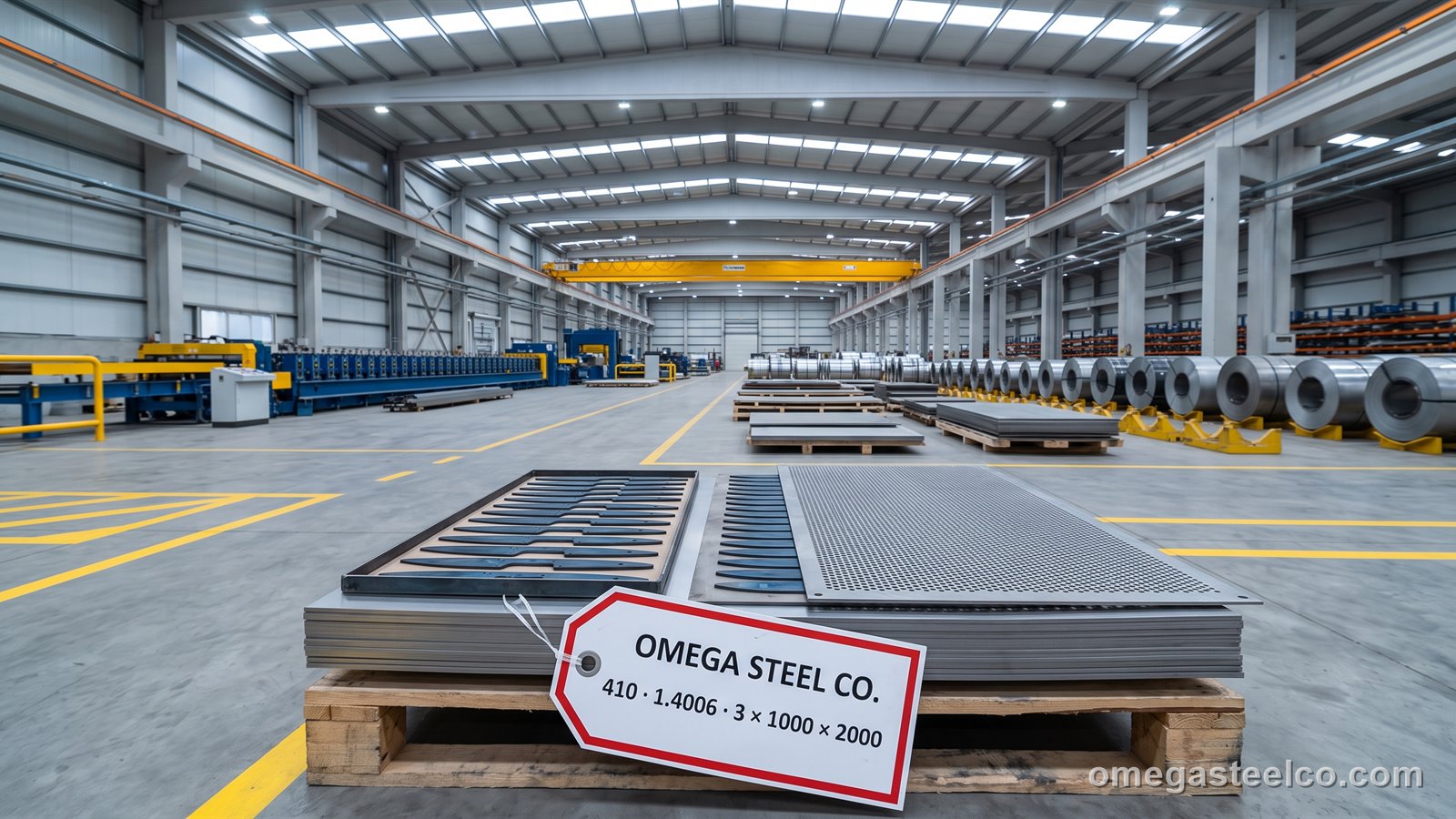
What is 410 stainless steel sheet?
410 (EN 1.4006, X12Cr13) belongs to the martensitic group: with 12–13 % chromium it is just stainless enough for water, steam, food and mild atmospheres, and with 0.08–0.15 % carbon it transforms to martensite on quenching — the same hardening mechanism as tool steel. Supplied annealed (≤ 200 HB, tensile ≤ 730 MPa), it bends, blanks and machines readily; hardened from 950–1 000 °C in oil or air and tempered at 200–300 °C it reaches 38–45 HRC with a tensile strength of 1 200–1 500 MPa, or tempered at 600–700 °C it gives a tough 800–900 MPa. That two-stage life — soft to form, hard in service — is why 410 is the steel of cutlery and knife blanks, screen and sieve plates, valve trim, pump shafts and impellers, turbine blades, fasteners and wear liners in food and water plants. Corrosion resistance is below 430 in the hardened condition and well below 304; it is magnetic at all times. Welding needs preheat (200–300 °C) and post-weld tempering because the HAZ hardens and cracks otherwise, so it is not a fabrication grade. 420 (1.4021, 0.2–0.4 % C) is the harder cutlery version and 1.4028 the surgical-blade grade, both available to order.
Chemical composition
| Element | C | Si | Mn | P | S | Cr | Ni |
|---|---|---|---|---|---|---|---|
| max. % (ladle) | 0.08–0.15 | ≤ 1.00 | ≤ 1.50 | ≤ 0.040 | ≤ 0.015 | 11.5–13.5 | ≤ 0.75 |
ASTM 410: C ≤ 0.15, Cr 11.5–13.5. 420 (1.4021): C 0.16–0.25; 1.4028: C 0.26–0.35.
Mechanical properties and heat treatment
| Condition | Yield Rp0.2 (MPa) | Tensile Rm (MPa) | Elongation / hardness |
|---|---|---|---|
| Annealed +A (as delivered) | ≥ 250 | ≤ 730 | A ≥ 15 %, ≤ 200 HB |
| +QT650 (hardened, tempered 650 °C) | ≥ 450 | 650–850 | A ≥ 15 % |
| +QT800 (tempered 600 °C) | ≥ 600 | 800–1 000 | A ≥ 12 % |
| Hardened, tempered 200–300 °C | ≈ 1 000 | 1 200–1 500 | 38–45 HRC |
| Hardening | 950–1 000 °C, oil or air quench | — | temper immediately |
| Magnetic | yes | — | all conditions |
Equivalent grades
| System | Grade | Note |
|---|---|---|
| EN 10088 | 1.4006 | material number |
| DIN | X12Cr13 / X10Cr13 | historic |
| AISI / ASTM A240 | 410 | US designation |
| JIS G4304/4305 | SUS 410 | |
| GB/T 3280 | 12Cr13 | |
| UNS | S41000 |
Delivery condition and surface
| Stage | Condition | Surface | Hardness |
|---|---|---|---|
| As delivered, sheet | annealed (+A) | 2B, filmed | ≤ 200 HB |
| As delivered, plate | annealed (+A) | 1D pickled | ≤ 200 HB |
| After forming and blanking | annealed | as delivered | — |
| After hardening and tempering | +QT | oxide scale — grind / blast | 38–45 HRC or as specified |
| After grinding and polishing | +QT | No.4, mirror or ground | unchanged |
| After passivation | +QT | clean, passive | unchanged |
Hardened material cannot be bent; do all forming before heat treatment and allow for scale removal in the thickness.
Thickness range and stock sizes
| Thickness | Widths × lengths | Availability |
|---|---|---|
| 1.0–3.0 mm | 1 000 / 1 250 × 2 000 / 2 500, 2B annealed | to order 3–5 weeks |
| 4–6 mm | 1 250 / 1 500 × 3 000, 1D annealed | to order 3–5 weeks |
| 420 / 1.4028 | sheet 1–4 mm | to order 4–6 weeks |
Weight per m² and per sheet
| Thickness | kg/m² | 1 000 × 2 000 (kg) | 1 250 × 2 500 (kg) | 1 500 × 3 000 (kg) |
|---|---|---|---|---|
| 1 mm | 7.70 | 15.4 | 24.1 | 34.7 |
| 1.5 mm | 11.55 | 23.1 | 36.1 | 52.0 |
| 2 mm | 15.40 | 30.8 | 48.1 | 69.3 |
| 2.5 mm | 19.25 | 38.5 | 60.2 | 86.6 |
| 3 mm | 23.10 | 46.2 | 72.2 | 104.0 |
| 4 mm | 30.80 | 61.6 | 96.3 | 138.6 |
| 5 mm | 38.50 | 77.0 | 120.3 | 173.3 |
| 6 mm | 46.20 | 92.4 | 144.4 | 207.9 |
Density 7.7 kg/dm³; tolerances EN ISO 9445 / EN 10051.
Forming, heat treatment and welding
Form, blank and machine in the annealed condition (bend 1.5–2 × t); harden after forming at 950–1 000 °C with oil or air quench and temper within an hour — 200–300 °C for maximum hardness (avoid 450–550 °C, the embrittlement range), 600–700 °C for toughness. Grind and polish after hardening. Welding: preheat 200–300 °C, 410 or 309L filler, post-weld temper at 650–750 °C — or avoid welding and use mechanical joints. Passivate after machining for best corrosion resistance.
Where it is used
- Knife, cutlery and blade blanks
- Screen, sieve and perforated wear plates
- Valve trim, seats, stems and pump components
- Turbine blades, bolts and fasteners
- Wear liners and chutes in food and water plants
- Moulds and dies for plastics (polished)
410 vs 430 vs 420
430 has more chromium and no useful carbon: better corrosion resistance, not hardenable — the decorative and appliance grade. 410 hardens to 45 HRC for wear and cutting; 420 (0.2–0.4 % C) hardens to 50–55 HRC for finer blades and surgical tools at the cost of corrosion resistance. For anything not needing hardness, 304 is easier to fabricate.
Price
410 is a specialist grade priced above 430; the band below is indicative FOB Istanbul for annealed sheet to order. Hardened or ground material is quoted per job.
Bands from our weekly export list (September 2026), FOB Istanbul, full-container quantities, excluding freight and certificates. Firm price per project on RFQ within one working day.
Export and packing
Packing of 410 stainless steel sheet: coils on cradles (eye-to-sky, VCI wrap, four straps, 5–25 t) or sheet packs on skids up to 3 t with interleaving paper and corner protectors; 20' ≈ one coil (≤ 20 t), 40' HC ≈ two coils or 24 t of sheet. Tariff 7210 / 7209 / 7208.
| Term | Detail |
|---|---|
| MOQ | 1 t |
| Incoterms | FOB Istanbul · CIF / CFR Gulf, Africa · DAP EU, Balkans, Iraq, Caucasus · DAP Aktau |
| Lead time | To order 3–5 weeks |
| Packing | Sheets on skids ≤ 2 t, interleaving, film on 2B |
| Container / truck | 20' ≈ 18–20 t; 40' HC ≈ 24 t |
| Documents | Invoice, packing list, EN 10204 3.1 (3.2 on request), certificate of origin; SASO / SONCAP / PVoC on request |
| Payment | 30% advance, balance against B/L copy; L/C at sight for orders above 100 t |
Certificates and testing
Every lot of 410 stainless steel sheet carries an EN 10204 3.1 inspection certificate listing heat, chemistry, mechanical and impact results. On request we add 3.2 witnessing by a classification society or inspector, EN 10160 ultrasonic testing and supplementary impact tests at the customer's design temperature.
How to order
Specify 1.4006 / 410 (or 420 / 1.4028), thickness × width × length, condition (annealed 2B or 1D), quantity, intended hardness after heat treatment and certificate; we confirm mill and delivery within a day.
Standards
- EN 10088-2 — 1.4006 (X12Cr13)
- ASTM A240 / A176 — Type 410
- EN 10204 3.1
Grades
Grade data sheets (chemistry, mechanicals, equivalents) are on our reference site: 1.4006 · 1.4016 · 1.4021
Frequently asked questions
What is 410 stainless steel?
A martensitic stainless steel with 12 % chromium and 0.08–0.15 % carbon (EN 1.4006, AISI 410) that can be hardened by quenching to 38–45 HRC — used for blades, wear parts, valve trim and fasteners.
Can 410 stainless be hardened?
Yes — heat to 950–1 000 °C, quench in oil or air and temper; 200–300 °C tempering gives 38–45 HRC, 600–700 °C a tough 800–900 MPa.
What is the difference between 410 and 430?
410 has 12 % Cr and enough carbon to harden; 430 has 17 % Cr, no useful carbon, better corrosion resistance and cannot be hardened. Both are magnetic.
Is 410 stainless steel magnetic?
Yes, in all conditions.
Can 410 be welded?
With preheat (200–300 °C), matching or 309L filler and post-weld tempering; otherwise the heat-affected zone hardens and cracks. It is not a fabrication grade.