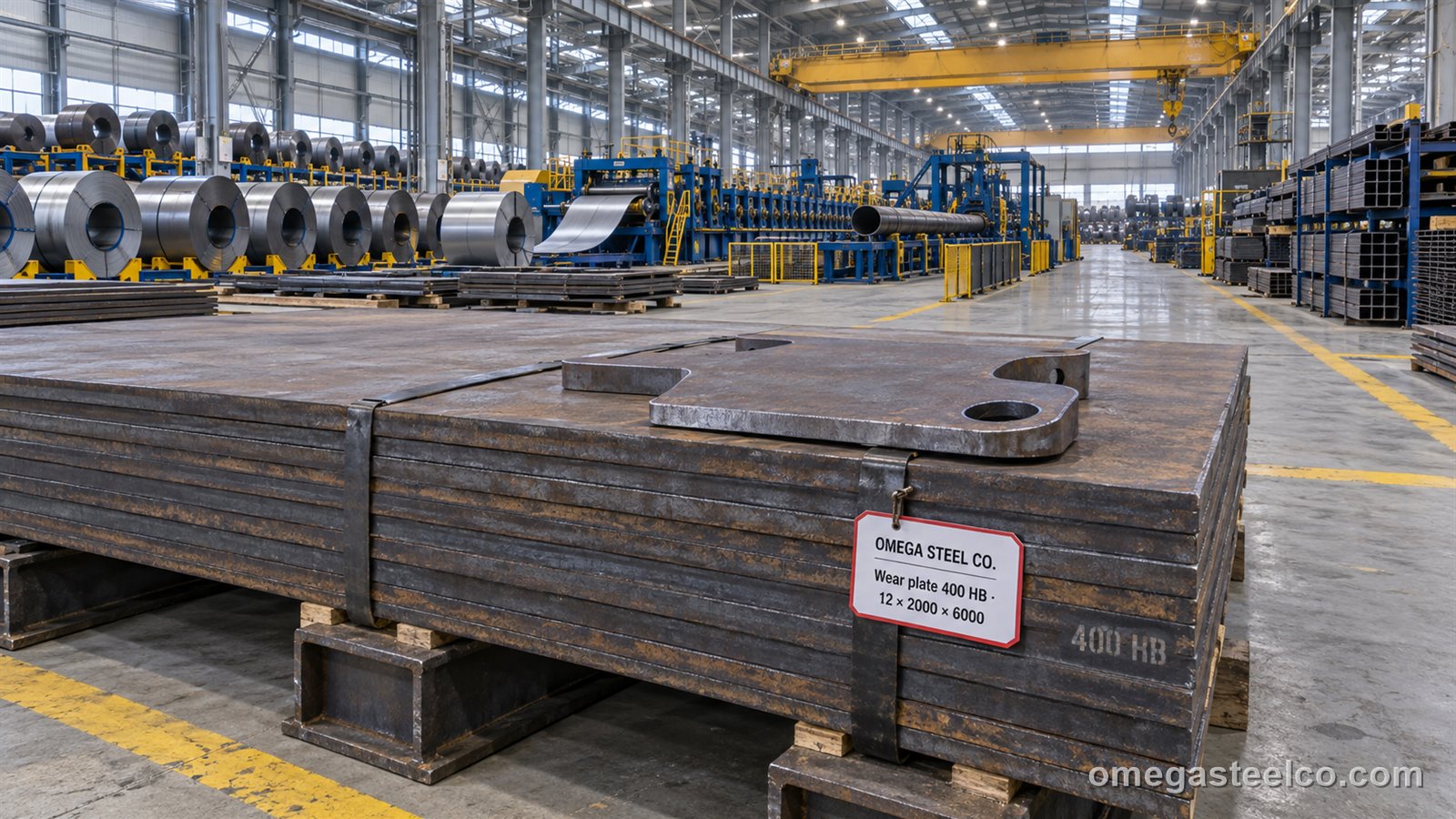
What is wear-resistant (AR) plate?
Abrasion-resistant plate is low-alloy steel (C 0.15–0.30%, Mn, Cr, Mo, B) that is water-quenched after rolling and lightly tempered, giving a hard martensitic structure of 370–540 HB through the thickness while keeping enough toughness to cut, bend and weld. It lasts 3–5× longer than S355 in sliding abrasion — sand, gravel, ore, coal, scrap, cement clinker — which is why buckets, tipper floors, chutes, hoppers, liners and screens are made from it. Branded plates (Hardox®, Dillidur®, XAR®, Raex®) are mill trademarks; the hardness classes below are the generic, certified equivalents we supply.
Grade pages
Each wear class has its own page with hardness, chemistry, bending and welding limits, equivalents and plate weights: AR400 wear plate (the formable all-rounder), AR450 wear plate (the tipper-body grade), AR500 wear plate (liners and fixed parts) and, for load-bearing parts that also wear, the quenched-and-tempered structural S690QL plate.
Hardness classes and properties
| Class | Hardness HBW | Yield typ. (MPa) | Tensile typ. (MPa) | Impact (−40 °C) | Min. bend radius | Max. service temp. | Branded equivalents (properties) |
|---|---|---|---|---|---|---|---|
| 400 HB | 370–430 | 1 000 | 1 250 | 45 J | 3t (transverse) | 250 °C | Hardox 400, Dillidur 400V, XAR 400, Raex 400 |
| 450 HB | 420–475 | 1 200 | 1 400 | 40 J | 4t | 250 °C | Hardox 450, Dillidur 450V, XAR 450, Raex 450 |
| 500 HB | 470–530 | 1 300 | 1 550 | 30 J | 5t | 250 °C | Hardox 500, Dillidur 500V, XAR 500, Raex 500 |
| S690QL | ≈ 240–290 | 690 min | 770–940 | 30 J (−40 °C) | 3t | — | Weldox 700, Dillimax 690, XABO 690, Strenx 700 |
| S890QL | ≈ 300–340 | 890 min | 940–1 100 | 30 J | 4t | — | Weldox 900, Dillimax 890 |
Brand names shown for property comparison only; we supply generic grades with mill 3.1 certificates stating hardness and chemistry.
Which hardness for which job
| Application | Class | Typical thickness | Why |
|---|---|---|---|
| Tipper and dump bodies | 400 HB (450 floor) | 4–8 mm | Best weldability/formability, 3× life of S355 |
| Excavator and loader buckets | 450 HB (500 cutting edge) | 8–25 mm | Balance of wear and toughness |
| Chutes, hoppers, bins (sliding abrasion) | 450 / 500 HB | 6–20 mm | Sliding wear dominates |
| Crusher and mill liners, screens | 500 HB | 12–40 mm | Maximum hardness |
| Concrete mixer drums, asphalt plants | 400 HB | 4–6 mm | Formed shells |
| Crane booms, lifting frames, chassis | S690QL / S890QL | 6–60 mm | Yield strength, not hardness |
| Shredder and recycling plant | 500 HB | 10–50 mm | Impact + abrasion |
Sizes and stock
| Class | Thickness | Width | Length | Availability |
|---|---|---|---|---|
| 400 HB | 4–80 mm | 1 500 / 2 000 / 2 500 | 6 000 / 12 000 | 6–40 mm stock |
| 450 HB | 4–80 mm | 1 500 / 2 000 / 2 500 | 6 000 / 12 000 | 8–30 mm stock |
| 500 HB | 6–100 mm | 2 000 / 2 500 | 6 000 / 12 000 | Mill order 4–8 weeks |
| S690QL | 6–100 mm | 2 000 / 2 500 | 6 000 / 12 000 | 8–40 mm partly stock |
| S890QL | 6–60 mm | 2 000 / 2 500 | 6 000 / 12 000 | Mill order |
Cutting, bending and welding wear plate
Cutting: plasma to 80 mm and laser to 25 mm are standard; keep the plate below 250 °C (cutting speed, no flame preheating) so the hardness is not drawn; water-jet for hardness-critical edges. Bending: cold only, across the rolling direction, radius per the table (3–5t), die opening 10–14t, deburred edges; never hot-form above 250 °C. Welding: low-hydrogen consumables (E7018 / ER70S-6 for the joint, matching strength only where needed), preheat 100–175 °C from 20 mm (400 HB) or 10 mm (500 HB), interpass ≤ 225 °C, and keep welds out of the wear zone. Drilling with carbide or cobalt drills at low speed; tapping is possible in 400 HB, difficult in 500 HB.
Processing we offer
- Plasma / laser / water-jet cutting to DXF, ±0.5 mm (plasma) / ±0.1 mm (laser)
- Bevelling for weld prep, drilling and countersinking (carbide)
- Press-brake bending to 6 m, radius per class
- Rolling of drum shells and cones (400 HB to 12 mm)
- Kits for buckets, bodies and liners: nested, cut, labelled, bolted liner sets with countersunk holes
Wear plate vs S355 vs stainless vs hardfacing
| Material | Hardness | Relative life | Relative cost per m² | Note |
|---|---|---|---|---|
| S355J2 | 160 HB | 1 | 1.0 | Baseline |
| 400 HB wear plate | 400 | 3–4 | 2.0–2.4 | Formable, weldable |
| 500 HB wear plate | 500 | 5–6 | 2.4–2.8 | Liners, mining |
| Chromium-carbide overlay | 600–700 | 8–15 | 5–8 | Not formable; bolted liners |
| Stainless 304 | 180 HB | 0.8 | 5.5 | Corrosion, not wear |
| Manganese steel (Hadfield) | 200 → 500 work-hardened | 4–8 (impact) | 3–5 | Casting, impact wear |
Wear plate price per ton
Wear plate and Q&T plate are priced per mill lot at 2–2.8× the S355J2 level (alloying, quenching, small lots): 400 HB lowest, 500 HB and S890QL highest, thin plate (4–6 mm) above thick. Cutting is quoted per metre. Ask for the current USD/MT for your class, thickness and quantity.
Bands from our weekly export list (September 2026), FOB Istanbul, full-container quantities, excluding freight and certificates. Firm price per project on RFQ within one working day.
Export and packing
Plates in packs to 5 t, kits crated; 6 m in 40' HC, 12 m by flat-rack. HS code 7225.40 (alloy flat-rolled, quenched and tempered) — for many markets a different duty rate from 7208; stated on the invoice.
| Term | Detail |
|---|---|
| MOQ | 3 t per class/thickness; 1 × 20' for freight economy |
| Incoterms | FOB Istanbul · CIF / CFR Gulf, Africa · DAP EU, Balkans, Iraq, Caucasus · DAP Aktau |
| Lead time | 400/450 HB stock 5–10 working days; 500 HB, S690QL/S890QL 4–8 weeks; cutting +5–10 |
| Packing | Packs to 5 t on skids; cut kits crated and labelled |
| Container / truck | 40' HC ≈ 24 t · flat-rack for 12 m · truck 24 t |
| Documents | Invoice, packing list, EN 10204 3.1 with hardness, certificate of origin; UT / 3.2 on request |
| Payment | 30% advance, balance against B/L copy; L/C at sight via London office |
Certificates
EN 10204 3.1 with hardness (HBW per plate), chemistry, and for S690QL yield/tensile/impact per EN 10025-6; UT to EN 10160 on request; certificate of origin; 3.2 on request.
How to order
Send class (400/450/500 HB or S690QL), thickness, sheet size or DXF, quantity and port. Reply within one working day with price per ton and per part, nesting and lead time.
Standards
- EN 10025-6 (S690QL, S890QL quenched and tempered)
- EN ISO 6506-1 (Brinell hardness)
- ASTM A514 (S690 near-equivalent)
- Wear plates: mill specifications per hardness class (no EN product standard); EN 10029 tolerances
Grades
Grade data sheets (chemistry, mechanicals, equivalents) are on our reference site: S355J2 (structural comparison) · S700MC
Frequently asked questions
Is your wear plate Hardox?
No — Hardox is SSAB's trademark. We supply generic quenched-and-tempered wear plate in 400, 450 and 500 HB classes from European and Asian mills, certified by hardness and chemistry, with properties comparable to the branded grades listed for reference.
What is the density of 400 HB wear plate?
7.85 kg/dm³ like other carbon steels; a 10 mm plate weighs 78.5 kg/m² and a 2 000 × 6 000 mm plate 942 kg.
What is the difference between 400 and 500 HB?
Hardness 370–430 vs 470–530 HBW: 500 HB lasts about 50–70% longer in sliding abrasion but is harder to bend (5t vs 3t), needs more preheat for welding and has lower impact toughness. Tipper bodies use 400/450, liners 500.
Can wear plate be welded?
Yes, with low-hydrogen consumables, 100–175 °C preheat from 20 mm (400 HB) or 10 mm (500 HB), interpass below 225 °C and welds kept out of the wear zone. S690QL welds with matching high-strength consumables.
Can wear plate be bent?
Cold, across the rolling direction, at 3t (400 HB), 4t (450) and 5t (500) minimum inside radius with deburred edges. Never hot-form above 250 °C — it destroys the hardness.
What is S690QL used for?
Crane booms, telescopic sections, lifting frames, truck chassis and mining structures where 690 MPa yield cuts weight; it is a structural Q&T steel to EN 10025-6, not a wear plate.
How much does wear plate cost?
Roughly 2–2.8 times the price of S355J2 plate per ton, depending on class, thickness and lot; firm USD/MT and per-part prices within one working day.
Do you cut bucket and liner parts?
Yes — plasma, laser and water-jet to DXF, countersunk bolt holes, bevels and bending; kits ship crated and labelled with the plate order.