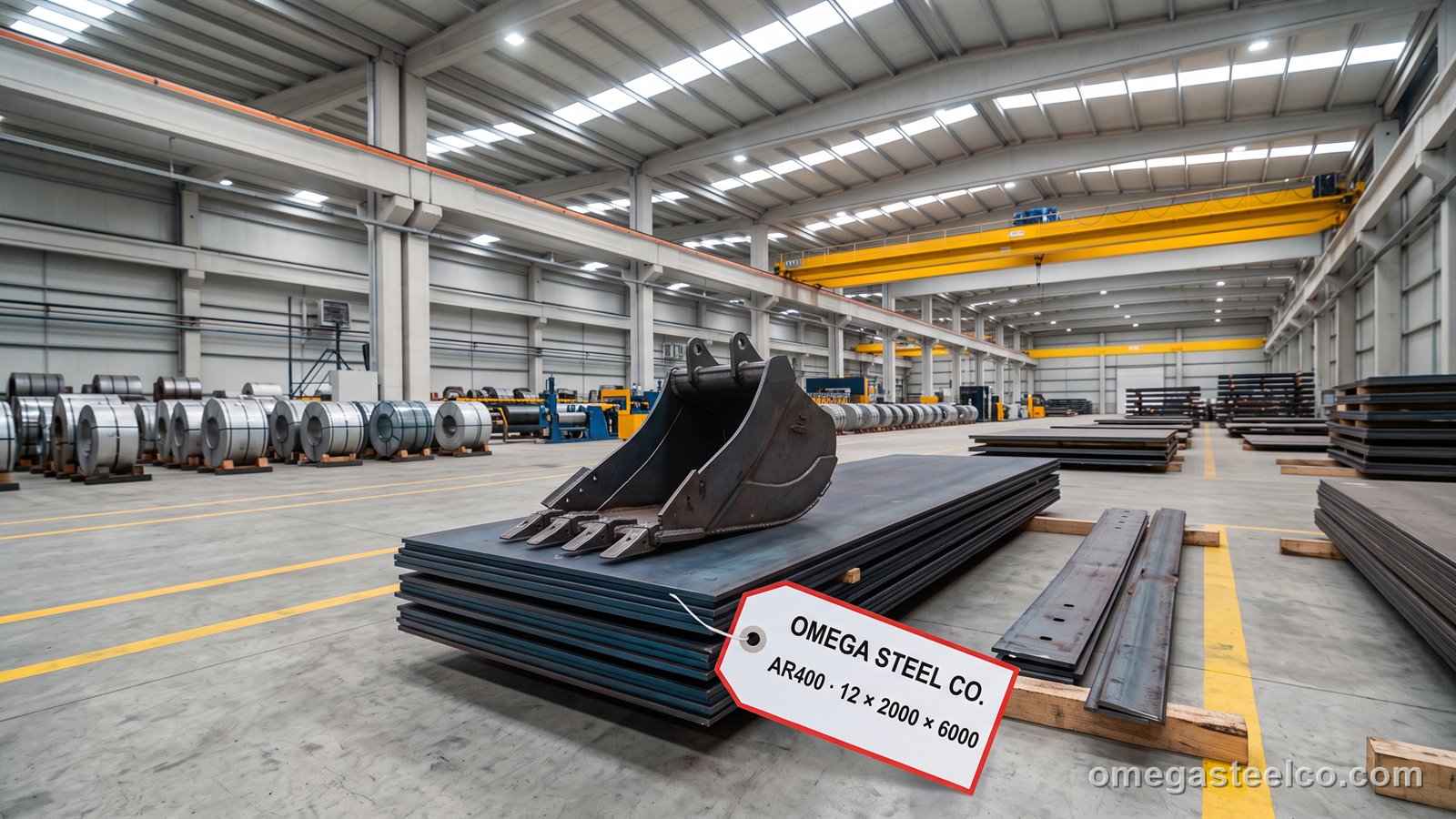
What is AR400 wear plate?
AR400 — AR for abrasion-resistant, 400 for the nominal Brinell hardness — is a low-alloy plate (about 0.15–0.20 % carbon with small boron, chromium and manganese additions) that is water-quenched straight from the rolling heat and lightly tempered so that its structure is fine martensite through the full thickness. The result is a plate roughly 2.5 times harder than S355 (400 vs 160 HB) with a yield strength around 1 000 MPa, yet — because the carbon is kept low and the alloying lean — it remains tough (typically 40 J at −40 °C), bendable and weldable. In sliding abrasion against sand, ore, coal, aggregate or grain, relative wear life is roughly proportional to hardness, so AR400 lasts three to four times longer than a mild-steel part of the same thickness, which is why a 6 mm AR400 truck floor replaces a 10 mm S355 floor and saves 300 kg per body. The plate is sold under mill brand names — Hardox 400 (SSAB), Dillidur 400 V (Dillinger), XAR 400 (thyssenkrupp), Raex 400 (Raahe), JFE-EH400, NM400 (China) — which differ in guaranteed hardness range, flatness and bending data but are interchangeable for most applications; we quote the brand available at the lead time you need and state it on the certificate. AR400 is not a structural grade: no yield is guaranteed by any EN standard, and it should not be used for load-bearing members without the mill's design data.
Chemical composition
| Element | C | Si | Mn | P | S | Cr | Ni | Mo | B |
|---|---|---|---|---|---|---|---|---|---|
| max. % (ladle) | ≤ 0.20 | ≤ 0.70 | ≤ 1.60 | ≤ 0.025 | ≤ 0.010 | ≤ 1.00 | ≤ 0.25 | ≤ 0.25 | ≤ 0.005 |
CEV typically 0.35–0.45 for ≤ 20 mm; the boron is what gives through-hardening at low carbon. Composition is chosen by the mill per thickness to reach the hardness — check the certificate.
Hardness and mechanical properties
| Property | Requirement | Typical value | Note |
|---|---|---|---|
| Brinell hardness (surface) | 360–440 HB | 400 HB | EN ISO 6506-1, 0.5–2 mm below surface |
| Yield strength Rp0.2 | not guaranteed | ≈ 1 000 MPa | for design use mill data |
| Tensile strength Rm | not guaranteed | ≈ 1 250 MPa | |
| Elongation A5 | — | ≈ 10 % | |
| Charpy V (longitudinal) | — | ≈ 45 J at −40 °C | mill guarantee available |
| Max. service temperature | — | 250 °C | hardness drops above |
Equivalent grades
| System | Grade | Note |
|---|---|---|
| SSAB | Hardox 400 | the reference brand |
| Dillinger | Dillidur 400 V | |
| thyssenkrupp | XAR 400 | |
| Raahe / SSAB | Raex 400 | |
| JFE | JFE-EH400 | |
| GB/T 24186 | NM400 | Chinese mills |
| ASTM | A514 (approx.) | structural Q&T, not a wear grade |
Bending and forming limits
| Thickness | Min. inner radius | Min. die width | Note |
|---|---|---|---|
| 6–8 mm | 3 × t | 10 × t | longitudinal bends: 4 × t |
| 10–12 mm | 3 × t | 12 × t | grind cut edges before bending |
| 15–20 mm | 3.5 × t | 14 × t | slow bending, no impact |
| 25–40 mm | 4 × t | 16 × t | consider hot forming or pre-bent supply |
Bend with the cut burr on the inside; remove hardened plasma edges (0.5–1 mm) by grinding on critical bends. Radii apply at ≥ 10 °C plate temperature.
Thickness range and stock sizes
| Thickness | Widths × lengths | Availability |
|---|---|---|
| 6–12 mm | 2 000 / 2 500 × 6 000 / 12 000 | stock brands, 3–7 days |
| 15–25 mm | 2 000 / 2 500 × 6 000 | stock and mill order |
| 30–40 mm | 2 000 / 2 500 × 6 000 | mill order 4–6 weeks |
| Cut parts | plasma / laser per DXF, up to 25 mm laser | from 500 kg |
Weight per m² and per plate
| Thickness | kg/m² | 1 500 × 6 000 (kg) | 2 000 × 6 000 (kg) | 2 500 × 12 000 (kg) |
|---|---|---|---|---|
| 6 mm | 47.1 | 424 | 565 | 1 413 |
| 8 mm | 62.8 | 565 | 754 | 1 884 |
| 10 mm | 78.5 | 707 | 942 | 2 355 |
| 12 mm | 94.2 | 848 | 1 130 | 2 826 |
| 15 mm | 117.8 | 1 060 | 1 413 | 3 533 |
| 20 mm | 157.0 | 1 413 | 1 884 | 4 710 |
| 25 mm | 196.3 | 1 766 | 2 355 | 5 888 |
| 30 mm | 235.5 | 2 120 | 2 826 | 7 065 |
| 40 mm | 314.0 | 2 826 | 3 768 | 9 420 |
Nominal weights — mill tolerance to EN 10029 class A adds up to +4 % on thin plate; invoiced on theoretical weight unless agreed otherwise.
Cutting, welding and machining
Plasma and laser cut cleanly; oxy-fuel is possible on thicker plate but leaves a wider hardened edge — preheat to 100–150 °C above 20 mm to avoid edge cracking, and let cut parts cool slowly in a stack. Welding: any low-hydrogen process (MAG with G3Si1 / G4Si1 solid wire, basic electrodes, flux-cored) with soft, unalloyed or low-alloy consumables — the weld is not expected to be wear-resistant, only sound; preheat 20 mm and above (100 °C) or when combined thickness exceeds 40 mm; keep interpass below 225 °C; keep the HAZ narrow. Drilling with cobalt HSS or carbide at low speed and firm feed; tapping is hard — through-bolts or welded studs are easier. Never flame-straighten above 250 °C: the hardness is lost.
Where it is used
- Tipper and dump-truck bodies and floors
- Excavator and loader buckets — sides, bottoms and lips
- Chutes, hoppers, transfer points and bins
- Liner plates for crushers, mills and screens
- Agricultural and forestry equipment blades and wear strips
- Concrete mixer drums and recycling equipment
AR400 vs AR450 vs AR500
AR450 adds 10–15 % wear life for a slightly tighter bend radius and is the modern choice for truck bodies; AR500 lasts about 30 % longer than AR400 but bends only at 5 × t and needs preheat for welding — for liners and fixed parts. For structural parts that must also carry load, S690QL gives guaranteed yield at 690 MPa. Below AR400 there is only S355J2 at a third of the wear life.
Price
Wear plate is quoted per plate or per cut part rather than by list band: the price depends on brand, thickness and quantity, and moves with the European Q&T mill lists. Ask with the size list and we return a firm offer within a working day.
Bands from our weekly export list (September 2026), FOB Istanbul, full-container quantities, excluding freight and certificates. Firm price per project on RFQ within one working day.
Export and packing
Packing for AR400 wear plate: plates banded on hardwood skids (max 5 t per pack), edges protected, heat numbers marked; Six-metre plate loads 24–25 t into a 40' HC. Over-length plate is loaded flat-rack, and heavy plate above 25 t per piece travels breakbulk from Derince. HS 7208.51 / 7208.52.
| Term | Detail |
|---|---|
| MOQ | 1 plate (cut parts from 500 kg) |
| Incoterms | FOB Istanbul · CIF / CFR Gulf, Africa · DAP EU, Balkans, Iraq, Caucasus · DAP Aktau |
| Lead time | Stock sizes 3–7 working days; mill order 4–6 weeks |
| Packing | Plates on bearers, banded, heat stencilled; cut parts on pallets |
| Container / truck | 20' ≈ 20 t; 40' HC ≈ 24 t of 6 m plate |
| Documents | Invoice, packing list, EN 10204 3.1 (3.2 on request), certificate of origin; SASO / SONCAP / PVoC on request |
| Payment | 30% advance, balance against B/L copy; L/C at sight for orders above 100 t |
Certificates and testing
Every lot of AR400 wear plate carries an EN 10204 3.1 inspection certificate listing heat, chemistry, mechanical and impact results. On request we add 3.2 witnessing by a classification society or inspector, EN 10160 ultrasonic testing and supplementary impact tests at the customer's design temperature.
How to order
Specify AR400 (or a brand), thickness × width × length or the DXF for cut parts, quantity, whether bending is planned (we advise on direction and radius) and the certificate level; state impact or temperature requirements if any.
Standards
- Mill specifications (Hardox 400, Dillidur 400, XAR 400, Raex 400, JFE-EH400, NM400)
- EN ISO 6506-1 Brinell hardness test
- EN 10029 plate tolerances
- EN 10204 3.1
Grades
Grade data sheets (chemistry, mechanicals, equivalents) are on our reference site: AR400 · AR450 · AR500
Frequently asked questions
What is AR400 steel?
Quenched-and-tempered abrasion-resistant plate with a nominal Brinell hardness of 400 HB (360–440 guaranteed), used for buckets, truck bodies, chutes and liners; Hardox 400, Dillidur 400 and XAR 400 are the common brands.
Is AR400 the same as Hardox 400?
Hardox 400 is SSAB's brand of AR400-class plate; other mills make equivalent plate (Dillidur 400, XAR 400, Raex 400, NM400). Guaranteed hardness ranges and bending data differ slightly.
Can AR400 be welded?
Yes, with any low-hydrogen process and soft consumables; preheat is only needed from about 20 mm. The weld itself is not wear-resistant.
Can AR400 be bent?
Yes — minimum inner radius about 3 × thickness transverse to the rolling direction, with ground cut edges and a die width of 10–16 × t.
How much longer does AR400 last than mild steel?
In sliding abrasion roughly three to four times longer than S355 at the same thickness, which lets a part be made thinner and lighter.
What is the price of AR400 plate?
Quoted per plate or per ton on request — it depends on brand, thickness and quantity. Send the size list for a firm offer.