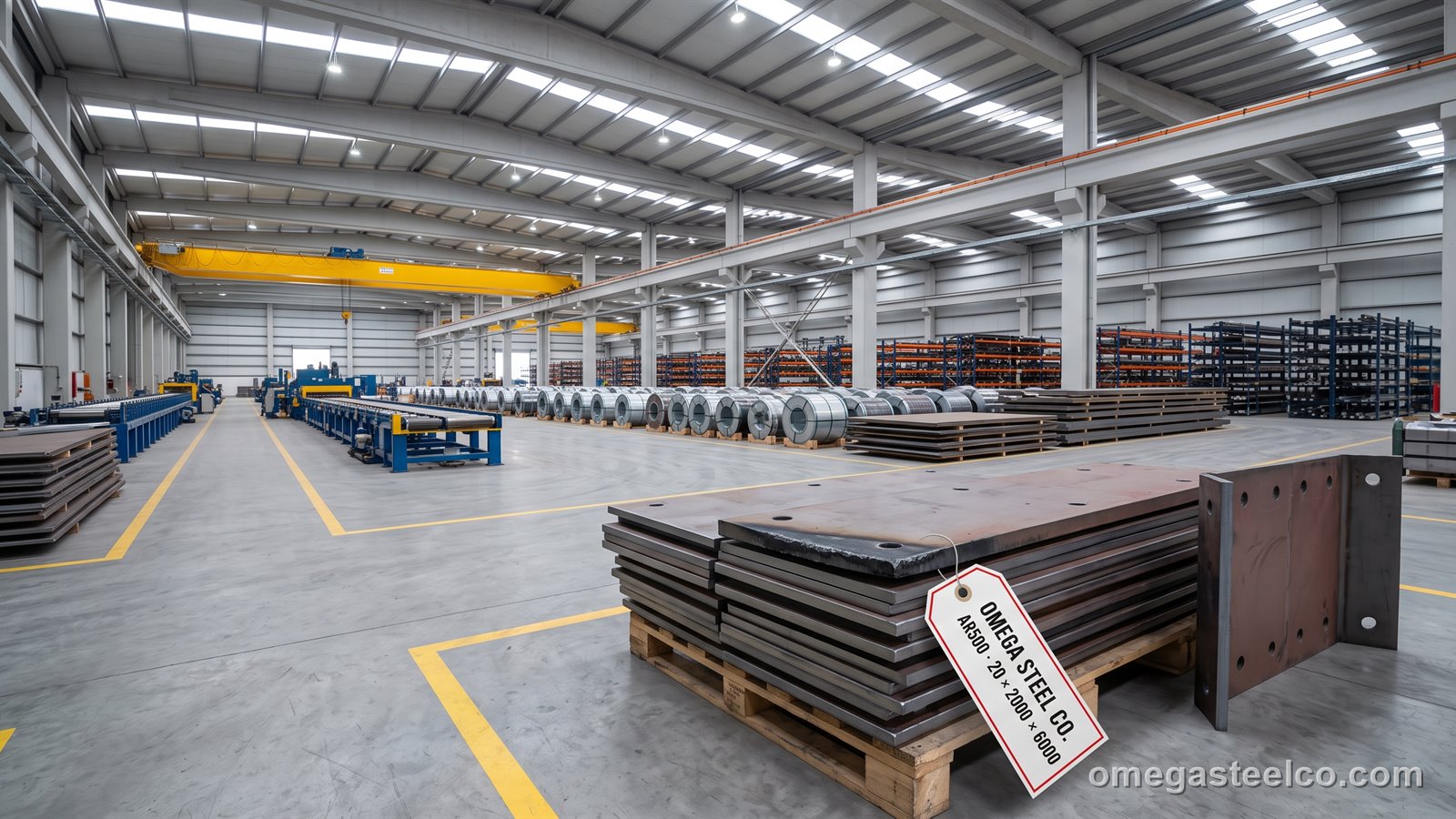
What is AR500 wear plate?
AR500 is a quenched-and-tempered plate hardened to a nominal 500 HB (mills guarantee 470–530, some to 540) with a carbon content around 0.30 % and chromium–molybdenum–boron alloying that hardens the full thickness up to 40 mm and more. At that hardness the plate resists sliding abrasion about 30 % better than AR400 and stands up to hard, sharp minerals — granite, basalt, sinter, clinker, slag — that gouge softer plate. What it gives up is ductility: elongation is around 8 %, cold bending needs an inner radius of 5–6 × t and is best avoided, toughness is lower (typically 25–30 J at −40 °C), and welding without preheat cracks in the heat-affected zone. So AR500 is used as flat or gently curved plate, mostly bolted: crusher and grinding-mill liners, screen decks and grizzly bars, chute and hopper floors, dredge pump housings, cement and sinter plant liners, and the lip and wear strips of buckets where AR400/450 bodies get local reinforcement. Every Q&T mill makes it — Hardox 500 (SSAB), Dillidur 500 V, XAR 500, Raex 500, JFE-EH500, NM500 — and above it come AR550/600 and the ceramic-composite plates for the most extreme service. Hardness falls away above 200–250 °C, which rules out hot service, hot slag and flame straightening.
Chemical composition
| Element | C | Si | Mn | P | S | Cr | Ni | Mo | B |
|---|---|---|---|---|---|---|---|---|---|
| max. % (ladle) | ≤ 0.30 | ≤ 0.70 | ≤ 1.60 | ≤ 0.020 | ≤ 0.010 | ≤ 1.50 | ≤ 1.50 | ≤ 0.60 | ≤ 0.005 |
CEV about 0.50–0.65 → preheat required for welding; check the certificate for the actual analysis of the thickness ordered.
Hardness and mechanical properties
| Property | Requirement | Typical value | Note |
|---|---|---|---|
| Brinell hardness | 470–530 HB | 500 HB | EN ISO 6506-1 |
| Yield strength Rp0.2 | not guaranteed | ≈ 1 300 MPa | |
| Tensile strength Rm | not guaranteed | ≈ 1 550 MPa | |
| Elongation A5 | — | ≈ 8 % | |
| Charpy V | — | ≈ 30 J at −40 °C | longitudinal |
| Max. service temperature | — | 200–250 °C |
Equivalent grades
| System | Grade | Note |
|---|---|---|
| SSAB | Hardox 500 | reference brand |
| Dillinger | Dillidur 500 V | |
| thyssenkrupp | XAR 500 | |
| SSAB Raahe | Raex 500 | |
| JFE | JFE-EH500 | |
| GB/T 24186 | NM500 | Chinese mills |
Relative wear life by hardness class
| Grade | Hardness | Relative life | Cold bending | Welding |
|---|---|---|---|---|
| S355J2 | ≈ 160 HB | 1 | free | free |
| AR400 | 400 HB | 3–4 | 3 × t | no preheat ≤ 20 mm |
| AR450 | 450 HB | 3.5–4.5 | 3.5–4 × t | preheat ≥ 15 mm |
| AR500 | 500 HB | 4.5–5.5 | 5–6 × t (avoid) | preheat always |
| AR550 / 600 | 550–600 HB | 5.5–7 | not recommended | preheat, special |
| Chromium-carbide overlay | 58–62 HRC | 10–20 | no | bolt or stud-weld |
Ratios are for sliding abrasion with mineral particles; under heavy impact the tougher AR400/450 often outlast AR500 because they do not chip.
Thickness range and stock sizes
| Thickness | Widths × lengths | Availability |
|---|---|---|
| 6–12 mm | 2 000 / 2 500 × 6 000 | stock brands |
| 15–25 mm | 2 000 / 2 500 × 6 000 | stock and mill |
| 30–40 mm | 2 000 / 2 500 × 6 000 | mill order 4–8 weeks |
| Cut liners | plasma per DXF, drilled / countersunk on request | from 500 kg |
Weight per m² and per plate
| Thickness | kg/m² | 1 500 × 6 000 (kg) | 2 000 × 6 000 (kg) | 2 500 × 12 000 (kg) |
|---|---|---|---|---|
| 6 mm | 47.1 | 424 | 565 | 1 413 |
| 8 mm | 62.8 | 565 | 754 | 1 884 |
| 10 mm | 78.5 | 707 | 942 | 2 355 |
| 12 mm | 94.2 | 848 | 1 130 | 2 826 |
| 15 mm | 117.8 | 1 060 | 1 413 | 3 533 |
| 20 mm | 157.0 | 1 413 | 1 884 | 4 710 |
| 25 mm | 196.3 | 1 766 | 2 355 | 5 888 |
| 30 mm | 235.5 | 2 120 | 2 826 | 7 065 |
| 40 mm | 314.0 | 2 826 | 3 768 | 9 420 |
Nominal weights — mill tolerance to EN 10029 class A adds up to +4 % on thin plate; invoiced on theoretical weight unless agreed otherwise.
Cutting, welding and fixing
Plasma-cut with the plate at ≥ 20 °C; for oxy-fuel or thickness above 20 mm preheat to 150–200 °C and cool slowly under cover — cut edges are hard and prone to cracking. Weld only with low-hydrogen processes and soft austenitic (307/309) or low-alloy consumables, preheat 150–175 °C at all thicknesses, interpass ≤ 200 °C, and keep welds short and away from the wear face; plug welds and stud-welded bolts are the standard fixing for liners. Cold bending is possible above 5 × t but chipping risk is high — order pre-formed parts from the mill for curved liners. Countersunk holes are cut by plasma or drilled with carbide at low speed.
Where it is used
- Crusher, grinding-mill and screen liners
- Chute, hopper, cyclone and silo wear floors
- Cement, sinter and pellet plant liners
- Dredge, slurry pump and pipeline wear parts
- Bucket lips, wear strips and cutting edges
- Shredder and recycling plant wear parts
AR500 vs AR450 vs AR400
AR400 and AR450 are the grades for anything that is formed, welded extensively or takes impact; AR500 is for flat, bolted, sliding-abrasion service where every extra week of life counts. For load-bearing parts that also wear, S690QL at 690 MPa guaranteed yield is the structural alternative.
Price
AR500 is quoted per plate or per cut part rather than from a list band; brand, thickness and tonnage set the price, which follows the European Q&T plate lists. A firm offer comes back within a working day of receiving the size list.
Bands from our weekly export list (September 2026), FOB Istanbul, full-container quantities, excluding freight and certificates. Firm price per project on RFQ within one working day.
Export and packing
Export packing of AR500 wear plate is by skid: up to 5 t per pack, steel straps, corner boards, stencilled heat numbers and a pack list that references the 3.1 certificates. One 40' HC carries 24–25 t of 6 m plate; short plate goes 20 t to a 20'. Long and heavy plate is shipped flat-rack or breakbulk via Derince. HS code 7208.51 / 7208.52.
| Term | Detail |
|---|---|
| MOQ | 1 plate (cut parts from 500 kg) |
| Incoterms | FOB Istanbul · CIF / CFR Gulf, Africa · DAP EU, Balkans, Iraq, Caucasus · DAP Aktau |
| Lead time | Stock 3–7 working days; mill order 4–8 weeks |
| Packing | Plates on bearers, banded, stencilled; cut parts palletised |
| Container / truck | 20' ≈ 20 t; 40' HC ≈ 24 t of 6 m plate |
| Documents | Invoice, packing list, EN 10204 3.1 (3.2 on request), certificate of origin; SASO / SONCAP / PVoC on request |
| Payment | 30% advance, balance against B/L copy; L/C at sight for orders above 100 t |
Certificates and testing
AR500 wear plate ships with EN 10204 3.1 certificates cross-referenced to the stencilled heat numbers. Where the project requires it we arrange 3.2 certification with Lloyd's, BV, TÜV or SGS, ultrasonic examination to EN 10160 and Charpy testing at the temperature you specify.
How to order
Specify AR500 (or brand), thickness × width × length or DXF (with hole pattern for liners), quantity, and whether any bending or welding is planned; certificate 3.1 standard.
Standards
- Mill specifications (Hardox 500, Dillidur 500 V, XAR 500, Raex 500, NM500)
- EN ISO 6506-1
- EN 10029
- EN 10204 3.1
Grades
Grade data sheets (chemistry, mechanicals, equivalents) are on our reference site: AR500 · AR450 · AR400
Frequently asked questions
What is AR500 steel?
Quenched-and-tempered abrasion-resistant plate with 470–530 HB hardness (nominal 500) — about 30 % more wear life than AR400, used for liners and fixed wear parts.
Can AR500 be welded?
Yes, but only with low-hydrogen processes, soft or austenitic consumables and 150–175 °C preheat at every thickness; welds are kept short and away from the wear face.
Can AR500 be bent?
Only at 5–6 × thickness and with a real risk of chipping; for curved parts order mill-formed segments or use AR450.
Is AR500 the same as Hardox 500?
Hardox 500 is the SSAB brand of the class; Dillidur 500, XAR 500, Raex 500 and NM500 are equivalents.
Which is better, AR400 or AR500?
AR500 for sliding abrasion on flat, bolted parts; AR400 or AR450 where the part is formed, heavily welded or takes impact — harder plate chips under impact.