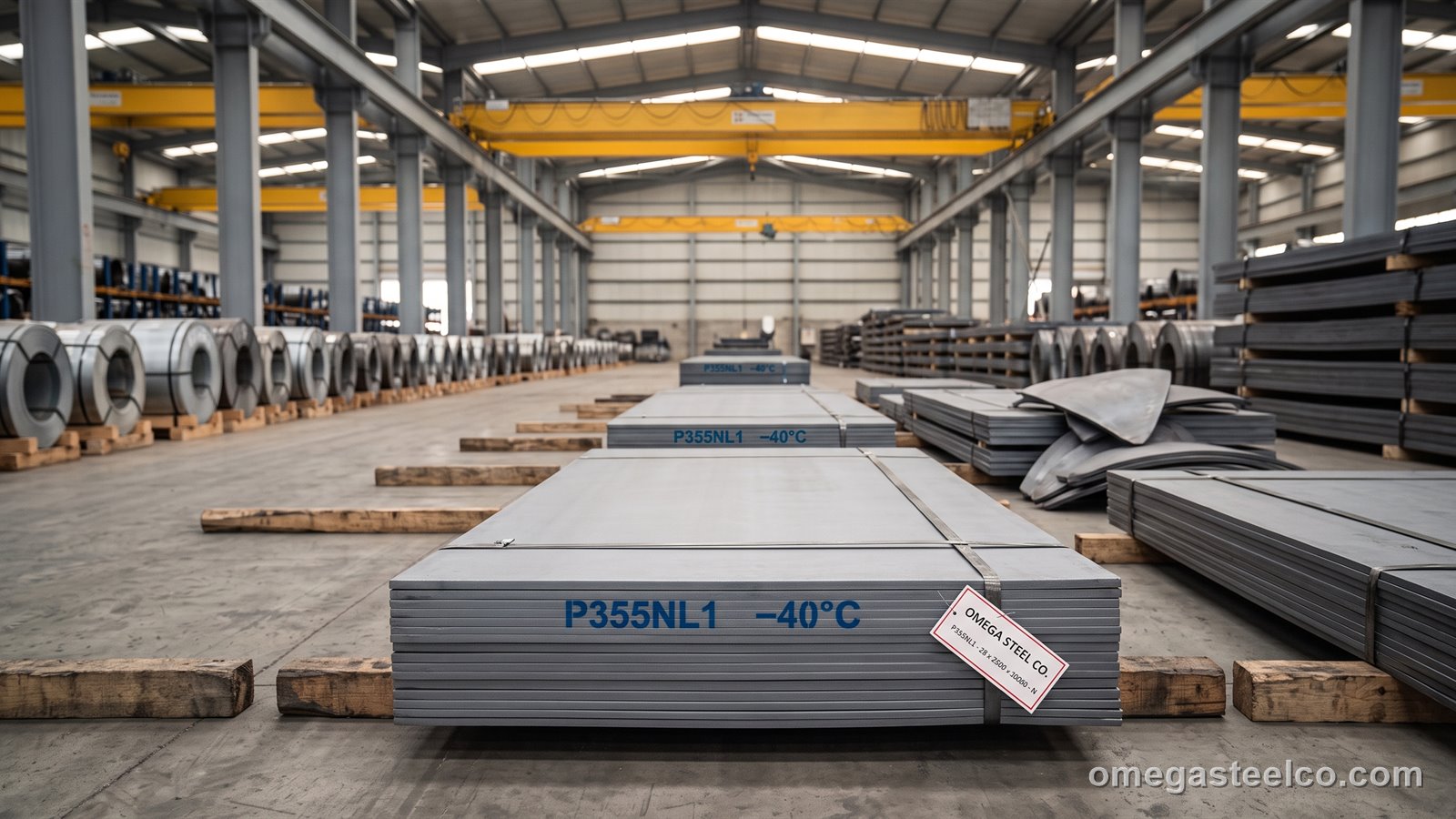
What is P355NL1 steel plate?
EN 10028-3 groups its fine-grain pressure steels by strength (P275, P355, P460) and by toughness class: N (−20 °C), NH (−20 °C with elevated-temperature yield values), NL1 (−40 °C) and NL2 (−50 °C). P355NL1 (1.0566) therefore shares its 355 MPa yield, 490–630 MPa tensile and normalised delivery with P355NH but is made to reach 27 J transverse and 40 J longitudinal at −40 °C: carbon is capped at 0.18 %, sulphur at 0.010 %, the nickel allowance rises to 0.50 % and the niobium-vanadium-titanium grain refinement is set to hold an ASTM 7 or finer grain after normalising. The result is a plate that, unlike a normalised C-Mn steel, keeps its upper-shelf toughness down to the −40 °C design temperature of propane and LPG service (propane boils at −42 °C, and a vessel that could see auto-refrigeration on blowdown is designed to that) without going to a nickel steel. Under the PED and AD 2000 codes P355NL1 is the standard plate for LPG spheres and bullets with MDMT −40 °C, for mounded storage, ammonia and butadiene vessels, and for any process vessel whose site winter minimum sets the MDMT — Kazakh and Uzbek gas plants, Balkan LPG terminals, Iraqi and Caucasus refineries at altitude. It also serves as a structural plate for cold-climate crane and mining equipment where a certified −40 °C fine-grain steel is wanted with pressure-code paperwork.
Chemical composition
| Element | C | Si | Mn | P | S | Al | Nb | V | Ti | Ni | Cr | Mo | Cu | N |
|---|---|---|---|---|---|---|---|---|---|---|---|---|---|---|
| max. % (ladle) | ≤ 0.18 | ≤ 0.50 | 1.10–1.70 | ≤ 0.025 | ≤ 0.010 | ≥ 0.020 | ≤ 0.05 | ≤ 0.10 | ≤ 0.03 | ≤ 0.50 | ≤ 0.30 | ≤ 0.08 | ≤ 0.30 | ≤ 0.020 |
Nb + Ti + V ≤ 0.12 %. Mills typically run C 0.12–0.15 %, S ≤ 0.005 % for NL1. CEV ≤ 0.43.
Mechanical properties
| Thickness | Yield ReH min (MPa) | Tensile Rm (MPa) | Elongation A min | Impact KV |
|---|---|---|---|---|
| ≤ 16 mm | 355 | 490–630 | 22 % | 27 J trans. / 40 J long. at −40 °C |
| > 16–40 mm | 345 | 490–630 | 22 % | 27 / 40 J at −40 °C |
| > 40–60 mm | 335 | 490–630 | 22 % | 27 / 40 J at −40 °C |
| > 60–100 mm | 325 | 480–620 | 21 % | 27 / 40 J at −40 °C |
| Elevated temperature | — | — | — | Rp0.2 at 50–400 °C as for P355NH on request |
Equivalent grades
| System | Grade | Note |
|---|---|---|
| DIN 17102 | TStE 355 | direct predecessor |
| EN 10028-3 | P355NH / P355NL2 | siblings: −20 / −50 °C |
| ASTM | A537 Cl. 1 (−45 °C option) | normalised C-Mn-Si pressure plate |
| ASTM | A516 Gr. 70 normalised + impact | commonly substituted under ASME |
| EN 10025-3 | S355NL | structural −50 °C, no pressure certification |
| GOST 5520 | 09G2S (approx.) | CIS low-temperature vessel steel |
Design temperature and grade choice
| MDMT | Grade | Impact test | Typical service |
|---|---|---|---|
| ≥ −20 °C | P355N / P355NH | 40 J at −20 °C | steam drums, air receivers, ambient LPG in temperate climates |
| −20 to −40 °C | P355NL1 | 27 J at −40 °C | propane / LPG spheres and bullets, mounded storage, continental winters |
| −40 to −50 °C | P355NL2 | 27 J at −50 °C | refrigerated LPG, Siberian and Arctic sites |
| below −50 °C | nickel steels (X8Ni9, 5 % Ni) / austenitic | — | LNG, ethylene, LPG at −60 °C |
Impact values are minimum transverse at the stated temperature per EN 10028-3 Table 5; longitudinal values are higher. The pressure code (PED / AD 2000 / ASME VIII) and the design MDMT govern the choice.
Thickness range and stock sizes
| Thickness | Widths × lengths | Availability |
|---|---|---|
| 6–12 mm | 2 000 / 2 500 × 6 000–12 000 | to order 4–6 weeks |
| 15–40 mm | 2 500 / 3 000 × 6 000–12 000 | to order 4–6 weeks; sphere petals cut to drawing |
| 50–100 mm | 2 500 × 6 000–10 000 | to order 6–7 weeks; UT S1/E1 |
| Head blanks | circles to Ø 4 000 mm | plasma-cut, bevelled |
Weight per m² and per plate
| Thickness | kg/m² | 1 500 × 6 000 (kg) | 2 000 × 6 000 (kg) | 2 500 × 12 000 (kg) |
|---|---|---|---|---|
| 6 mm | 47.1 | 424 | 565 | 1 413 |
| 8 mm | 62.8 | 565 | 754 | 1 884 |
| 10 mm | 78.5 | 707 | 942 | 2 355 |
| 12 mm | 94.2 | 848 | 1 130 | 2 826 |
| 15 mm | 117.8 | 1 060 | 1 413 | 3 533 |
| 20 mm | 157.0 | 1 413 | 1 884 | 4 710 |
| 25 mm | 196.3 | 1 766 | 2 355 | 5 888 |
| 30 mm | 235.5 | 2 120 | 2 826 | 7 065 |
| 40 mm | 314.0 | 2 826 | 3 768 | 9 420 |
| 50 mm | 392.5 | 3 533 | 4 710 | 11 775 |
| 60 mm | 471.0 | 4 239 | 5 652 | 14 130 |
| 80 mm | 628.0 | 5 652 | 7 536 | 18 840 |
| 100 mm | 785.0 | 7 065 | 9 420 | 23 550 |
Nominal weights — mill tolerance to EN 10029 class A adds up to +4 % on thin plate; invoiced on theoretical weight unless agreed otherwise.
Welding, cutting and forming
Qualified procedures with basic low-hydrogen consumables giving 27 J at −40 °C in weld and HAZ (E42 5 / G42 5 class or better, nickel-bearing wires for thick sections); preheat 75 °C above 25 mm and 100–125 °C above 40 mm; interpass ≤ 200 °C; heat input 1.0–3.0 kJ/mm to keep the fine grain. Post-weld heat treatment 550–600 °C where the code requires it — P355NL1 tolerates PWHT without loss of toughness. Cold forming of sphere petals and heads is normal; hot forming above 950 °C requires re-normalising.
Where it is used
- LPG and propane spheres, bullets and mounded vessels (MDMT −40 °C)
- Refrigerated ammonia and butadiene storage
- Process vessels and columns in Kazakhstan, Uzbekistan, the Balkans and the Caucasus
- Cold-climate crane, mining and rail equipment needing certified −40 °C plate
- Heads, nozzles and skirts of low-temperature vessels
P355NL1 vs P355NH vs P355NL2
P355NH is the −20 °C grade with elevated-temperature yield values — cheaper and stocked more widely, sufficient for temperate LPG service. P355NL1 adds the −40 °C guarantee for propane and continental winters at a modest premium; P355NL2 (−50 °C) is the step for refrigerated LPG and Siberian sites. For the same −40 °C without pressure certification the structural S355NL is the cheaper plate; for 460 MPa at −20 °C see P460NH.
Price
P355NL1 is priced about 300 USD/t over the S235JR base as an imported low-temperature fine-grain pressure plate — roughly 50 USD/t above P355NH; UT, Z-quality and 3.2 inspection are added per ton. Indicative FOB Istanbul band below; firm price per plate list within a working day.
Bands from our weekly export list (September 2026), FOB Istanbul, full-container quantities, excluding freight and certificates. Firm price per project on RFQ within one working day.
Export and packing
P355NL1 steel plate leaves Dilovası on timber skids in packs of up to 5 t, steel-strapped with corner protectors and the heat number stencilled on every plate. One 40' HC carries 24–25 t of 6 m plate; short plate goes 20 t to a 20'. 12 m and heavy plate go by flat-rack or breakbulk from Derince port. Customs code 7208.51 / 7208.52.
| Term | Detail |
|---|---|
| MOQ | 20 t (mill lot) |
| Incoterms | FOB Istanbul · CIF / CFR Gulf, Africa · DAP EU, Balkans, Iraq, Caucasus · DAP Aktau |
| Lead time | To order 4–7 weeks (EU / Turkish mill programme) |
| Packing | Loose on bearers or skids ≤ 5 t, strapped, heat numbers stencilled |
| Container / truck | ≤ 6 m: 40' HC 24–25 t; 8–12 m flat-rack / breakbulk |
| Documents | Invoice, packing list, EN 10204 3.1 (3.2 on request), certificate of origin; SASO / SONCAP / PVoC on request |
| Payment | 30% advance, balance against B/L copy; L/C at sight for orders above 100 t |
Certificates and testing
P355NL1 steel plate ships with EN 10204 3.1 certificates cross-referenced to the stencilled heat numbers. Where the project requires it we arrange 3.2 certification with Lloyd's, BV, TÜV or SGS, ultrasonic examination to EN 10160 and Charpy testing at the temperature you specify.
How to order
Send thickness × width × length or the petal / head drawings, tonnage, MDMT and pressure code, certificate level (3.1 / 3.2 with inspector), UT class, Z-quality and whether PWHT simulation is needed; we return the mill programme date and price within a working day.
Standards
- EN 10028-3:2017 — P355NL1, 1.0566
- PED 2014/68/EU; AD 2000 W1 / W10
- EN 10160 UT; EN 10164 Z15/Z25/Z35
- DIN 17102 — TStE 355 (withdrawn)
Grades
Grade data sheets (chemistry, mechanicals, equivalents) are on our reference site: P355NL1 · P355NH · P355NL2
Frequently asked questions
What is P355NL1 steel?
A normalised, micro-alloyed fine-grain pressure-vessel steel to EN 10028-3 (1.0566) with 355 MPa yield and impact energy guaranteed at −40 °C (27 J transverse), used for LPG and propane spheres, bullets and low-temperature process vessels.
What is the difference between P355NH and P355NL1?
Same strength and delivery condition; NH is impact-tested at −20 °C and carries elevated-temperature yield values, NL1 is tested at −40 °C with tighter carbon and sulphur. NL1 is required when the design temperature is below −20 °C.
Is P355NL1 suitable for propane storage?
Yes — propane boils at −42 °C and LPG vessels with auto-refrigeration cases are designed to −40 °C MDMT, which is exactly the P355NL1 test temperature; it is the standard plate for LPG spheres under PED and AD 2000.
What is the ASTM equivalent of P355NL1?
A537 Class 1 with the −45 °C impact option, or A516 Grade 70 normalised with supplementary low-temperature impact testing; neither is a drop-in replacement without the code review.
Can P355NL1 be post-weld heat treated?
Yes — PWHT at 550–600 °C is common and the grade retains its −40 °C toughness; simulated-PWHT test pieces can be supplied for procedure qualification.