Profile laser cutting — IPE, HEA, UPN, angles and flat bar cut, coped and drilled by laser
A steel profile used to pass through four machines before it was ready to weld: the saw for length, the drill for holes, the notcher or the torch for copes, and a man with a scriber for the layout. The profile laser does all of it from the model in one clamping — a UPN with its four bolt holes and coped ends comes off the machine ready for the fitter, numbered, with no burr and a ±0.2 mm accuracy that turns a bolted frame into a kit. We run the open-profile programme on the same 3D fibre laser that cuts our tubes, feeding 6–12 m bars of IPE, HEA, UPN, UPE, angle, flat and T-bar from our own stock, and ship the parts with the beams, purlins and plates of the same order.
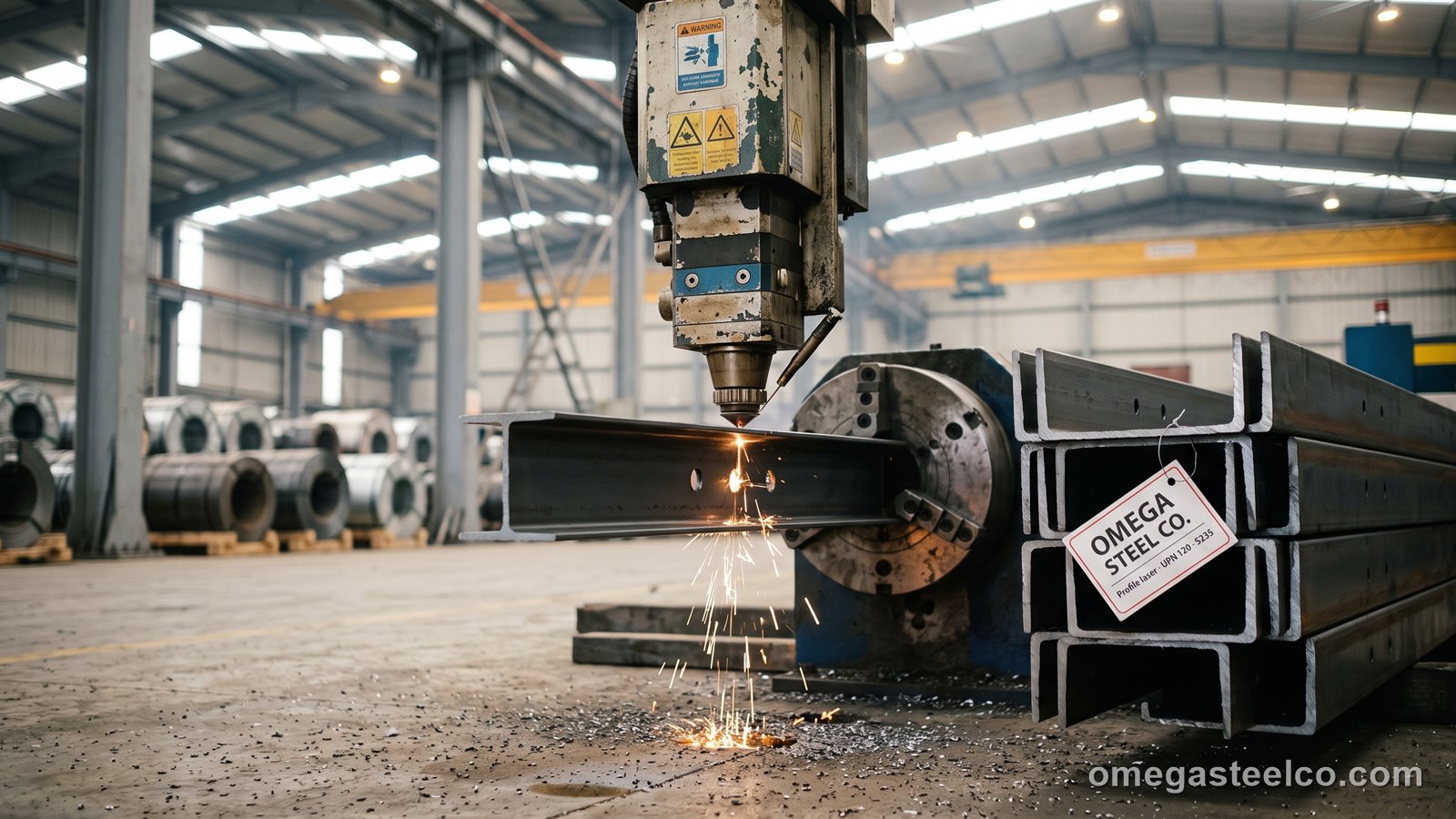
Machine and capacity
3D fibre laser (4 kW, five-axis bevel head) with a chain-type bundle loader for bars up to 12 m and 40 kg/m, four-jaw self-centring chuck accepting any open section that fits a 220 mm circle: IPE 80–200, IPN 80–180, HEA / HEB 100–160 (HEB 200 on request), UPN / UPE 50–200, equal angles 30 × 30 to 150 × 150, unequal angles to 150 × 100, flat bar 20 × 4 to 200 × 20, T-bar to 100. Wall and flange thickness to 12 mm in carbon steel, 8 mm in stainless, 6 mm in aluminium. Cutting length to 12 000 mm, remnant under 100 mm. The head cuts all four faces of a section, bevels to 45° for weld preparation and engraves part numbers; the software imports IFC, STEP, DSTV / NC1 and DXF from Tekla, Advance Steel, SolidWorks and Inventor, nests parts along the bar and outputs the cutting list and bar requirement.
What the profile laser does
| Operation | Detail | Replaces | Typical part |
|---|---|---|---|
| Cut to length | ±0.2 mm, square, mitred or compound-angle ends | band saw | purlins, rafters, posts |
| Holes | round Ø 5–80 mm, in web and flanges, ±0.15 mm position | drilling line, magnetic drill | bolted connections, base plates |
| Slots and oblongs | any length, for adjustment or cable | punch, milling | purlin cleats, brackets |
| Copes and notches | flange cut-backs and web notches for beam-to-beam joints | oxy-torch, grinder | secondary beams, channels into columns |
| Mitres | single and double, 3D-compensated across the flange | saw + grinder | portal-frame rafters, frames |
| Bevelled ends | to 45° on flange and web | chamfering machine | full-penetration welds |
| Contour cuts and windows | any shape on any face | plasma hand-cutting | service openings, lugs |
| Marking | engraved part number, orientation, assembly mark | stencil / scriber | every part in a kit |
Because all faces are cut in one clamping, hole patterns on flange and web are aligned to each other to ±0.15 mm — a bolted frame assembles without reaming.
Profile laser vs beam drilling line vs saw and torch
| Profile laser | Beam drill + saw line | Saw + torch + mag drill | |
|---|---|---|---|
| Section size | to 220 mm circle | to HEB 1 000+ | any |
| Holes | laser, any shape, ±0.15 mm | drilled, round, ±0.5 mm | drilled, ±1–2 mm |
| Copes / notches | clean laser cut | separate coping robot or torch | torch + grinding |
| Setup per part type | none — from model | tool change | manual layout |
| Batch economics | from 1 piece | from 20–50 pieces | from 1 piece, slow |
| Accuracy of the kit | bolts without reaming | good | site fitting |
| Best for | IPE–HEB 200, purlins, channels, angles, kits | heavy beams above HEB 200 | one-off repair |
Sections above the laser's 220 mm circle — HEB 220 to 600, IPE 240 to 600 — go to our drilling and sawing line and to plasma for copes; ask for the combined kit.
Materials and stock
All open sections from our own stock in S235JR and S355J2 — IPE, HEA, HEB, UPN, UPE, equal and unequal angles, flat bar — plus galvanized angles and flats, stainless 304 / 316L angle and flat bar, and aluminium 6060 / 6082 profiles. Customer-supplied bars are accepted with a certificate. Galvanized sections cut without damage to the coating beyond the cut edge; parts to be galvanized after cutting get vent and drain holes in the same programme.
Design, files and kits
- Send the 3D model (IFC, STEP, Tekla / Advance Steel NC1) or per-part DXF with a section callout; we nest and return the bar list
- Keep holes ≥ 1.2 × thickness from a flange edge and ≥ 2 × thickness from a cope
- Copes: leave R ≥ 10 mm at the root — the laser cuts it, the weld likes it
- Mitres above 60° on heavy flanges may need a two-pass cut — we advise from the model
- Engraved marks are placed on a face that stays visible after assembly
- Kits are bundled per assembly with a pick list; bolts and cleats can be added from stock
Where it is used
- Purlin, rail and cleat kits for steel buildings and canopies
- Bolted mezzanine, platform and staircase frames
- Machine bases, conveyor frames and support structures
- Handrail posts and balustrade frames in flat and angle
- Solar mounting structures and cable trays (galvanized angle and channel)
- Trailer, body-builder and agricultural frames
- Facade and curtain-wall sub-frames in angle and T
Pricing and lead time
Priced per part from the model: cutting time (about 1–3 minutes for a channel with holes and copes), material from stock at the section price per ton, and a small programming charge per drawing set waived above 50 parts. A UPN 120 purlin 2 m with four holes and two copes typically costs 15–25 % more than the bare bar; a full purlin kit is usually cheaper than sawn-and-drilled parts once the site fitting is counted. Lead time 3–7 working days from approved nesting; kits ship with the rest of the steel order.
Frequently asked questions
Which profiles can be laser cut?
Any open section within a 220 mm circle: IPE / IPN to 200, HEA / HEB to 160 (200 on request), UPN / UPE to 200, angles to 150, flat bar to 200 × 20, T-bar to 100; wall to 12 mm carbon, 8 mm stainless, 6 mm aluminium.
What is the difference between tube laser and profile laser cutting?
The same 3D machine; tube laser cutting handles closed hollow sections and pipe, profile laser cutting handles open sections — beams, channels, angles, flats — where the head cuts flanges and web in one clamping.
How accurate are laser-cut holes in a beam?
±0.15 mm in position and ±0.1 mm in diameter, aligned between flange and web — bolted frames assemble without reaming.
Can you cut copes and mitres on IPE and UPN?
Yes — flange cut-backs, web notches, single and compound mitres and 45° bevels are cut from the model, replacing torch and grinder.
What files do you need?
A 3D model (IFC, STEP) or Tekla / Advance Steel NC1 / DSTV files; per-part DXF with a section callout also works. We return the nesting and bar list for approval.
Do you cut heavier beams than HEB 200?
Above the laser envelope (HEB 220–600, IPE 240–600) we use the beam drilling and sawing line with plasma copes and combine both in one kit.