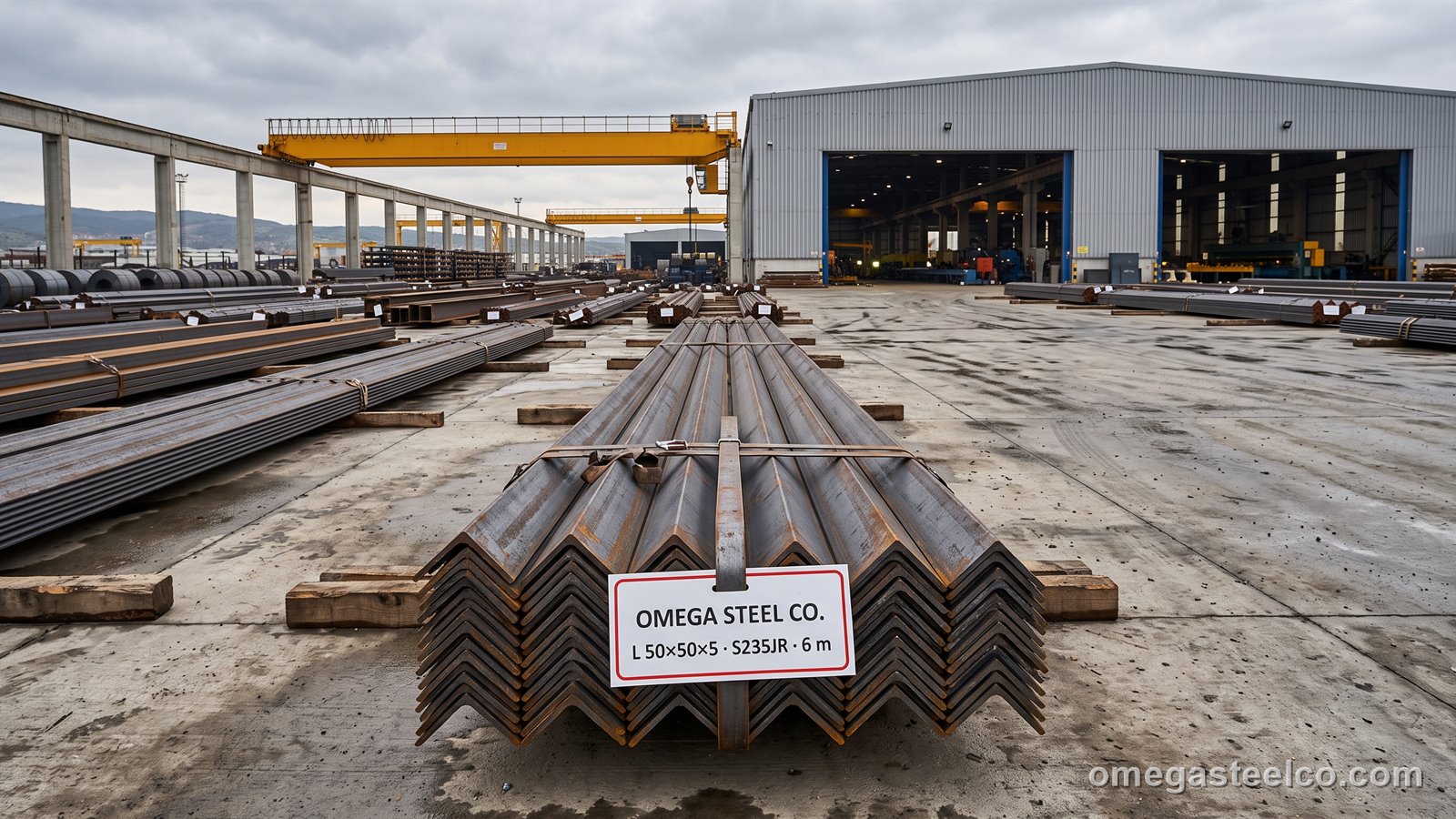
What is Equal angles?
An equal angle is an L-shaped hot-rolled bar with two legs of the same length and thickness meeting at a rounded root (EN 10056-1); it is described as leg × leg × thickness, so "50×50×5" is a 50 mm angle 5 mm thick weighing 3.77 kg/m. The section is the simplest way to connect, stiffen or brace: it bolts flat to a plate or a flange on one leg while the other leg projects, it nests for shipping, and pairs of angles back-to-back make a tee or a light column. Lattice towers for power and telecom lines are built almost entirely of angles (typically S355J2, 12 m, hot-dip galvanized); tank shells are stiffened with curved angles; racks, ladders, frames, machine guards, lintels, edge trims and countless cleats are cut from the 25–75 mm sizes. Turkish mills roll 20×20 to 200×200 with the common thicknesses; wider leg ranges and odd thicknesses are imported. Standard grade S235JR; S275JR and S355J2 to order, ASTM A36 on request. Equal angles are also called angle iron, angle bar, L-profile or L-section; Turkish köşebent, Arabic zawiya.
Equal angle sizes and weight per metre
| Size (mm) | Leg a (mm) | Thickness t (mm) | Root radius r (mm) | kg/m | kg per 12 m | Bars per ton (12 m) |
|---|---|---|---|---|---|---|
| 20 × 20 × 3 | 20 | 3 | 3.5 | 0.88 | 11 | 95 |
| 25 × 25 × 3 | 25 | 3 | 3.5 | 1.12 | 13 | 74 |
| 25 × 25 × 4 | 25 | 4 | 3.5 | 1.45 | 17 | 57 |
| 30 × 30 × 3 | 30 | 3 | 5 | 1.36 | 16 | 61 |
| 30 × 30 × 4 | 30 | 4 | 5 | 1.78 | 21 | 47 |
| 35 × 35 × 4 | 35 | 4 | 5 | 2.09 | 25 | 40 |
| 40 × 40 × 4 | 40 | 4 | 6 | 2.42 | 29 | 34 |
| 40 × 40 × 5 | 40 | 5 | 6 | 2.97 | 36 | 28 |
| 45 × 45 × 4.5 | 45 | 4.5 | 7 | 3.06 | 37 | 27 |
| 50 × 50 × 4 | 50 | 4 | 7 | 3.06 | 37 | 27 |
| 50 × 50 × 5 | 50 | 5 | 7 | 3.77 | 45 | 22 |
| 50 × 50 × 6 | 50 | 6 | 7 | 4.47 | 54 | 19 |
| 60 × 60 × 5 | 60 | 5 | 8 | 4.57 | 55 | 18 |
| 60 × 60 × 6 | 60 | 6 | 8 | 5.42 | 65 | 15 |
| 60 × 60 × 8 | 60 | 8 | 8 | 7.09 | 85 | 12 |
| 65 × 65 × 6 | 65 | 6 | 9 | 5.91 | 71 | 14 |
| 70 × 70 × 6 | 70 | 6 | 9 | 6.38 | 77 | 13 |
| 70 × 70 × 7 | 70 | 7 | 9 | 7.38 | 89 | 11 |
| 75 × 75 × 6 | 75 | 6 | 9 | 6.85 | 82 | 12 |
| 75 × 75 × 8 | 75 | 8 | 9 | 8.99 | 108 | 9 |
| 80 × 80 × 8 | 80 | 8 | 10 | 9.63 | 116 | 9 |
| 80 × 80 × 10 | 80 | 10 | 10 | 11.9 | 143 | 7 |
| 90 × 90 × 8 | 90 | 8 | 11 | 10.9 | 131 | 8 |
| 90 × 90 × 9 | 90 | 9 | 11 | 12.2 | 146 | 7 |
| 100 × 100 × 8 | 100 | 8 | 12 | 12.2 | 146 | 7 |
| 100 × 100 × 10 | 100 | 10 | 12 | 15.0 | 180 | 6 |
| 100 × 100 × 12 | 100 | 12 | 12 | 17.8 | 214 | 5 |
| 120 × 120 × 10 | 120 | 10 | 13 | 18.2 | 218 | 5 |
| 120 × 120 × 12 | 120 | 12 | 13 | 21.6 | 259 | 4 |
| 130 × 130 × 12 | 130 | 12 | 14 | 23.6 | 283 | 4 |
| 150 × 150 × 12 | 150 | 12 | 16 | 27.3 | 328 | 3 |
| 150 × 150 × 15 | 150 | 15 | 16 | 33.8 | 406 | 2 |
| 160 × 160 × 15 | 160 | 15 | 17 | 36.2 | 434 | 2 |
| 180 × 180 × 16 | 180 | 16 | 18 | 43.5 | 522 | 2 |
| 200 × 200 × 16 | 200 | 16 | 18 | 48.5 | 582 | 2 |
| 200 × 200 × 20 | 200 | 20 | 18 | 59.9 | 719 | 1 |
Tolerances EN 10056-2: leg length ±1–3 mm, thickness ±0.5–1.5 mm, mass ±6 %. Intermediate thicknesses (e.g. 50×50×4, 60×60×8) on request.
Grades and standards
| Grade | Yield (MPa) | Impact | Use |
|---|---|---|---|
| S235JR | 235 | 27 J at +20 °C | the stock grade for channels, angles and flats |
| S275JR | 275 | 27 J at +20 °C | to order |
| S355J2 | 355 | 27 J at −20 °C | heavy or cold-climate structures, to order |
| A36 / A572 Gr. 50 | 250 / 345 | on order | ASTM projects |
Certified to EN 10025-2, CE-marked under EN 10025-1; S235JR is the stocked grade — sections are mostly governed by stiffness and connection geometry, so the higher grades are ordered only where the design demands them.
Lengths, tolerances and stock
Lengths 6 and 12 m (+100/−0). Dilovası stock covers 25×25×3 to 150×150×15 in S235JR in the thicknesses listed; 160–200 mm and S355J2 from the mill programme in 1–3 weeks. EN 10056-2 tolerances: leg ±1 mm (≤ 50), ±2 mm (to 100), ±3 mm (to 200); thickness ±0.5 to ±1.5 mm; out-of-square ≤ 1 %; straightness ≤ 0.4 % of length (≤ 0.2 % on request); mass ±6 %. Cut lengths ±3 mm.
Cutting, drilling and galvanizing
Cut on band saws and angle shears, punched on our CNC angle line (holes to Ø 26 mm in legs up to 12 mm, stamped part numbers for tower kits), drilled, notched and mitred, bent into rings for tank stiffeners, hot-dip galvanized to EN ISO 1461 (the standard finish for towers and outdoor structures) or blast-and-primed.
Where it is used
- Lattice transmission and telecom towers (S355J2, galvanized)
- Bracing, cleats and connection angles in steel buildings
- Tank shell stiffeners, curb angles and wind girders
- Racks, shelving, ladders, cages and machine guards
- Lintels, corner protection and edge trims in masonry
- Trailer, body and equipment frames
Equal vs unequal angles
Equal angles bolt symmetrically and are the default for bracing, cleats and towers. Unequal angles (unequal angle bar) put the long leg where bending is resisted and the short leg where the connection is — lintels, purlin cleats, stair stringers — and give more stiffness per kilogram in one direction. If both legs do the same job, equal; if one leg carries and the other connects, unequal. For the full range see steel angle bar.
Price
Angles are priced per ton with hollow sections and channels; the bands below split the light stock sizes (25–100 mm) from the heavy range. Punching, galvanizing and tower kitting are quoted per ton or per piece.
Bands from our weekly export list (September 2026), FOB Istanbul, full-container quantities, excluding freight and certificates. Firm price per project on RFQ within one working day.
Export and packing
We pack Equal angles in strapped bundles of one size and one length (about 1–2 t per bundle for 6 m, 2–3 t for 12 m), tagged with size, grade and heat. 6 m bundles fill a 40' HC at 24–25 t; 12 m bundles are shipped on flat-racks or breakbulk from Derince. Tariff 7216.
| Term | Detail |
|---|---|
| MOQ | 5 t (mixed sizes accepted) |
| Incoterms | FOB Istanbul · CIF / CFR Gulf, Africa · DAP EU, Balkans, Iraq, Caucasus · DAP Aktau |
| Lead time | Stock 25–150 mm: 3–7 working days; 160–200 mm and S355 1–3 weeks |
| Packing | Bundles 1–2 t, strapped, tagged |
| Container / truck | 40' HC ≈ 24–25 t of 6 m; 12 m flat-rack |
| Documents | Invoice, packing list, EN 10204 3.1, CE DoP, certificate of origin; SASO / SONCAP / PVoC on request |
| Payment | 30% advance, balance against B/L copy; L/C at sight above 100 t |
Certificates
Documentation for Equal angles: EN 10204 3.1 mill certificate per heat, CE marking (EN 10025-1), dimensional tolerances to the section standard; third-party 3.2 witnessing on request.
How to order
Send size (a × a × t), grade, length or cut list, quantity in pieces or tons, punching pattern if any and coating; a tower bill of materials in Excel is enough for a full quote.
Standards
- EN 10056-1 — dimensions (equal and unequal angles)
- EN 10056-2 — tolerances
- EN 10025-2 — S235JR, S275JR, S355J2
- EN 10025-1 — CE marking
Grades
Grade data sheets (chemistry, mechanicals, equivalents) are on our reference site: S235JR · S355J2 · S275JR
Frequently asked questions
What is angle bar?
A hot-rolled L-shaped steel section with two legs at 90°, equal (both legs the same) or unequal, to EN 10056-1 — also called angle iron, L-profile or L-section.
What are standard angle bar sizes?
Equal angles run from 20×20×3 to 200×200×20 mm; the most-used stock sizes are 40×40×4, 50×50×5, 60×60×6, 75×75×8 and 100×100×10, in 6 and 12 m.
How much does a 50×50×5 angle weigh?
3.77 kg/m — 22.6 kg per 6 m bar; 100×100×10 is 15.0 kg/m and 75×75×8 is 8.99 kg/m.
What is the difference between angle bar and tubular section?
An angle is an open L-section that connects and braces; a tube (SHS/RHS) is a closed section with far better torsional and buckling behaviour for columns and frames. Angles are cheaper per ton and easier to bolt.
Which grade for tower angles?
S355J2 (or S355J0) hot-dip galvanized to EN ISO 1461 is the standard for transmission and telecom towers; S235JR for general framing and bracing.