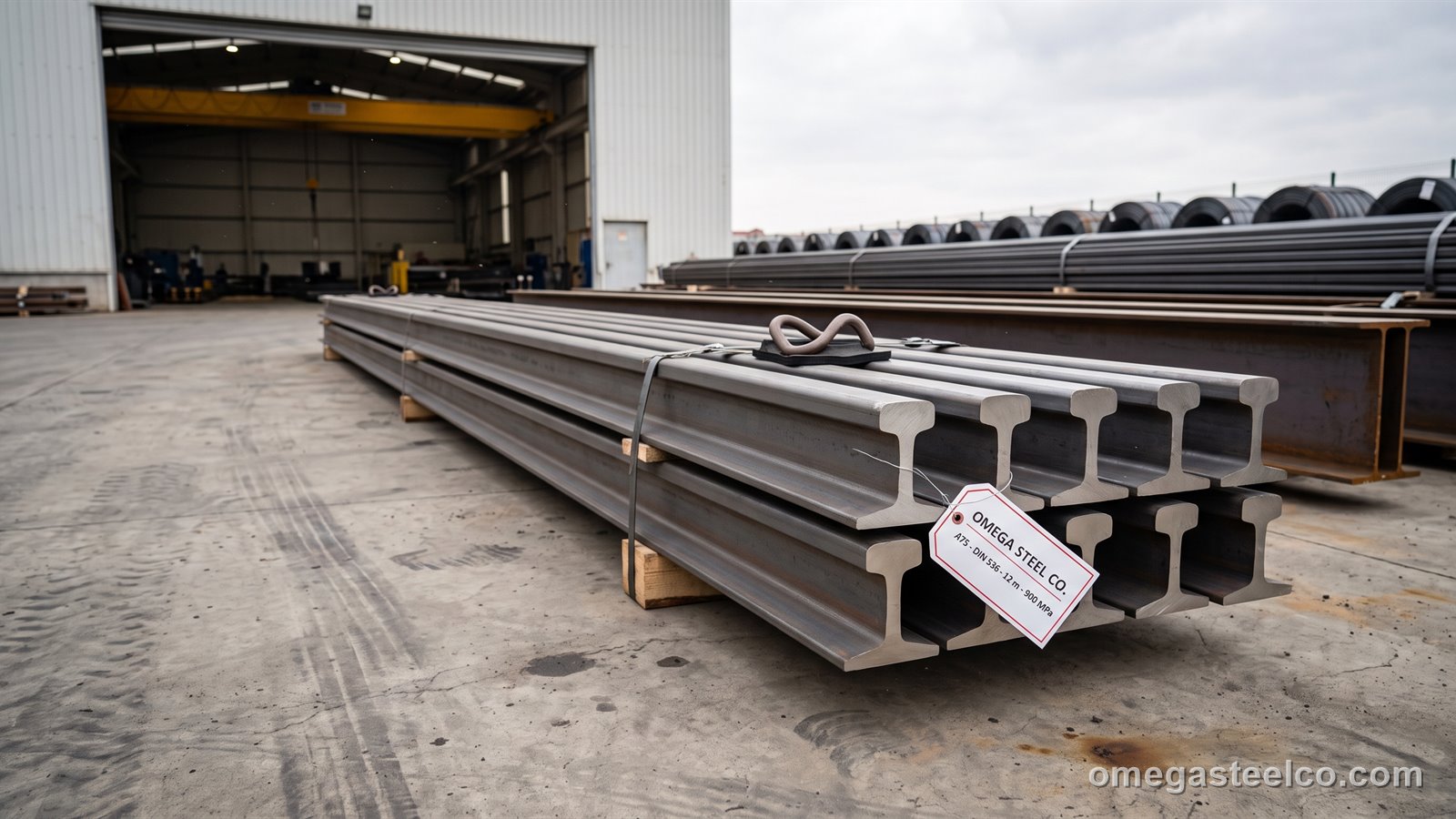
What is Crane rails?
A crane rail is a rolled section designed to do one thing: carry a hard, small wheel with a very high contact stress along a runway thousands of times a day without wearing, spalling or working loose. Its profile therefore has a flat, wide head (45 to 150 mm) of high-carbon steel, a stiff web and a wide foot that sits on a continuous elastomer pad and is held by clips that allow slight lateral adjustment — the DIN 536 A-series, adopted by every European crane maker and by the Gulf and CIS steel, cement and port industries. The rail is selected by wheel load and wheel diameter: A45 and A55 for workshop cranes up to about 10 t wheel load, A65 and A75 for 15–30 t (the most common sizes in steel service centres, precast yards and general industry), A100 for 30–45 t and A120 / A150 for ship-to-shore container cranes, slab-handling cranes and portal cranes with 50–80 t wheel loads. Railway profiles S49 (49E1) and UIC 60 (60E1) serve where the runway is a track — rail-mounted gantry cranes in container yards, stacker-reclaimers, shipyard portal cranes and industrial sidings — or where a cheaper rail with an existing fastening system is acceptable; flat bar S355 (50 × 30 to 100 × 60) covers light monorails and runways at a fraction of the price but wears fast under hard wheels. Rails are supplied in 12 m (6 m for A45–A55 and for container shipment, 15–18 m for terminals), drilled for fishplates or plain-ended for welding, in the 700 or 900 MPa tensile class, with the fastening system — welded-on or bolted soft clips, rigid clips for older designs, 8–10 mm rubber pads, fishplates and end stops — and with thermit or flash-butt welding of the joints to make a continuous runway.
Crane rail dimensions and weight per metre
| Designation | Head width (mm) | Height (mm) | Foot width (mm) | kg/m | kg per 12 m | Bars per ton (12 m) |
|---|---|---|---|---|---|---|
| A45 | 45 | 55 | 125 | 22.1 | 265 | 4 |
| A55 | 55 | 65 | 150 | 31.8 | 382 | 3 |
| A65 | 65 | 75 | 175 | 43.1 | 517 | 2 |
| A75 | 75 | 85 | 200 | 56.2 | 674 | 1 |
| A100 | 100 | 95 | 200 | 74.3 | 892 | 1 |
| A120 | 120 | 105 | 220 | 100.0 | 1 200 | 1 |
| A150 | 150 | 150 | 220 | 150.3 | 1 804 | 1 |
| S49 (49E1) | 67 | 149 | 125 | 49.4 | 593 | 2 |
| UIC 60 (60E1) | 72 | 172 | 150 | 60.2 | 722 | 1 |
DIN 536 A rails have a flat head and a foot equal to about 2.8 × head width, made for clip fastening on a continuous pad; S49 and UIC 60 have the railway head profile and are fixed with baseplates and clips. Tolerances per DIN 536-1 / EN 13674: height ±0.5–1.0 mm, head width ±0.5 mm, length +30/−0 mm.
Grades and standards
| Grade | Yield (MPa) | Impact | Use |
|---|---|---|---|
| Rail steel 700 MPa (DIN 536 / R200 class) | ≈ 400 | not specified | light and medium cranes, workshops |
| Rail steel 900 MPa (R260 class, 0.6–0.8 % C) | ≈ 500 | not specified | the standard crane-rail grade: steel plants, ports, heavy duty |
| R350HT head-hardened | ≈ 700 | not specified | container terminals, high wheel loads, long life |
| S355J2 flat bar rail (50 × 30 – 100 × 60) | 355 | 27 J at −20 °C | light runways, monorails, budget |
| Rail with hardened head (induction) | ≈ 800 head | not specified | special order, high-cycle duty |
DIN 536 rails are supplied in tensile classes 690 and 880 MPa (commonly called 700 / 900); EN 13674 railway rails as R260 (880 MPa) or R350HT (1 175 MPa head-hardened). Chemistry of the 900 class: C 0.60–0.80, Mn 0.80–1.30, Si 0.15–0.60, P/S ≤ 0.025. Certification EN 10204 3.1 with hardness and tensile per rolling.
Lengths, tolerances and stock
Crane rails are mill-programme items: A45–A100 and S49 in 700 / 900 MPa are rolled monthly by European and Turkish mills and delivered in 3–6 weeks in 12 m (A45–A55 also in 6 m); A120 / A150, head-hardened R350HT and lengths of 15–18 m are programmed 6–10 weeks ahead. We hold flat bar S355 runway sizes (50 × 30 to 100 × 60) in stock for immediate delivery. Rails are cut to length with a rail saw (never flame), drilled for fishplate bolts (Ø 24–28 mm) where a bolted joint is wanted, and matched with crane runway beams — HEB, IPE or welded plate girders — from the same order.
Cutting, drilling and galvanizing
Rails are sawn square (±1 mm) and drilled; welded joints are made by thermit (aluminothermic) welding on site with our kits and welders or by flash-butt welding in the works for lengths up to 36 m before shipment; bolted joints use fishplates with 4 or 6 bolts. Fastenings: soft clips (adjustable, welded or bolted to the beam flange, with a continuous 8–10 mm rubber pad — the modern standard, EN 1993-6 friendly), rigid clips and hook bolts for light cranes, and clamp plates on concrete. Head hardening by induction, end stops, buffers and rail-earthing straps are supplied to the crane maker's drawing. Runway alignment tolerances (EN 1993-6 / ISO 12488: ±3 mm gauge, 2 mm per 2 m straightness) are set by the erector; we supply the survey template on request.
Where it is used
- Overhead-crane runways in workshops, service centres and precast yards (A45–A75)
- Steel-plant, foundry and cement-plant cranes with heavy wheel loads (A100–A150)
- Ship-to-shore and rail-mounted gantry cranes in ports and container terminals (A120, A150, UIC 60)
- Portal cranes, stacker-reclaimers and shipyard cranes (S49, UIC 60)
- Rail-mounted machinery, transfer cars and industrial sidings
- Monorails and light runways in S355 flat bar
A-series vs railway rail vs flat bar
DIN 536 A rails are made for clip fastening on a pad and for a flat crane wheel — the correct rail for any runway designed to EN 1993-6 or a crane maker's drawing. Railway rails (S49, UIC 60) are cheaper per tonne and easy to source, have a curved head for conical railway wheels and need baseplate-and-clip or clamp fastening; they are the right choice for rail-mounted gantries and sidings. Flat bar in S355 is the budget runway for light monorails and hoists — no hardened head, so it wears under hard wheels. Runway beams: HEB / HEA; the load capacity of the beams is on the H-beam guide.
Price
Crane rails are quoted per ton or per metre from the mill programme: 700 MPa A-rails sit roughly 40–60 % above the structural-section list per ton, 900 MPa and head-hardened grades higher, S49 / UIC 60 between them; clips, pads, fishplates and welding are priced per set and per joint. Send the profile, grade, length, metres and fastening system for a firm price within two working days.
Bands from our weekly export list (September 2026), FOB Istanbul, full-container quantities, excluding freight and certificates. Firm price per project on RFQ within one working day.
Export and packing
We pack Crane rails in strapped bundles of one size and one length (about 1–2 t per bundle for 6 m, 2–3 t for 12 m), tagged with size, grade and heat. 6 m bundles fill a 40' HC at 24–25 t; 12 m bundles are shipped on flat-racks or breakbulk from Derince. Tariff 7216.
| Term | Detail |
|---|---|
| MOQ | 20 t (one mill lot) or 240 m of one profile |
| Incoterms | FOB Istanbul · CIF / CFR Gulf, Africa · DAP EU, Balkans, Iraq, Caucasus · DAP Aktau |
| Lead time | A45–A100 and S49: 3–6 weeks (mill programme); A120 / A150, 900 MPa and long lengths: 6–10 weeks |
| Packing | Rails bundled 4–8 per bundle on timber bearers, strapped; clips and pads in crates |
| Container / truck | 12 m rails on 40' flat-rack or breakbulk; 6 m in 40' HC ≈ 24 t |
| Documents | Invoice, packing list, EN 10204 3.1, CE DoP, certificate of origin; SASO / SONCAP / PVoC on request |
| Payment | 30% advance, balance against B/L copy; L/C at sight above 100 t |
Certificates
Crane rails comes with the mill certificate EN 10204 3.1 (heat, ladle analysis, tensile, impact where the grade requires it) and the dimensional tolerance statement; 3.2 with an inspector, CE marking under EN 10025-1 and factory production control declarations are available on request.
How to order
Specify the rail (A45–A150 / S49 / UIC 60 or flat bar size), tensile class (700 / 900 / head-hardened), length (6 / 12 / 15–18 m), total metres, ends (plain for welding / drilled for fishplates), fastening system (soft clips, rigid clips, clamps) and pads, welding on site or in works, and the port; a crane runway drawing or the crane maker's rail specification is enough.
Standards
- DIN 536-1 — crane rails, A-series (A45–A150)
- EN 13674-1 — railway rails (49E1 / S49, 60E1 / UIC 60)
- DIN 536-2 / EN 13674 — rail steel grades (R260, R350HT, 700–900 MPa)
- EN 1993-6 — crane supporting structures
- EN 10204 3.1
Grades
Grade data sheets (chemistry, mechanicals, equivalents) are on our reference site: R260 · R350HT · S355J2
Frequently asked questions
What is a crane rail?
A rolled high-carbon steel rail with a flat, wide head and a wide foot (DIN 536 A-series, A45–A150) on which the wheels of overhead, gantry and portal cranes run; it is fixed to the runway beam with clips on a rubber pad and welded or fishplated into a continuous track.
Which crane rail size do I need?
By wheel load: A45 / A55 up to about 10 t per wheel, A65 / A75 for 15–30 t (most industrial cranes), A100 for 30–45 t, A120 / A150 for 50–80 t (container and steel-plant cranes). The crane maker's drawing states the rail.
What is the difference between A75 and A100 crane rail?
Head width 75 vs 100 mm, height 85 vs 95 mm, mass 56.2 vs 74.3 kg/m; A100 takes larger wheels and higher wheel loads (up to about 45 t) and is the usual rail of steel-plant and port cranes.
Can railway rail be used for a crane runway?
Yes for rail-mounted gantries, sidings and where the crane maker allows it — S49 and UIC 60 are common — but their curved head suits conical railway wheels and they need baseplate fastenings; for EN 1993-6 runways the DIN 536 A rail is standard.
How are crane rails joined and fixed?
Joined by thermit or flash-butt welding into a continuous rail (or by fishplates with 4–6 bolts), fixed with soft clips on a continuous rubber pad to the beam flange, or with clamps on concrete; we supply the complete fastening set.
What steel grade are crane rails?
High-carbon rail steel in the 700 or 900 MPa tensile class (DIN 536), or R260 / R350HT head-hardened (EN 13674) for heavy duty; flat-bar runways are S355J2.
What is the price of crane rail per ton?
Roughly 40–60 % above structural sections for 700 MPa A-rails, more for 900 MPa and head-hardened; quoted per programme — send profile, grade and metres for a firm price.