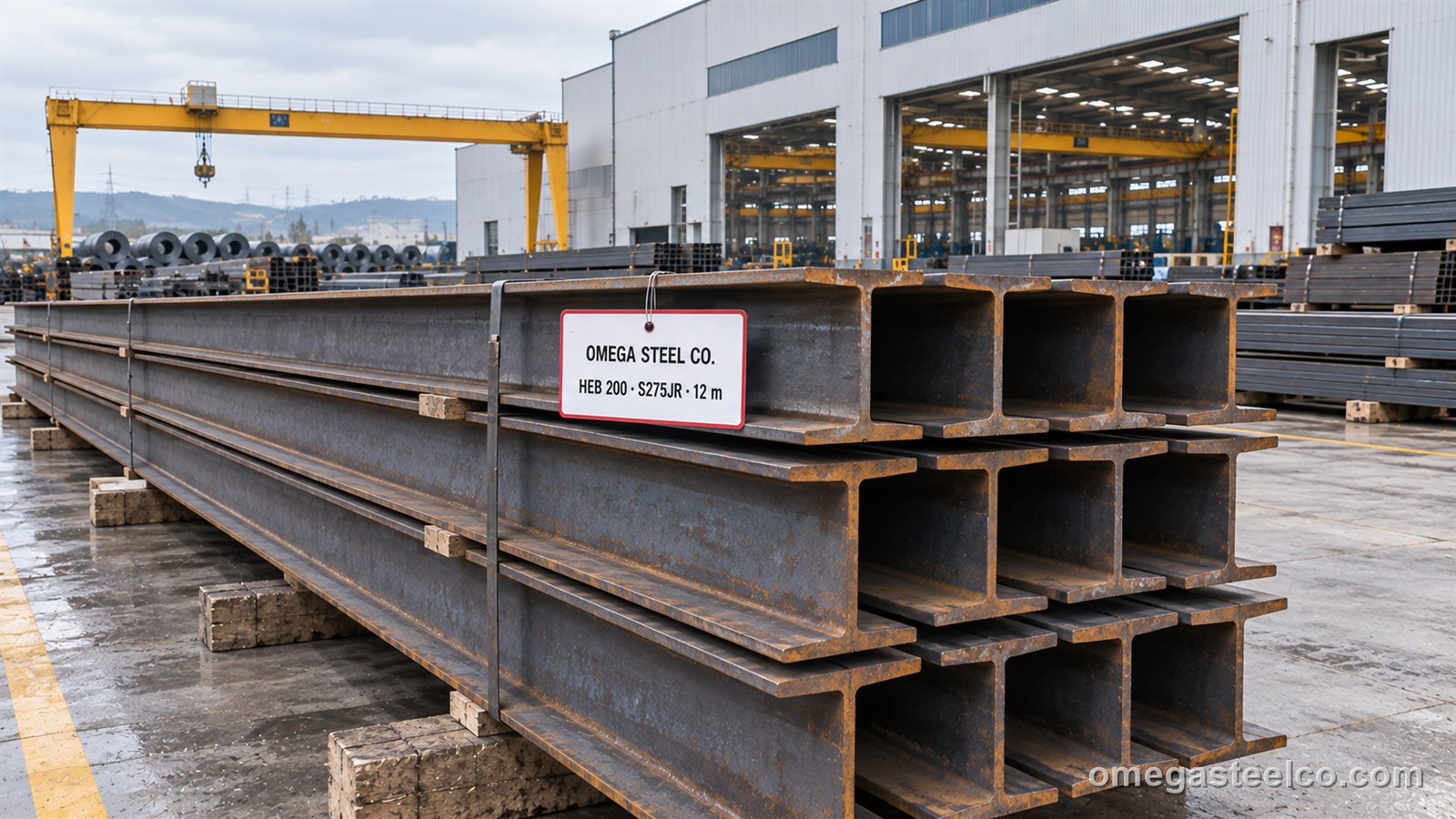
What is an H beam used for?
An H beam is a hot-rolled section whose flanges are as wide as the section is deep (HEB 200: 200 × 200 mm), with parallel flanges of equal thickness. That geometry gives similar stiffness about both axes, so H beams are the standard for columns, and their thick flanges make them the choice for heavily loaded primary beams, crane runways, transfer girders and bridge cross-beams. The three European series differ only in flange and web thickness: HEA (light) weighs 15–25% less than HEB for the same depth, HEM (heavy) 40–60% more. Section depth is the nominal HEB depth; HEA is a few millimetres shallower, HEM deeper.
HEA or HEB — the two series
Every H-beam size has its own page with the full dimension and weight table: HEA beams (light series, columns and unrestrained beams at the lowest weight) and HEB beams (standard series, heavy columns and girders); HEM extra-heavy on request. For restrained floor beams see IPE beams.
H beam sizes and weight chart
| Size | HEA h × b × tw × tf (mm) | HEA kg/m | HEB h × b × tw × tf (mm) | HEB kg/m | HEM kg/m |
|---|---|---|---|---|---|
| HE 100 | 96 × 100 × 5 × 8 | 16.7 | 100 × 100 × 6 × 10 | 20.4 | 41.8 |
| HE 120 | 114 × 120 × 5 × 8 | 19.9 | 120 × 120 × 6.5 × 11 | 26.7 | 52.1 |
| HE 140 | 133 × 140 × 5.5 × 8.5 | 24.7 | 140 × 140 × 7 × 12 | 33.7 | 63.2 |
| HE 160 | 152 × 160 × 6 × 9 | 30.4 | 160 × 160 × 8 × 13 | 42.6 | 76.2 |
| HE 180 | 171 × 180 × 6 × 9.5 | 35.5 | 180 × 180 × 8.5 × 14 | 51.2 | 88.9 |
| HE 200 | 190 × 200 × 6.5 × 10 | 42.3 | 200 × 200 × 9 × 15 | 61.3 | 103 |
| HE 220 | 210 × 220 × 7 × 11 | 50.5 | 220 × 220 × 9.5 × 16 | 71.5 | 117 |
| HE 240 | 230 × 240 × 7.5 × 12 | 60.3 | 240 × 240 × 10 × 17 | 83.2 | 157 |
| HE 260 | 250 × 260 × 7.5 × 12.5 | 68.2 | 260 × 260 × 10 × 17.5 | 93.0 | 172 |
| HE 280 | 270 × 280 × 8 × 13 | 76.4 | 280 × 280 × 10.5 × 18 | 103 | 189 |
| HE 300 | 290 × 300 × 8.5 × 14 | 88.3 | 300 × 300 × 11 × 19 | 117 | 238 |
| HE 320 | 310 × 300 × 9 × 15.5 | 97.6 | 320 × 300 × 11.5 × 20.5 | 127 | 245 |
| HE 340 | 330 × 300 × 9.5 × 16.5 | 105 | 340 × 300 × 12 × 21.5 | 134 | 248 |
| HE 360 | 350 × 300 × 10 × 17.5 | 112 | 360 × 300 × 12.5 × 22.5 | 142 | 250 |
| HE 400 | 390 × 300 × 11 × 19 | 125 | 400 × 300 × 13.5 × 24 | 155 | 256 |
| HE 450 | 440 × 300 × 11.5 × 21 | 140 | 450 × 300 × 14 × 26 | 171 | 263 |
| HE 500 | 490 × 300 × 12 × 23 | 155 | 500 × 300 × 14.5 × 28 | 187 | 270 |
| HE 550 | 540 × 300 × 12.5 × 24 | 166 | 550 × 300 × 15 × 29 | 199 | 278 |
| HE 600 | 590 × 300 × 13 × 25 | 178 | 600 × 300 × 15.5 × 30 | 212 | 285 |
Nominal values per EN 10365; tolerance per EN 10034. HE 650–1000 on mill order.
H beam vs I beam (IPE / IPN)
The rule of thumb: columns and transfer beams in H, floor and roof beams in IPE. For a 6 m simply supported beam carrying 20 kN/m, an IPE 270 (36 kg/m) does the job that an HEA 220 (50 kg/m) would do — but the HEA 220 is the better column for the same frame. IPE and IPN sections are on the IPE / IPN page.
| H beam (HEA/HEB) | I beam (IPE) | I beam (IPN) | |
|---|---|---|---|
| Flange width | ≈ depth (100–300 mm) | About half the depth | Narrow, tapered flanges |
| Weak-axis stiffness | High — good column | Low — beam only | Low |
| Weight for same depth | Heaviest | Lightest | Medium |
| Best for | Columns, heavy beams, crane girders | Floor beams, purlins, rafters | Legacy designs, machine frames |
| Price per ton | 1.00–1.05 | 1.00 | 1.02–1.08 |
Grades: S235JR, S275JR, S355J2
Stock beams are S275JR (dual-certified S235JR on most heats); S355J2 is held in the common sizes HE 160–400 and ordered from the mill for the rest. Full grade data sheets are on our reference site.
| Grade | Yield (t ≤ 16 mm) | Tensile | Impact | Typical use | Price vs S235 |
|---|---|---|---|---|---|
| S235JR | 235 MPa | 360–510 | 27 J at +20 °C | Light frames, non-critical members | 1.00 |
| S275JR | 275 MPa | 410–560 | 27 J at +20 °C | Standard for stock beams, EU/Gulf buildings | 1.01–1.02 |
| S355J2 | 355 MPa | 470–630 | 27 J at −20 °C | Primary structures, cranes, EN 1090 EXC3, cold regions | 1.04–1.08 |
| S355J0 | 355 MPa | 470–630 | 27 J at 0 °C | Where J2 not required | 1.03–1.06 |
Load capacity — quick guide
Simply supported, uniformly distributed, strong axis, S275, deflection L/250: HEA 160 carries about 10 kN/m over 6 m; HEA 200 16 kN/m; HEB 200 22 kN/m; HEB 300 55 kN/m over 6 m or 25 kN/m over 9 m. As a pin-ended column 4 m high (EN 1993-1-1, curve b/c): HEB 200 S275 about 900 kN; HEB 300 about 2 000 kN. Full tables with section properties (Ix, Wx, iy) are in our load-capacity guide; the project engineer confirms the design.
Lengths, cutting, drilling and surface
Stock length 12 m (6 m and 18 m on request); mill lengths 6–24 m for breakbulk. We cut to length (±3 mm), drill and slot flanges and webs to DXF, cope ends, weld end plates and stiffeners, and shot-blast to Sa 2½ with 20–25 µm shop primer — so the beams arrive ready to erect. Hot-dip galvanizing for outdoor structures via partner plant.
- Cut to length ±3 mm, mitred ends
- Drilling and slotting to drawing (CNC beam line)
- Shot-blast Sa 2½ + zinc-silicate or epoxy shop primer
- End plates, stiffeners, base plates welded to drawing (EN 1090 EXC2)
- Hot-dip galvanizing (EN ISO 1461) on request
H beam price per ton
Indicative FOB Istanbul band from our weekly export list, HEA/HEB 100–600 S275JR, 12 m, full-truck or container quantities. Sizes above HE 300 and S355J2 sit at the top of the band; cutting, drilling and priming are separate lines on the offer.
Bands from our weekly export list (September 2026), FOB Istanbul, full-container quantities, excluding freight and certificates. Firm price per project on RFQ within one working day.
Export: container, flat-rack, breakbulk
12 m beams load into 40' HC containers (24–25 t, about 190 m of HEB 200 per box); 18 m and mill lengths go on flat-racks or by breakbulk from Derince/Gemlik in lots from 100 t. Beams are bundled 2–4 pieces, strapped, chocked and lashed; primed beams get corner protectors. HS code 7216.33 (H sections, height ≥ 80 mm).
| Term | Detail |
|---|---|
| MOQ | 1 truck (24 t) or 1 × 40' HC (12 m); breakbulk lots from 100 t |
| Incoterms | FOB Istanbul / Derince · CIF / CFR Gulf, Africa · DAP EU, Balkans, Iraq, Caucasus |
| Lead time | Stock 5–10 working days; mill order 3–5 weeks; processing +5–10 days |
| Packing | Bundles 2–4 beams, strapped, chocked; corner protectors on primed beams |
| Container / truck | 40' HC ≈ 24–25 t (12 m) · flat-rack to 18 m · breakbulk 6–24 m · truck 24 t |
| Documents | Invoice, packing list per bundle, EN 10204 3.1, CE, certificate of origin; SASO / SONCAP / COC / EAC on request |
| Payment | 30% advance, balance against B/L copy; L/C at sight via London office |
Certificates
EN 10204 3.1 mill certificate per heat (chemistry, tensile, impact), CE marking per EN 10025 for the product and EN 1090-1 for fabricated components on request, certificate of origin; SASO, SONCAP, COC (Iraq), EAC arranged before loading.
How to order
Send size, grade, length (or cutting list with drilling drawings), tonnage and port. We reply within one working day with price per ton, piece list, gross weight and container / breakbulk plan; stock sizes load in 5–10 working days.
Standards
- EN 10365 (dimensions of hot-rolled I and H sections)
- EN 10034 (tolerances on shape and dimensions)
- EN 10025-2 (S235JR, S275JR, S355J2)
- ASTM A992 / A572 Gr. 50 W-shapes (on request)
- EN 1090-2 (execution of steel structures)
Grades
Grade data sheets (chemistry, mechanicals, equivalents) are on our reference site: S235JR · S275JR · S355J2 · A572 Grade 50
Frequently asked questions
What is an H beam used for?
Columns, heavy primary beams, crane runways, transfer girders, bridge cross-members and pile sections — anywhere strength about both axes or thick flanges are needed. HEA is the light series, HEB standard, HEM heavy.
What is stronger, an H beam or an I beam?
For the same depth an H beam (HEB) is stronger and stiffer, especially about the weak axis, because its flanges are wider and thicker — and it weighs 60–80% more. For a pure floor beam an IPE gives more strength per kilogram; for a column the H beam wins.
What is the difference between HEA and HEB?
Same depth series, different thickness: HEB 200 is 200 × 200 mm with 9 mm web and 15 mm flanges at 61.3 kg/m; HEA 200 is 190 × 200 mm with 6.5 mm web and 10 mm flanges at 42.3 kg/m. HEA is used where weight matters, HEB where capacity does.
What sizes of H beam are available?
HE 100 to HE 600 from stock in HEA and HEB (HEM in common sizes), 12 m bars; HE 650–1 000 and 18–24 m lengths on mill order. The weight chart above lists dimensions and kg/m.
What is the weight of an HEB 200?
61.3 kg per metre, 736 kg per 12 m bar. HEA 200 is 42.3 kg/m, HEM 200 103 kg/m.
How much does an H beam cost per ton?
See the indicative FOB Istanbul band above for HEA/HEB S275JR; S355J2 adds 4–8%, large sizes (HE 400+) sit at the top of the band, and cutting, drilling and priming are quoted per piece. Firm price within one working day.
Can you supply beams cut, drilled and primed?
Yes — CNC cutting and drilling to DXF, coping, welded end plates and stiffeners, shot-blast Sa 2½ and shop primer, or hot-dip galvanizing. Fabricated components can be CE-marked under EN 1090 EXC2.
How are H beams shipped?
12 m in 40' HC containers (24–25 t), 18 m on flat-racks, longer or larger lots by breakbulk vessel from Derince or Gemlik; by truck (24 t) to the EU, Balkans, Iraq and the Caucasus.