Plate rolling — cylinders, cones and rolled shells to 40 mm × 3 000 mm
Every tank, silo, chimney, duct, vessel, drum and crusher has a rolled shell in it, and a shell rolled badly — with flat ends, an oval belly or a wrong diameter — costs more to fix than the plate it is made from. Our four-roll CNC machine pre-bends both edges, rolls the plate in one pass to the programmed radius and holds it round to a few millimetres, from a 5 mm silo ring to a 40 mm pressure-vessel course, in carbon, boiler, stainless and duplex plate from our own stock. Shells leave Dilovası tacked, seam-welded and back-gouged, or bundled as open rolled plates, with the plates, flanges and nozzles of the same order.
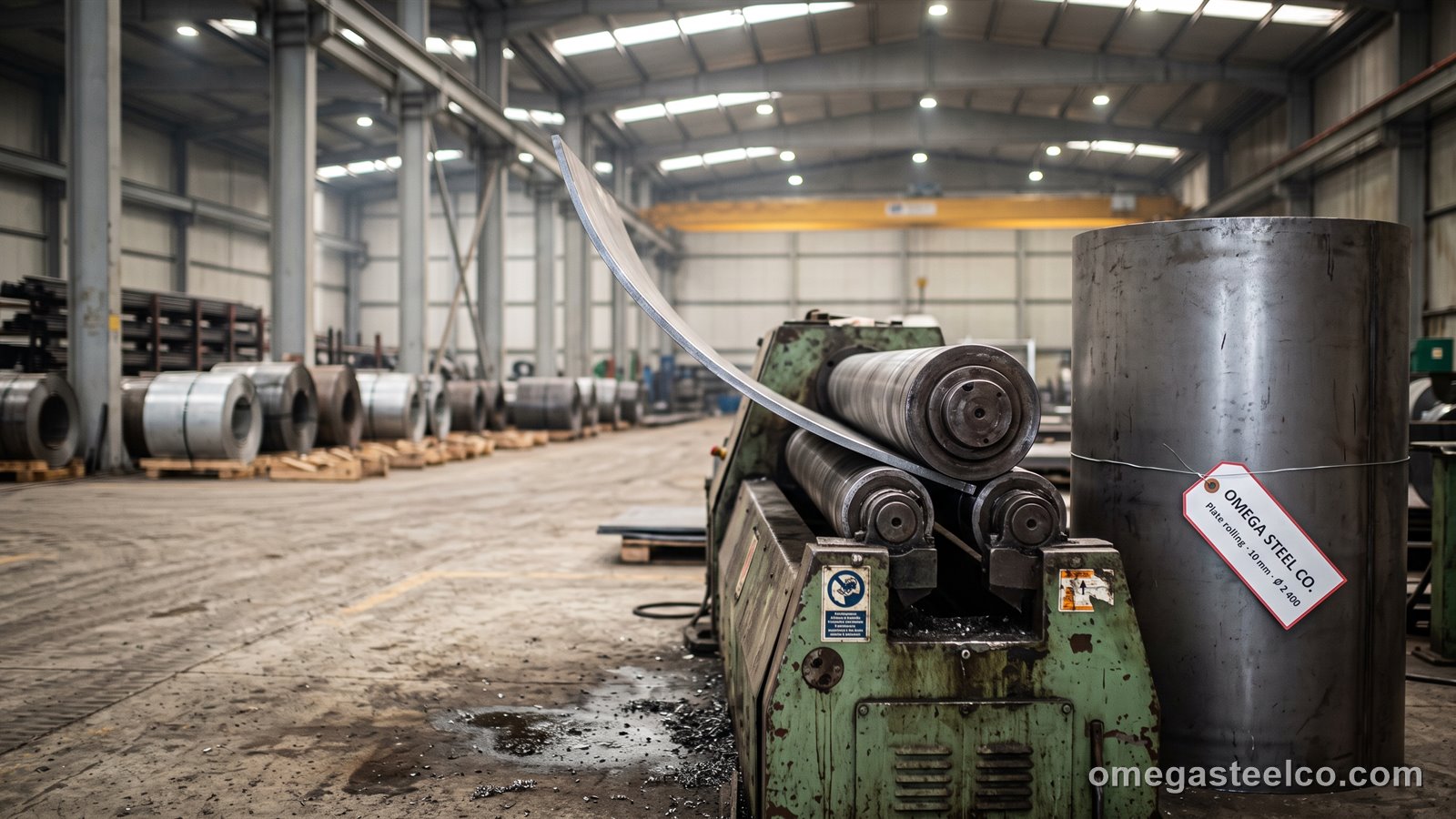
Machine and capacity
Four-roll CNC hydraulic plate roll, 3 000 mm working length, capacity 40 mm mild steel (S235) full length, 30 mm S355, 25 mm stainless / duplex, 16 mm at Ø 400 mm; minimum diameter about 1.1 × top-roll diameter (≈ 380 mm for thin plate, 600 mm for 20 mm and above); maximum diameter limited only by the shop crane at Ø 6 000 mm. Both plate edges are pre-bent in the machine, so there is no flat land at the seam; the CNC program rolls cylinders, cones (by differential side-roll tilt), ovals and variable-radius shapes from the drawing, and the side supports hold shells over Ø 2 500 mm round while rolling. A second three-roll machine, 2 500 mm × 12 mm, takes thin shells, ducts and tubes from Ø 300 mm. Shells are tacked in the machine, seam-welded (SAW for 8 mm and above, MIG below), back-gouged and re-rounded, and checked on a template to EN 13445 / EN 14015 roundness.
What we roll
| Product | Thickness | Diameter | Length per shell | Typical use |
|---|---|---|---|---|
| Cylindrical shells (courses) | 5–40 mm | Ø 400–6 000 mm | to 3 000 mm | tanks, vessels, silos, mixers |
| Thin cylinders and ducts | 2–12 mm | Ø 300–3 000 mm | to 2 500 mm | ducting, chimneys, hoppers, casings |
| Cones and frustums | 3–20 mm | Ø 300–4 000 mm | slant height to 2 500 mm | hoppers, silo bottoms, transitions, cyclones |
| Pipe segments (rolled and welded) | 6–30 mm | Ø 500–2 000 mm | to 3 000 mm | large-bore pipe, piles, casings, penstocks |
| Half-shells and arcs | 5–40 mm | R 300–5 000 mm | to 3 000 mm | saddles, wear liners, tunnel segments, chutes |
| Ovals and profiles | 3–12 mm | to 2 500 mm | to 2 500 mm | manways, tank ends, architectural |
| Rings from flat bar / plate strip | 6–40 mm | Ø 400–6 000 mm | strip width to 300 mm | stiffener rings, flanges, wear rings |
Longer cylinders are made from several courses welded circumferentially; we supply courses fitted and tacked, or fully welded to 9 m with our welding shop.
Materials
From our stock: S235JR and S355J2 plate, boiler plate P265GH, P355GH and P355NH for vessels under PED with 3.1 / 3.2 certificates, corten for chimneys, checkered plate for drum linings, stainless 304 / 316L and duplex 2205 rolled on protected rolls with clean-room separation from carbon steel, galvanized sheet for silos and ducts, and aluminium 5754 / 5083. Rolling direction, minimum radius (about 1.5 × t for cold rolling of carbon steel, 2 × t for stainless and duplex) and springback are set per material in the CNC program; heavy plate above 30 mm or tight radii are rolled warm.
Tolerances and quality
| Item | Standard shell | Vessel shell (EN 13445 / ASME VIII) |
|---|---|---|
| Diameter | ± 0.5 % | ± 0.25 % |
| Out-of-roundness | ≤ 1 % of Ø | ≤ 0.5 % of Ø (max 1 % per code) |
| Flat land at seam | none (pre-bent) | none |
| Peaking at weld | ≤ 3 mm | ≤ 1.5 mm, template-checked |
| Length / squareness | ± 2 mm | ± 1 mm |
| Seam weld | MIG / SAW, visual | SAW, back-gouged, RT / UT per code, WPS / PQR |
| Certificates | plate 3.1 | plate 3.1 / 3.2, weld records, dimensional report |
Cones are checked on slant height, both diameters and the half-angle; rings on a surface plate for flatness.
Design and drawings
- Send the inside or outside diameter, plate thickness, shell length and material; for cones both diameters and the height
- State whether shells are to be open (rolled only), tacked, or seam-welded with weld procedure
- Cylinders over 3 m are made from courses — tell us the course length or let us optimise from plate width
- Nozzle and manway cut-outs can be laser- or plasma-cut flat before rolling (cheaper) or after (more accurate)
- For vessels under PED, send the design code, material certificate level and NDT requirement
- Stiffener rings and flanges are rolled from flat bar and supplied with the shells
Where it is used
- Storage tanks, silos and hoppers (courses and cone bottoms)
- Pressure vessels, air receivers and heat-exchanger shells under PED / ASME
- Chimneys, stacks, ducting and cyclones
- Large-bore pipe, casings, piles and penstock segments
- Mixers, drums, kilns and crusher housings
- Architectural columns, cladding drums and tunnel liners
Pricing and lead time
Rolling is charged per shell by machine time — typically 20–60 minutes for a course, more for cones and heavy plate — plus material at the plate price per ton, seam welding per metre and NDT per test. As a guide a Ø 2 400 × 3 000 mm course from 10 mm S355 costs the plate plus about 15–20 % for rolling and tacking, 30–35 % fully welded. Lead time 5–10 working days for rolled shells, 2–3 weeks for welded and tested vessel courses; shells nest inside each other for shipping.
Frequently asked questions
What thickness and diameter can you roll?
Up to 40 mm × 3 000 mm in mild steel (30 mm S355, 25 mm stainless), diameters from about Ø 400 mm (Ø 300 on the thin-plate machine) to Ø 6 000 mm; longer cylinders from welded courses.
Do rolled shells have flat ends at the seam?
No — the four-roll machine pre-bends both plate edges before rolling, so the shell is round through the seam without a flat land.
Can you roll cones?
Yes — cones and frustums from 3–20 mm plate to Ø 4 000 mm by CNC side-roll tilting, checked on both diameters and the half-angle.
Can you roll stainless and duplex plate?
Yes — on protected rolls, separated from carbon steel, with a minimum radius of about 2 × thickness; 304, 316L and 2205 from our stock.
Are shells delivered welded?
As you specify: open rolled, tacked, or seam-welded (SAW / MIG), back-gouged, re-rounded and NDT-tested, with the welding records for vessel work.
What is the roundness tolerance?
≤ 1 % of diameter as standard, ≤ 0.5 % on vessel shells, template-checked; diameter ± 0.5 % (± 0.25 % vessels).