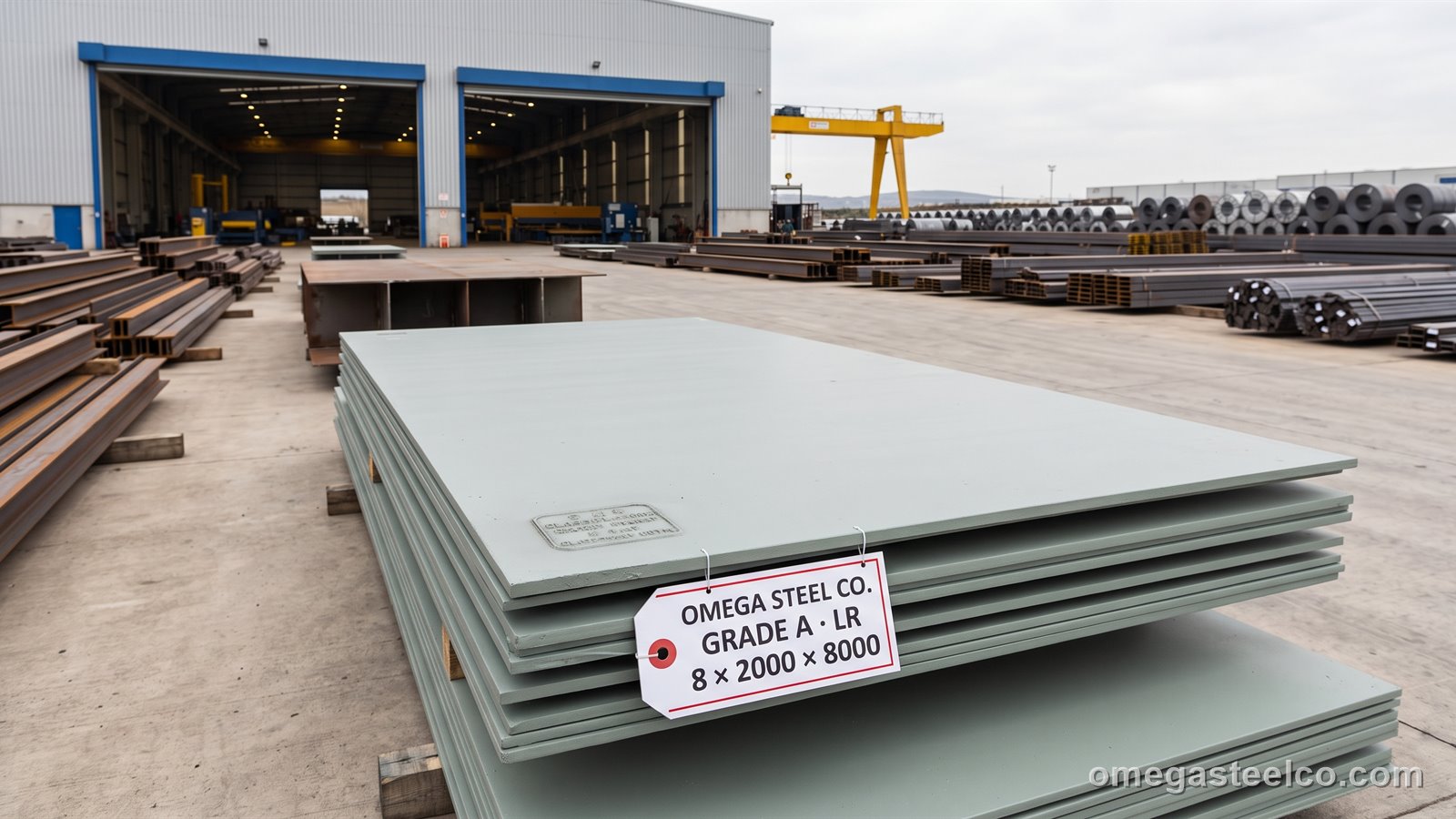
What is Grade A ship plate?
Grade A is the first of the four ordinary-strength hull steels (A, B, D, E) that the classification societies define jointly through IACS UR W11 and each write into their own rules. All four have the same strength — 235 MPa yield, 400–520 MPa tensile, 22 % elongation — and differ only in the guaranteed toughness: Grade A is tested at +20 °C (27 J longitudinal, and only above 50 mm), B at 0 °C, D at −20 °C and E at −40 °C. Chemistry is a killed or semi-killed carbon-manganese steel with carbon ≤ 0.21 %, manganese at least 2.5 times the carbon, and a carbon equivalent low enough for shipyard welding without preheat. What makes it ship plate rather than S235 is the process: the mill is approved by the society, the surveyor witnesses the tests, every plate carries the society mark, grade and heat number in hard stamping or paint, and the certificate is a society document — which is why the yard\'s class surveyor accepts it into a hull. Grade A covers the largest tonnage in any ship: shell plating, decks, bulkheads, floors, girders and stiffeners wherever the rules do not call for a higher grade — they do above certain thicknesses and in the sheer strake, deck stringer and other high-stress zones, where Grade B, D or the AH36 series are required. It is also the plate of barges, pontoons, dredgers, fish farms and floating docks, and of non-classed steel boats that simply want traceable hull steel.
Chemical composition
| Element | C | Si | Mn | P | S | Al |
|---|---|---|---|---|---|---|
| max. % (ladle) | ≤ 0.21 | ≤ 0.50 | ≥ 2.5 × C | ≤ 0.035 | ≤ 0.035 | killed or semi-killed |
Grade A may be semi-killed up to 50 mm; above 50 mm it must be fully killed and fine-grain. CEV usually 0.30–0.38.
Mechanical properties
| Property | Requirement | Typical value | Note |
|---|---|---|---|
| Yield strength ReH | ≥ 235 MPa | 260–300 MPa | |
| Tensile strength Rm | 400–520 MPa | 430–470 MPa | |
| Elongation A5 | ≥ 22 % | 28–34 % | |
| Charpy V longitudinal | ≥ 27 J at +20 °C | > 80 J | required only > 50 mm |
| Charpy V transverse | ≥ 20 J at +20 °C | > 60 J | |
| Delivery condition | as rolled (≤ 50 mm) | N above 50 mm |
Equivalent grades
| System | Grade | Note |
|---|---|---|
| IACS / all societies | Grade A | LR A, BV A, DNV NV A, ABS A, RINA A, TL A, NK KA |
| EN 10025-2 | S235JR (approx.) | same strength, no class certificate |
| ASTM | A131 Grade A | US equivalent |
| JIS G3106 | SS400 / KA | |
| GB 712 | A | Chinese |
| Next grade up | Grade B | impact at 0 °C |
Classification society approval
A Grade A plate without a society certificate is just S235 with a different name. What the yard\'s class surveyor needs is a plate rolled at a mill approved by the society on the class contract — Lloyd\'s Register, Bureau Veritas, DNV, ABS, RINA, Türk Loydu or ClassNK — tested under the society surveyor and hard-stamped with the society mark, grade and heat number. Approvals are society-specific: LR-certified plate is not accepted for a BV-classed hull. Turkish mills hold approvals from all of these, and we ask which society before we quote. For workboats, barges and fabrication outside class the same grade is supplied with an EN 10204 3.1 mill certificate at a lower price.
Ordinary-strength grades compared
| Grade | Impact test | Deoxidation | Where the rules require it |
|---|---|---|---|
| A | +20 °C (> 50 mm only) | killed / semi-killed | general hull structure |
| B | 0 °C, 27 J | killed / semi-killed | thicker shell and deck plate (> 20 mm in some zones) |
| D | −20 °C, 27 J | killed, fine grain | sheer strake, stringer, bilge in thick sections |
| E | −40 °C, 27 J | killed, fine grain, normalised | highest-stress zones, thick plate, cold-climate vessels |
Selection by thickness and hull zone follows each society's material grade tables (e.g. LR Rules Pt 3 Ch 2); the yard's class plan defines the grade per plate.
Thickness range and stock sizes
| Thickness | Widths × lengths | Availability |
|---|---|---|
| 5–8 mm | 1 500 / 2 000 / 2 500 × 6 000 / 8 000 / 12 000 | stock and mill |
| 10–20 mm | 2 000 / 2 500 / 3 000 × 6 000 / 12 000 | stock and mill |
| 25–50 mm | 2 000 / 2 500 / 3 000 × 6 000 / 12 000 | mill order |
| Shop primer | zinc silicate / epoxy 15–25 µm, blasted Sa 2½ | on request |
Weight per m² and per plate
| Thickness | kg/m² | 1 500 × 6 000 (kg) | 2 000 × 6 000 (kg) | 2 500 × 12 000 (kg) |
|---|---|---|---|---|
| 5 mm | 39.3 | 353 | 471 | 1 178 |
| 6 mm | 47.1 | 424 | 565 | 1 413 |
| 8 mm | 62.8 | 565 | 754 | 1 884 |
| 10 mm | 78.5 | 707 | 942 | 2 355 |
| 12 mm | 94.2 | 848 | 1 130 | 2 826 |
| 15 mm | 117.8 | 1 060 | 1 413 | 3 533 |
| 20 mm | 157.0 | 1 413 | 1 884 | 4 710 |
| 25 mm | 196.3 | 1 766 | 2 355 | 5 888 |
| 30 mm | 235.5 | 2 120 | 2 826 | 7 065 |
| 40 mm | 314.0 | 2 826 | 3 768 | 9 420 |
| 50 mm | 392.5 | 3 533 | 4 710 | 11 775 |
Nominal weights — mill tolerance to EN 10029 class A adds up to +4 % on thin plate; invoiced on theoretical weight unless agreed otherwise.
Cutting, bevelling, shop primer and welding
Grade A welds like S235 — MAG, FCAW, SAW, MMA — with no preheat up to 50 mm; consumables must be society-approved for the grade (Grade 1 or 2). We plasma- and oxy-cut to the nesting, bevel to the yard\'s weld-prep drawings and can supply plates shot-blasted to Sa 2½ with a 15–25 µm zinc-silicate or epoxy shop primer that is weld-through approved. Straightening by line heating is permitted below 650 °C. Plates are marked with heat and society stamp — do not cut the stamped corner off before the surveyor has seen it.
Where it is used
- Hull shell, bottom, side and deck plating
- Bulkheads, floors, girders, web frames and stiffeners
- Barges, pontoons, floating docks and dredgers
- Fish-farm cages, workboats and tugs
- Superstructures and deckhouses
- Non-classed steel boats requiring traceable hull steel
Grade A vs Grade B vs AH36
Grade B is the same steel with impact tested at 0 °C, required in thicker and more critical plates; AH36 is the higher-strength series (355 MPa) that reduces thickness in decks and shell of larger vessels. Without a class certificate the same plate is S235JR — fine for a fabrication shop, not for a hull.
Price
Ship plate is quoted per lot rather than from a list band, because the society certificate, surveyor attendance, shop primer and plate size all enter the price; ask with the class plan or plate list and we return a firm offer within a working day.
Bands from our weekly export list (September 2026), FOB Istanbul, full-container quantities, excluding freight and certificates. Firm price per project on RFQ within one working day.
Export and packing
Packing for Grade A ship plate: plates banded on hardwood skids (max 5 t per pack), edges protected, heat numbers marked; Container loading: 40' HC ≈ 24–25 t of 6 m plate, 20' ≈ 20 t of short plate. Over-length plate is loaded flat-rack, and heavy plate above 25 t per piece travels breakbulk from Derince. HS 7208.51 / 7208.52.
| Term | Detail |
|---|---|
| MOQ | 5 t per size; 20 t per certificate lot recommended |
| Incoterms | FOB Istanbul · CIF / CFR Gulf, Africa · DAP EU, Balkans, Iraq, Caucasus · DAP Aktau |
| Lead time | Stock 5–12 mm: 1–2 weeks; mill order 4–6 weeks (society surveyor) |
| Packing | Plates on bearers, banded, society stamp and heat visible; primed plates with paper separators |
| Container / truck | 20' ≈ 20 t; 40' HC ≈ 24 t; 8–12 m plate on flat-rack or breakbulk from Derince |
| Documents | Invoice, packing list, EN 10204 3.1 (3.2 on request), certificate of origin; SASO / SONCAP / PVoC on request |
| Payment | 30% advance, balance against B/L copy; L/C at sight for orders above 100 t |
Certificates and testing
Grade A ship plate is delivered with the mill certificate EN 10204 3.1 — heat number, ladle analysis, tensile and impact results and the delivery condition. Third-party 3.2 certification (Lloyd's, BV, TÜV, SGS), ultrasonic testing to EN 10160 and extra Charpy tests at a lower temperature are ordered per lot.
How to order
Specify Grade A, the society (LR / BV / DNV / ABS / RINA / TL), thickness × width × length list, quantity, shop primer yes/no, and the project or vessel name for the certificate; 3.1 mill certificate for non-classed work.
Standards
- IACS UR W11 — normal and higher strength hull structural steels
- LR / BV / DNV / ABS / RINA / TL / NK rules Part 2
- EN 10204 3.2 equivalent (society certificate)
- EN 10029 / society tolerances (−0.3 mm under-thickness)
Grades
Grade data sheets (chemistry, mechanicals, equivalents) are on our reference site: Grade A · Grade B · AH36
Frequently asked questions
What is Grade A ship steel?
The basic ordinary-strength hull steel of the classification societies — 235 MPa yield, 400–520 MPa tensile, impact tested at +20 °C — supplied from an approved mill with the society stamp and certificate.
What is the difference between Grade A and S235JR?
Same strength; Grade A is rolled at a class-approved mill, tested under a surveyor and stamped, so a shipyard can use it in a classed hull. S235JR has only a mill certificate.
Which classification society certificate can you supply?
LR, BV, DNV, ABS, RINA, Türk Loydu and ClassNK — we confirm the approved mill for the society named on your order before quoting.
When is Grade B or D required instead of Grade A?
The society rules set the grade by thickness and hull zone: thicker shell and deck plates need Grade B (0 °C), the sheer strake, stringer and bilge in thick sections need D (−20 °C) or E (−40 °C).
Can you deliver ship plate with shop primer?
Yes — shot-blasted to Sa 2½ and coated with 15–25 µm weld-through zinc-silicate or epoxy primer.