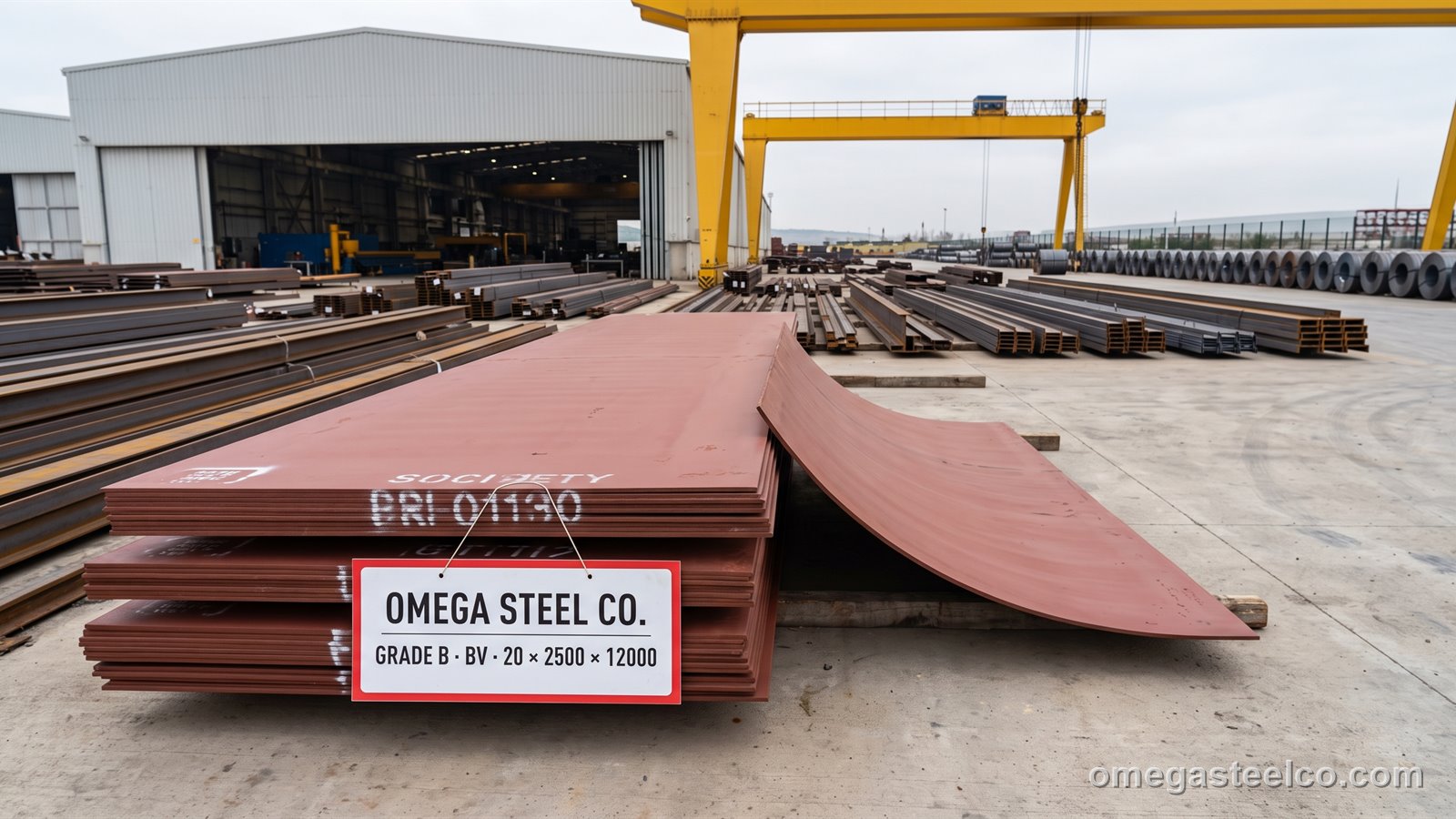
What is Grade B ship plate?
Grade B is the second of the ordinary-strength hull-steel grades. It shares Grade A\'s strength — 235 MPa yield, 400–520 MPa tensile, 22 % elongation — and adds a guaranteed Charpy V impact of 27 J longitudinal (20 J transverse) at 0 °C on every thickness, which Grade A does not have. To get there the steel is made with a slightly tighter chemistry: manganese at least 0.80 % (Grade A only needs 2.5 × C), carbon ≤ 0.21 %, and it may be semi-killed only up to 25 mm, fully killed above. The class rules of every society grade hull plates by thickness and location — a shell plate of 15 mm amidships may be Grade A while the same plate at 25 mm must be B, at 35 mm D, and in the sheer strake or bilge strake the limits are lower — so Grade B is the plate of the heavier bottom, side and deck plating of ships from about 100 m upward, of large barges and dredgers, and of any structure where the class plan says B. It is rolled, stamped and certified exactly like Grade A: approved mill, surveyor-witnessed tests, society mark and heat number on every plate. Welding needs no preheat up to 50 mm with approved Grade 2 consumables, and it takes shop primer, line heating and cold forming like any mild steel. When the tonnage is small, yards often buy Grade B for the whole hull to avoid mixing grades — the cost difference to A is a few percent.
Chemical composition
| Element | C | Si | Mn | P | S | Al |
|---|---|---|---|---|---|---|
| max. % (ladle) | ≤ 0.21 | ≤ 0.35 | ≥ 0.80 | ≤ 0.035 | ≤ 0.035 | killed (semi-killed ≤ 25 mm) |
Mn may be reduced to 0.60 % when C ≤ 0.18 %. Above 25 mm fully killed; above 50 mm fine-grain. CEV typically 0.32–0.40.
Mechanical properties
| Property | Requirement | Typical value | Note |
|---|---|---|---|
| Yield strength ReH | ≥ 235 MPa | 255–295 MPa | |
| Tensile strength Rm | 400–520 MPa | 430–480 MPa | |
| Elongation A5 | ≥ 22 % | 26–32 % | |
| Charpy V longitudinal | ≥ 27 J at 0 °C | > 70 J | all thicknesses |
| Charpy V transverse | ≥ 20 J at 0 °C | > 50 J | |
| Delivery condition | as rolled ≤ 50 mm; N or TM above |
Equivalent grades
| System | Grade | Note |
|---|---|---|
| IACS / all societies | Grade B | LR B, BV B, DNV NV B, ABS B, RINA B, TL B, NK KB |
| ASTM | A131 Grade B | US |
| EN 10025-2 | S235J0 (approx.) | same impact temperature, no class |
| JIS G3106 | KB | |
| GB 712 | B | Chinese |
| Higher-strength counterpart | AH36 | 355 MPa, 0 °C |
Society certificate and stamping
Grade B is delivered under the same regime as every hull steel: the rolling mill is approved by the classification society, the society surveyor witnesses tensile and Charpy tests on each heat and thickness range, and every plate carries the society mark, the grade "B", the heat number and the mill mark in hard stamping or approved paint marking. The certificate is issued by the society (LR, BV, DNV, ABS, RINA, TL or NK) and travels with the plate to the yard\'s surveyor. We source from mills approved by the society you name — approvals do not transfer between societies — and for non-classed work we supply the same steel with a 3.1 certificate.
When the rules require Grade B
| Hull area (material class) | Grade A up to | Grade B up to | Grade D up to |
|---|---|---|---|
| Class I — internal structure, decks inboard | 30 mm | 40 mm | 50 mm |
| Class II — shell, bottom, strength deck outboard | 20 mm | 25 mm | 40 mm |
| Class III — sheer strake, stringer, bilge strake amidships | — | 20 mm | 25 mm |
| Longitudinal hatch coamings, thick brackets | 20 mm | 25 mm | 40 mm |
Limits vary by society, ship length and service temperature (ice class and cold-climate vessels go one grade up). The class-approved drawing is the authority.
Thickness range and stock sizes
| Thickness | Widths × lengths | Availability |
|---|---|---|
| 6–12 mm | 2 000 / 2 500 × 6 000 / 8 000 / 12 000 | mill order, some stock |
| 15–25 mm | 2 000 / 2 500 / 3 000 × 6 000 / 12 000 | mill order |
| 30–50 mm | 2 500 / 3 000 × 6 000 / 12 000 | mill order |
| Shop primer | Sa 2½ + 15–25 µm zinc silicate / epoxy | on request |
Weight per m² and per plate
| Thickness | kg/m² | 1 500 × 6 000 (kg) | 2 000 × 6 000 (kg) | 2 500 × 12 000 (kg) |
|---|---|---|---|---|
| 6 mm | 47.1 | 424 | 565 | 1 413 |
| 8 mm | 62.8 | 565 | 754 | 1 884 |
| 10 mm | 78.5 | 707 | 942 | 2 355 |
| 12 mm | 94.2 | 848 | 1 130 | 2 826 |
| 15 mm | 117.8 | 1 060 | 1 413 | 3 533 |
| 20 mm | 157.0 | 1 413 | 1 884 | 4 710 |
| 25 mm | 196.3 | 1 766 | 2 355 | 5 888 |
| 30 mm | 235.5 | 2 120 | 2 826 | 7 065 |
| 40 mm | 314.0 | 2 826 | 3 768 | 9 420 |
| 50 mm | 392.5 | 3 533 | 4 710 | 11 775 |
Nominal weights — mill tolerance to EN 10029 class A adds up to +4 % on thin plate; invoiced on theoretical weight unless agreed otherwise.
Welding, cutting and fabrication
Welds like Grade A with society-approved Grade 2 consumables, no preheat to 50 mm, and standard MAG / FCAW / SAW procedures; the 0 °C impact requirement extends to the weld metal, which is why the consumable grade matters. Plasma and oxy-cutting, bevelling to the yard\'s prep drawings, cold forming of bilge radii (≥ 3 × t) and line heating below 650 °C are all routine. Shop-primed plates are welded through without removal of the primer where the primer is type-approved.
Where it is used
- Bottom and side shell plating above the Grade A thickness limit
- Strength deck and stringer plates amidships
- Large barges, pontoons, dredgers and floating docks
- Longitudinal bulkheads, girders and hatch coamings
- Offshore support vessel and tug hulls
- Single-grade hull orders for smaller yards
Grade B vs Grade A vs DH36
Grade A is the same steel without the guaranteed 0 °C impact and is allowed in thinner plates; Grade B is required as thickness grows. DH36 is the higher-strength (355 MPa) grade with −20 °C impact that lets designers cut thickness altogether in larger ships. Between them, AH36 matches Grade B\'s 0 °C impact at 355 MPa.
Price
Quoted per lot on request — the society certificate, surveyor attendance, plate sizes and shop primer set the price, which is a few percent above Grade A. Send the plate list from the class plan for a firm offer.
Bands from our weekly export list (September 2026), FOB Istanbul, full-container quantities, excluding freight and certificates. Firm price per project on RFQ within one working day.
Export and packing
Packing for Grade B ship plate: plates banded on hardwood skids (max 5 t per pack), edges protected, heat numbers marked; A 40' HC takes 24–25 t of 6 m plate. Over-length plate is loaded flat-rack, and heavy plate above 25 t per piece travels breakbulk from Derince. HS 7208.51 / 7208.52.
| Term | Detail |
|---|---|
| MOQ | 5 t per size; 20 t per certificate lot |
| Incoterms | FOB Istanbul · CIF / CFR Gulf, Africa · DAP EU, Balkans, Iraq, Caucasus · DAP Aktau |
| Lead time | Mill order 4–6 weeks (surveyor); limited stock 10–20 mm |
| Packing | Plates on bearers, banded, stamped; primed plates with separators |
| Container / truck | 20' ≈ 20 t; 40' HC ≈ 24 t; 12 m plate breakbulk from Derince |
| Documents | Invoice, packing list, EN 10204 3.1 (3.2 on request), certificate of origin; SASO / SONCAP / PVoC on request |
| Payment | 30% advance, balance against B/L copy; L/C at sight for orders above 100 t |
Certificates and testing
Grade B ship plate ships with EN 10204 3.1 certificates cross-referenced to the stencilled heat numbers. Where the project requires it we arrange 3.2 certification with Lloyd's, BV, TÜV or SGS, ultrasonic examination to EN 10160 and Charpy testing at the temperature you specify.
How to order
Specify Grade B, society, thickness × width × length list, quantity, shop primer, and the vessel or project reference for the certificate.
Standards
- IACS UR W11
- LR / BV / DNV / ABS / RINA / TL rules
- ASTM A131 Grade B
- Society certificate (3.2 equivalent)
Grades
Grade data sheets (chemistry, mechanicals, equivalents) are on our reference site: Grade B · Grade A · DH36
Frequently asked questions
What is Grade B ship steel?
Ordinary-strength hull steel (235 MPa yield) with a guaranteed 27 J Charpy impact at 0 °C, required by the class rules for thicker shell and deck plates where Grade A is no longer permitted.
What is the difference between Grade A and Grade B?
Same strength; Grade B guarantees impact toughness at 0 °C on all thicknesses (Grade A only at +20 °C above 50 mm) and has a minimum 0.80 % manganese. The rules allow B in thicker plates.
Is Grade B equivalent to A131 Grade B?
Yes — ASTM A131 Grade B is the US specification of the same IACS grade.
Does Grade B need preheat for welding?
No, up to 50 mm, with society-approved Grade 2 consumables.
Can I use Grade B for the whole hull?
Yes — smaller yards often do to avoid mixing grades; the premium over Grade A is a few percent.