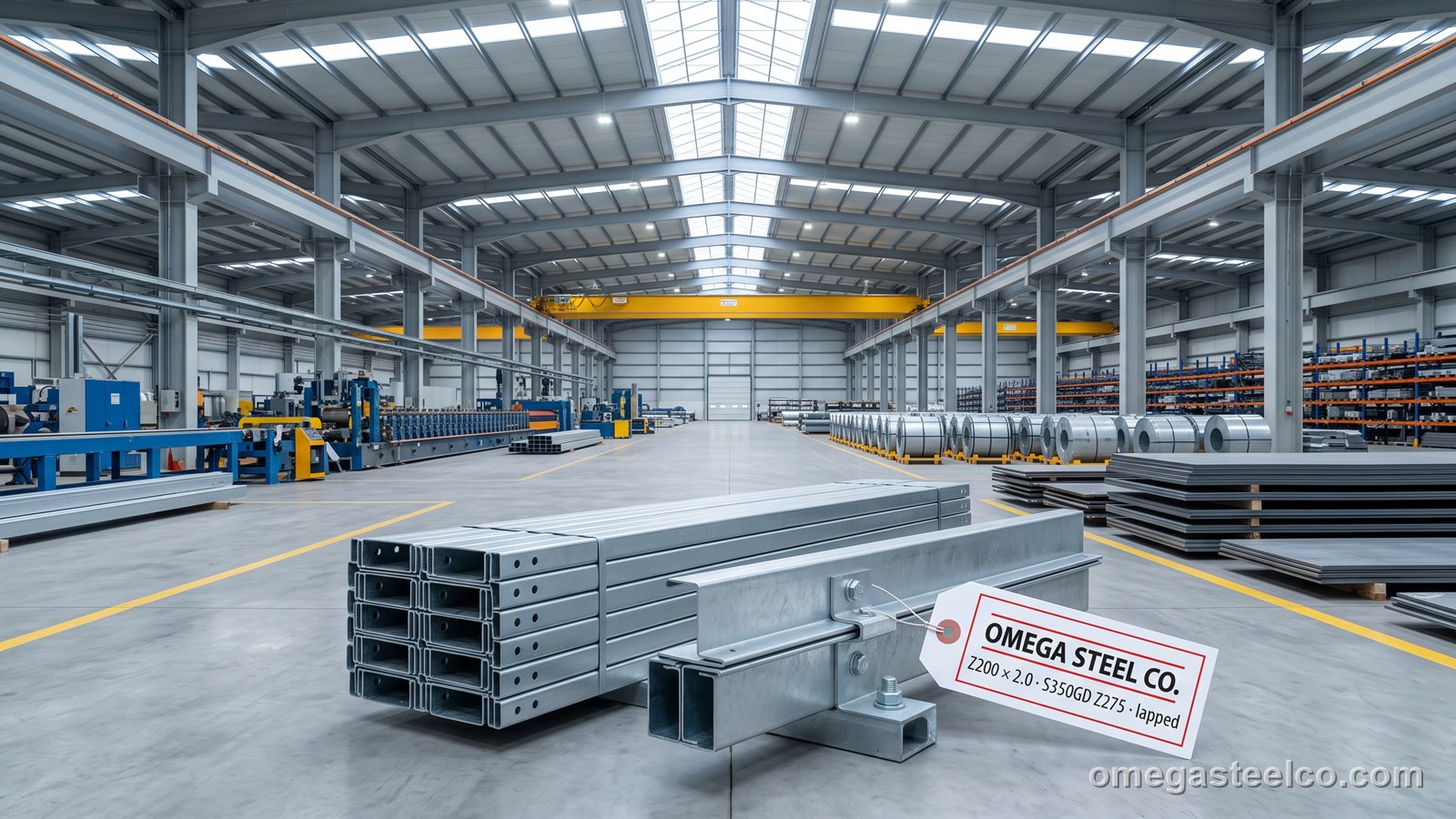
What is Z purlin?
A Z purlin is a cold-roll-formed zed: a web with one flange turned each way, both flanges lipped, and — the detail that matters — the two flanges made slightly different in width so that one purlin can be dropped inside the next and the two bolted together through the webs. That nesting is what makes a Z system continuous: at every rafter the purlin from bay A laps 10–15 % of the span over the purlin from bay B (or both are bolted into a short heavier sleeve), the joint transmits bending moment, and the whole run behaves as a multi-span beam whose mid-span moments are roughly 30 % lower than a simple span\'s. The designer either spans further with the same section or drops a size — a 20–30 % saving in purlin steel on any building of three bays or more, which is why Z purlins are the standard of pre-engineered steel buildings from 30 m warehouses to 300 m distribution centres. The Z is also the right section on a sloping roof: with the top flange pointing up-slope, the section\'s principal axis lines up with the load and the purlin deflects in the plane of the roof less than a C. The price is care in erection (every purlin has an orientation and a lap end) and a heavier hole pattern. We roll Z120 to Z350 in 1.5–3.0 mm from S280GD and S350GD Z275, punch lap, sleeve, cleat, sag-rod and bracing holes to the drawing, and supply sleeves, cleats and sag rods with the package.
Grades, standards and tolerances
| Grade / standard | Yield (MPa) | Note |
|---|---|---|
| S280GD+Z275 (EN 10346) | 280 | standard purlin strip; the stock grade |
| S350GD+Z275 | 350 | higher-strength purlins, longer spans |
| S450GD+Z275 | 450 | to order; maximum span per kg |
| DX51D+Z140 / Z275 | ≈ 140 (not guaranteed) | non-structural profiles only |
| Zinc Z275 | — | 275 g/m² both sides ≈ 20 µm per side; ZM on request |
For lapped systems S350GD is the usual grade — the lap bolts and web bearing at the cleat govern; S450GD on request for maximum span per kilogram.
Z purlin section table
| Section | Web × flanges × lip (mm) | t (mm) | kg/m | Ix (cm⁴) | Wx (cm³) |
|---|---|---|---|---|---|
| Z120 | 120 × 50/47 × 15 | 1.5 / 2.0 | 2.9 / 3.8 | 80 / 105 | 13.4 / 17.5 |
| Z150 | 150 × 60/57 × 20 | 1.5 / 2.0 | 3.5 / 4.6 | 155 / 205 | 20.7 / 27.3 |
| Z175 | 175 × 65/62 × 20 | 2.0 / 2.5 | 5.1 / 6.3 | 290 / 355 | 33.1 / 40.6 |
| Z200 | 200 × 70/67 × 20 | 2.0 / 2.5 | 5.7 / 7.1 | 420 / 515 | 42.0 / 51.5 |
| Z225 | 225 × 75/72 × 20 | 2.0 / 2.5 | 6.3 / 7.8 | 575 / 710 | 51.1 / 63.1 |
| Z250 | 250 × 75/72 × 25 | 2.5 / 3.0 | 8.5 / 10.1 | 960 / 1 140 | 76.8 / 91.2 |
| Z300 | 300 × 80/77 × 25 | 2.5 / 3.0 | 9.6 / 11.4 | 1 510 / 1 790 | 101 / 119 |
| Z350 | 350 × 90/87 × 25 | 2.5 / 3.0 | 10.9 / 13.0 | 2 350 / 2 780 | 134 / 159 |
Flange widths are given as broad/narrow to allow nesting. Effective properties for EN 1993-1-3 design and the lap-joint capacities are in the calculation note.
Lapped and sleeved systems
| System | Detail at rafter | Lap / sleeve length | Steel saving vs simple span | Note |
|---|---|---|---|---|
| Simple span (C or Z) | one purlin per bay on cleats | — | 0 | small buildings, cheapest detailing |
| Lapped Z | purlins nest and bolt through webs over the rafter | 10–15 % of span each side (≥ 600 mm) | 20–30 % | the PEB standard; end bays often one size heavier |
| Sleeved Z | both purlins bolt into a 1.2–1.6 m sleeve of the next size | sleeve 1.2–1.6 m | 15–25 % | equal-length purlins, easier logistics |
| Double-span Z | purlins two bays long, staggered | butted | 10–15 % | lengths to 13.5 m needed |
| Heavy-end-bay | end bays thicker or lapped longer | — | — | end-bay moments are highest |
Cleats, lap bolts (M12/M16 8.8), sleeves and anti-sag systems are dimensioned with the purlin design and supplied in the package.
Lengths and stock
Z purlins are made to order in 7–12 working days after drawing approval, in lengths 3–13.5 m. A typical PEB order is a purlin schedule with lap lengths per line, end-bay sections, sleeves, cleats, sag rods, eaves struts and bridging — we deliver the complete purlin package, bundled per roof line.
Punching, lapping and erection
Lap and sleeve holes are punched in line to the exact pattern (typically 4 × M12 or M16 per lap, web-to-web); cleat holes 18 mm slotted for tolerance; sag-rod holes at 1/2 or 1/3 span. On site each Z is placed with its broad flange up-slope and its lap end over the correct rafter (we mark orientation and lap ends on the bundle tags), bolted through the lap, then to the cleat; the sheeting is screwed to the top flange and restrains the section. Cold-saw cutting only; touch up with zinc-rich paint.
Where it is used
- Roof purlins on multi-bay portal-frame buildings (PEB)
- Wall girts in continuous lapped runs
- Long-span warehouses, distribution centres, hangars
- Roof purlins on sloping roofs where in-plane deflection matters
- Solar and canopy structures with continuous runs
- Re-roofing over existing frames with fewer supports
Z purlin vs C purlin
A C purlin is simpler and symmetric — right for single spans, girts and framing up to about 7.5 m, and cheaper per piece. The Z earns its detailing on buildings of three bays or more, where lapping saves 20–30 % of purlin steel. The C & Z purlin overview compares the systems; for cladding sub-frames the lighter omega profile applies.
Price
Z purlins are quoted per ton or per metre against the purlin schedule — section, thickness, grade, lap pattern and quantity set the price on top of the galvanized strip base — rather than from a list band; sleeves, cleats and sag rods are priced per piece in the same offer.
Bands from our weekly export list (September 2026), FOB Istanbul, full-container quantities, excluding freight and certificates. Firm price per project on RFQ within one working day.
Export and packing
Z purlin is bundled per size and length in strapped packs of 1–2 t with timber bearers and edge boards, nested (C in C, Z in Z, omega stacked) to save volume; each bundle tagged with section, thickness, length, count and heat. A 40' HC takes 20–24 t of nested 6–12 m purlins; up to 13.5 m by flat-rack or breakbulk from Derince. Customs heading 7216.61.
| Term | Detail |
|---|---|
| MOQ | 5 t per section size |
| Incoterms | FOB Istanbul · CIF / CFR Gulf, Africa · DAP EU, Balkans, Iraq, Caucasus · DAP Aktau |
| Lead time | 7–12 working days after drawing approval |
| Packing | Nested bundles 1–2 t, strapped, timber bearers, tagged |
| Container / truck | 40' HC ≈ 20–24 t nested; long purlins flat-rack |
| Documents | Invoice, packing list, EN 10204 3.1 (strip), CE DoP (EN 1090-1), certificate of origin; SASO / SONCAP on request |
| Payment | 30% advance, balance against B/L copy; L/C at sight above 100 t |
Certificates
Z purlin carries the EN 10204 3.1 certificate of the galvanized strip (grade, yield, zinc mass) and our roll-forming record (section dimensions, hole pattern check, length); CE marking under EN 1090-1 execution class 2 and a structural calculation note per span are supplied on request.
How to order
Send the purlin schedule or building drawings: section, thickness, grade, zinc, lengths and quantities per roof line, lap or sleeve system, hole pattern, accessories and destination port; a quotation and shop drawing follow within two working days.
Standards
- EN 10346 — S280GD / S350GD + Z275 strip
- EN 1993-1-3 — cold-formed design (continuous systems)
- EN 1090-1 / -2 — CE marking
- EN 10204 3.1
Grades
Grade data sheets (chemistry, mechanicals, equivalents) are on our reference site: S350GD · S280GD · S450GD
Frequently asked questions
What is a Z purlin?
A cold-roll-formed lipped zed section in galvanized high-strength strip whose unequal flanges let purlins nest and lap over the rafters, making a continuous multi-span roof beam that uses 20–30 % less steel than simple spans.
What is the difference between Z and C purlins?
Z purlins lap over supports to form continuous systems and align with sloping-roof loads; C purlins are symmetric, sit flat on cleats and suit single spans, girts and framing. Both are rolled from the same Z275 strip.
What sizes of Z purlin do you make?
Z120 to Z350 in 1.5–3.0 mm, lengths 3–13.5 m, S280GD or S350GD Z275, punched for lapped or sleeved systems.
How long should the lap be?
10–15 % of the span on each side of the rafter, minimum 600 mm; end bays often get a longer lap or a heavier section because their moments are highest.
How far can a Z200 purlin span?
In a lapped continuous system at 1.5 m spacing and 1.0 kN/m², Z200 × 2.0 handles bays of about 7–7.5 m; Z250 × 2.5 about 9 m. Design to the actual loads with the calculation note.