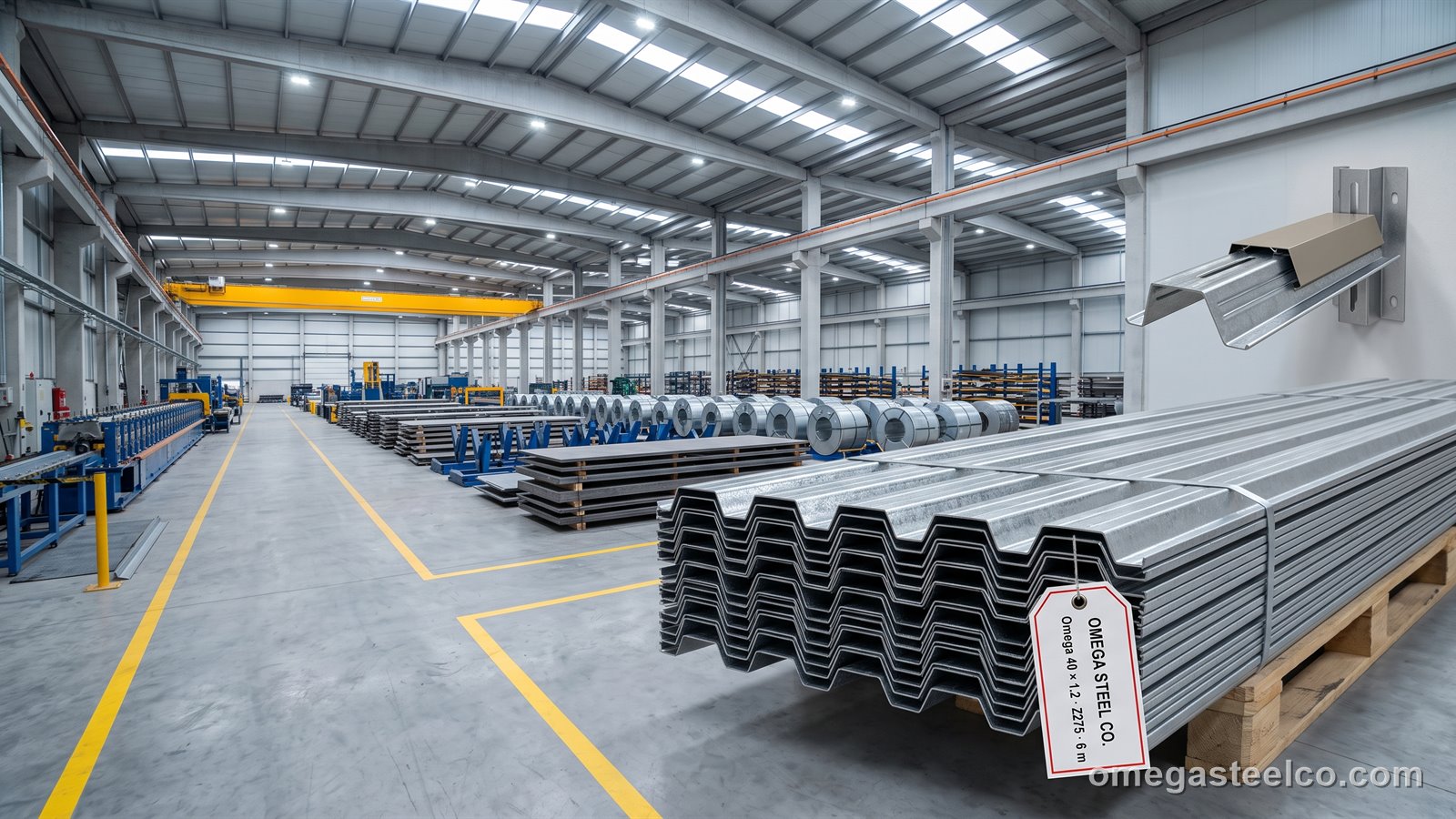
What is Omega profile?
An omega profile is a cold-roll-formed hat section: two horizontal flanges that fasten to the substrate, two inclined or vertical webs, and a flat crown on top that the cladding, roofing sheet, ceiling board or solar module is fixed to. Its geometry does three things at once — it spaces the outer skin off the structure by the crown height (20–100 mm), it spreads the fixing loads over a stiff closed-ish section so that thin strip (0.5–2.5 mm) can span 0.6–2.5 m between supports, and it leaves a continuous cavity under the crown for ventilation, insulation, wiring or drainage. That is why it is the universal sub-frame of rain-screen façades (fixed to brackets on the wall, cladding cassettes clipped to the crown), the batten of insulated roofs (over the rafters or over rigid insulation, sheet screwed to the crown), the furring of suspended and lined ceilings, the rail of PV mounting systems on trapezoidal roofs, and the support of wall-lining boards in industrial buildings. We roll it from pre-galvanized DX51D+Z140 for non-structural furring and from S280GD+Z275 where the profile carries roof or façade load; slotted webs (thermal break, adjustment) and punched flanges to drawing are done in line; standard crowns 20, 25, 30, 40, 50, 60, 80 and 100 mm with flange widths to suit the fixing, in 0.5–2.5 mm and lengths to 13.5 m. Aluminium omegas exist for some façade systems, but for spans above a metre and for fire performance galvanized steel remains the standard.
Grades, standards and tolerances
| Grade / standard | Yield (MPa) | Note |
|---|---|---|
| DX51D+Z140 (EN 10346) | ≈ 140 (not guaranteed) | furring, ceilings, indoor sub-frames |
| DX51D+Z275 | ≈ 140 | outdoor battens, unheated buildings |
| S280GD+Z275 | 280 | structural battens and façade rails |
| S350GD+Z275 | 350 | solar rails, long spans |
| ZM120–ZM175 (zinc-magnesium) | — | coastal, cut-edge protection, on request |
Zinc-magnesium (ZM) strip protects cut edges and slots better than Z275 and is offered on 10 t lots.
Omega profile section table
| Crown height (mm) | Crown width (mm) | Flange width (mm) | t (mm) | kg/m | Typical use |
|---|---|---|---|---|---|
| 20 | 30 | 20 | 0.5–0.8 | 0.45–0.72 | ceiling furring, board lining |
| 25 | 30 | 25 | 0.6–1.0 | 0.60–1.00 | wall furring, cladding sub-frame ≤ 0.6 m |
| 30 | 35 | 25 | 0.8–1.2 | 0.85–1.30 | roof batten over insulation |
| 40 | 40 | 30 | 1.0–1.5 | 1.25–1.90 | façade rail, roof batten 0.9–1.2 m |
| 50 | 50 | 30 | 1.2–2.0 | 1.75–2.90 | solar rails, façade rail 1.2–1.5 m |
| 60 | 50 | 35 | 1.5–2.0 | 2.30–3.05 | ventilated roof spacer, canopy |
| 80 | 60 | 40 | 1.5–2.5 | 2.95–4.90 | deep cavity façades, long spans |
| 100 | 60 | 40 | 2.0–2.5 | 3.90–4.90 | sub-purlin, mezzanine decking support |
Web angle 75–90° to order; flange and crown widths adjustable within the roll set. Weights for Z275 strip.
Span and fixing guide
| Profile | Span at 0.6 m spacing | Span at 1.0 m spacing | Fixing |
|---|---|---|---|
| 25 × 0.8 | 0.9 m | 0.7 m | 2 × 4.8 mm self-drilling screw per flange |
| 40 × 1.2 | 1.4 m | 1.1 m | 2 × 5.5 mm screw or M6 anchor |
| 50 × 1.5 | 1.8 m | 1.4 m | 2 × 5.5 mm screw / bracket bolt |
| 60 × 2.0 | 2.3 m | 1.8 m | M8 through bracket |
| 80 × 2.0 | 2.8 m | 2.2 m | M8 / M10 bracket |
| 100 × 2.5 | 3.4 m | 2.7 m | M10 bracket |
Slotted webs reduce capacity by 10–20 %; wind suction on façades usually governs — check the pull-out of the fixing as well as the profile.
Lengths and stock
Common sizes (25, 40, 50 × 1.0–1.5 mm in 3 and 6 m) are usually in stock or rolled within a week; punched, slotted and long profiles are made to order in 10–15 working days. Supplied with matching brackets, thermal-break pads and self-drilling screws on request.
Cutting, fixing and detailing
Cut with a cold saw or nibbler (no abrasive discs on galvanized — burnt zinc); slots and holes are punched in line before forming and are cleaner than site drilling. Fix through both flanges, never through the crown alone, with two fasteners per support; on façades use brackets with a thermal break and slotted holes for adjustment, and let the omega run continuous over at least two supports. Roof battens go perpendicular to the counter-battens; PV rails perpendicular to the trapezoidal ribs with EPDM under the flange. Cut ends can be touched up with zinc paint; ZM strip needs none.
Where it is used
- Rain-screen and cassette façade sub-frames
- Roof battens and counter-battens over insulation or sarking
- PV / solar mounting rails on trapezoidal and standing-seam roofs
- Ceiling furring and wall lining sub-frames
- Ventilated roof spacers and canopy purlins
- Sandwich-panel and cladding fixing rails on masonry
Omega vs Z/C purlin vs M profile
An omega is a batten and a spacer; a C purlin or Z purlin is a structural roof member for spans of 5–9 m. In between, a 100 mm omega can act as a sub-purlin at 2–3 m spans. For ceilings and boarded walls the smaller M profile (furring channel) is lighter and cheaper; the light-gauge profile overview shows the whole family.
Price
Omega profiles are priced per metre (or per ton) by size, thickness, zinc and punching on top of the galvanized strip base; standard plain sizes are the cheapest section we roll per metre. Quoted per drawing or per size list, not from a list band.
Bands from our weekly export list (September 2026), FOB Istanbul, full-container quantities, excluding freight and certificates. Firm price per project on RFQ within one working day.
Export and packing
Omega profile is bundled per size and length in strapped packs of 1–2 t with timber bearers and edge boards, nested (C in C, Z in Z, omega stacked) to save volume; each bundle tagged with section, thickness, length, count and heat. A 40' HC takes 20–24 t of nested 6–12 m purlins; up to 13.5 m by flat-rack or breakbulk from Derince. Customs heading 7216.61 / 7216.91.
| Term | Detail |
|---|---|
| MOQ | 2 t per size (≈ 2 000 m of 40 × 1.0) |
| Incoterms | FOB Istanbul · CIF / CFR Gulf, Africa · DAP EU, Balkans, Iraq, Caucasus · DAP Aktau |
| Lead time | Standard sizes 5–8 working days; punched / custom 10–15 |
| Packing | Stacked and strapped bundles 0.5–1.5 t, paper between rows, timber bearers |
| Container / truck | 40' HC ≈ 18–22 t (bulky); 20' ≈ 12–14 t |
| Documents | Invoice, packing list, EN 10204 3.1 (strip), certificate of origin; CE DoP where structural |
| Payment | 30% advance, balance against B/L copy; L/C at sight above 100 t |
Certificates
Omega profiles ship with the EN 10204 3.1 certificate of the galvanized strip (grade, zinc mass) and our forming record; where the profile is a structural member (façade rail, sub-purlin) we add the CE declaration under EN 1090-1 and a span calculation on request.
How to order
Specify crown height and width, flange width, thickness, grade and zinc (DX51D+Z140 / Z275, S280GD+Z275, ZM), length, plain / slotted / punched (with drawing), quantity in metres or pieces, and destination; we confirm within a day.
Standards
- EN 10346 — DX51D / S280GD + Z140–Z275 strip
- EN 10162 — cold-rolled section tolerances
- EN 1993-1-3 — where structural
- EN 10204 3.1
Grades
Grade data sheets (chemistry, mechanicals, equivalents) are on our reference site: DX51D · S280GD · S350GD
Frequently asked questions
What is an omega profile?
A cold-roll-formed galvanized hat (top-hat) section — two fixing flanges, two webs and a raised crown — used to hold cladding, roof sheets, ceilings and solar rails off the structure, 20–100 mm high and 0.5–2.5 mm thick.
Is an omega profile the same as a top-hat or hat channel?
Yes — omega, hat, top-hat and hat channel all describe the same Ω-shaped section; the names vary by country and trade.
What sizes do you roll?
Crowns of 20, 25, 30, 40, 50, 60, 80 and 100 mm, thicknesses 0.5–2.5 mm, lengths to 13.5 m, plain, slotted or punched.
How far can an omega profile span?
From under a metre for a 25 × 0.8 furring to about 3 m for a 100 × 2.5 sub-purlin at 1 kN/m²; see the span guide and check the fixing pull-out under wind suction.
Can omega profiles be used as roof purlins?
As battens and sub-purlins at spans up to 2–3 m yes; for 5–9 m rafter spacings use C or Z purlins.
Do you make aluminium omega profiles?
No — we roll galvanized steel (Z140, Z275, ZM), which is stronger, cheaper and fire-safe for spans above a metre.