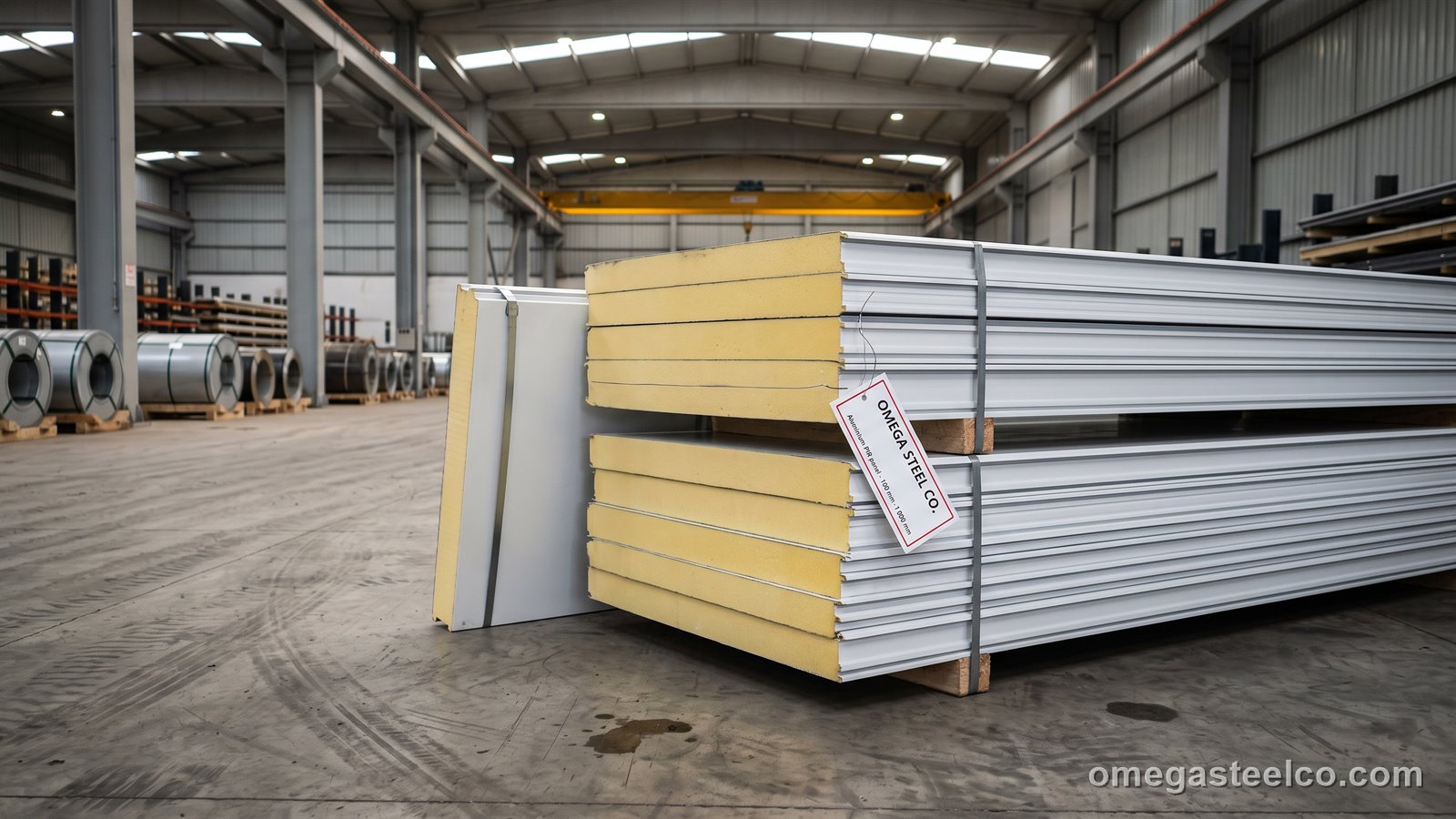
What is an aluminium sandwich panel?
An aluminium sandwich panel is a factory-made insulated wall or roof element — a rigid PIR or PUR foam core or a mineral-wool lamella core bonded between two metal skins — in which the skins are coil-coated aluminium instead of pre-painted galvanized steel. The skins are EN AW-3105 or 3005 alloy in H44 temper, 0.50–0.70 mm, micro-ribbed, lightly profiled or flat, coated to EN 1396 with polyester (PE 25 µm) for standard use, PVDF (25–35 µm) for coastal and architectural façades, or a food-contact lacquer on the inner face for food, dairy and pharmaceutical halls. Aluminium's advantage over steel is the edge: a steel panel is cut, drilled and scratched on site, and at every one of those places the zinc and paint are gone and the steel is exposed — in a fish plant, a salt store, a poultry house washed with chlorine or a Gulf coastal site it rusts there in a few years. Aluminium at the same cut simply forms its oxide and stops. The panel is 35 % lighter (a 100 mm PIR wall panel weighs about 9 kg/m² instead of 13), reflects more heat, is non-magnetic and non-sparking, and sheds no zinc or iron into food or clean water. Its trade-offs are price (about 30–50 % over the steel-faced panel), lower skin stiffness (spans about 15–20 % shorter for the same core) and higher thermal expansion (dark PVDF colours limited to 6–8 m panels). We make aluminium-faced panels on our continuous PIR / PUR line and on the rockwool line in 40–200 mm, roof profile (5-rib), wall (micro-rib, flat, box), cam-lock cold-room and fire-rated versions, with matching aluminium flashings and stainless fixings.
Panel types and cores
| Panel | Core | Thickness | λ (W/mK) | Skins | Fire class | Use |
|---|---|---|---|---|---|---|
| Wall panel (micro-rib / flat / box) | PIR | 40–150 mm | 0.022 | 0.50–0.70 mm | B-s1,d0 (B-s2,d0) | walls of coastal, food and chemical plants |
| Roof panel (5-rib, 40 mm rib) | PIR | 40–150 mm | 0.022 | 0.60–0.70 mm outer / 0.50 inner | B-s1,d0 | pitched roofs from 5° |
| Cold-room panel (cam-lock) | PIR / PUR | 60–200 mm | 0.022–0.024 | 0.50–0.60 mm, food-grade | B-s2,d0 | cold and freezer stores, CA stores, processing rooms |
| Fire wall panel | rockwool 100–150 kg/m³ | 50–200 mm | 0.040 | 0.60–0.70 mm | A2-s1,d0 · EI 30–120 | fire compartments, boiler rooms, kitchens |
| Rockwool roof panel | rockwool lamella | 80–200 mm | 0.040 | 0.70 mm outer | A2-s1,d0 · REI 30–60 | fire-rated roofs |
| Ceiling / partition panel | PIR | 40–100 mm | 0.022 | 0.50 mm both | B-s1,d0 | suspended ceilings, hygienic partitions |
Standard cover width 1 000 mm (1 150 mm on request), lengths 2–13.5 m; PIR cores are pentane-blown, CFC / HCFC-free; rockwool cores are cut and rotated lamellae bonded with two-component PU. Panels are CE-marked to EN 14509.
Thermal performance and weight
| Thickness | PIR U (W/m²K) | PIR weight (kg/m²) | Rockwool U (W/m²K) | Rockwool weight (kg/m²) |
|---|---|---|---|---|
| 40 mm | 0.52 | 6.5 | — | — |
| 50 mm | 0.42 | 6.9 | 0.78 | 11.5 |
| 60 mm | 0.35 | 7.3 | 0.65 | 13.0 |
| 80 mm | 0.27 | 8.1 | 0.49 | 16.0 |
| 100 mm | 0.21 | 8.9 | 0.39 | 19.0 |
| 120 mm | 0.18 | 9.7 | 0.33 | 22.0 |
| 150 mm | 0.14 | 10.9 | 0.26 | 26.5 |
| 200 mm | 0.11 | 12.9 | 0.20 | 34.0 |
Steel-faced PIR panels of the same thickness weigh about 3.5–4.5 kg/m² more. U-values per EN 14509 for the panel body; joints and fixings add 0.01–0.03 W/m²K.
Span tables
| Thickness | Single span | Multi span | Roof panel, 0.75 kN/m² (multi) |
|---|---|---|---|
| 40 mm | 2.6 m | 3.0 m | — |
| 60 mm | 3.3 m | 3.8 m | 2.6 m |
| 80 mm | 3.8 m | 4.4 m | 3.1 m |
| 100 mm | 4.3 m | 4.9 m | 3.5 m |
| 120 mm | 4.7 m | 5.3 m | 3.9 m |
| 150 mm | 5.2 m | 5.9 m | 4.3 m |
About 15–20 % less than steel-faced panels of the same thickness because of the aluminium skin's lower modulus; increase skin thickness to 0.70 mm for spans within 10 % of steel. Rockwool panels span about 20 % less than PIR. The project engineer designs to EN 14509 with the site loads and the panel's declared values.
Skins, colours and food-grade finishes
| Skin | Alloy | Coating | Where |
|---|---|---|---|
| Standard outer | 3105 H44 0.60 mm | PE 25 µm, RAL 9002 / 9010 / 9006 / 7016 stock | walls and roofs, C3–C4 |
| Coastal / architectural outer | 3105 or 3005 H44 0.60–0.70 mm | PVDF 25–35 µm, any RAL, metallic | C5 marine, façades, colour warranty 20 yr |
| Food-grade inner | 3105 H44 0.50 mm | food-contact PE 25 µm (EU 10/2011 / FDA), white | food, dairy, meat, pharma, cold rooms |
| Chemical inner | 3105 H44 0.50 mm | PVDF or HDP, washdown-resistant | chemical, fertiliser, chlorine washdown |
| Stucco mill-finish outer | 3105 H44 0.60 mm | uncoated stucco | industrial, budget corrosion resistance |
| Bare-mill inner | 3105 H44 0.50 mm | uncoated | warehouses, unheated buildings |
Dark PVDF colours (LRV < 20 %) on aluminium are limited to 6–8 m panel length for thermal bowing; light colours to 13.5 m.
Cold rooms, food plants and washdown
Aluminium-faced cam-lock panels are the natural cold-room panel for coastal and food sites: the food-grade white inner skin is smooth, non-porous, resistant to daily chlorinated or alkaline washdown and to the acids of fish and dairy processing, and a knocked or drilled panel does not develop the rust bloom that condemns a steel panel in a hygiene audit. Panels are joined with cam-locks or tongue-and-groove joints sealed with PU and finished with aluminium coving, corner and floor profiles and hygienic PVC or aluminium trims; cold-room doors, fast-action doors, floor panels with plywood or high-density core and pressure-relief valves complete the room. PIR cores of 100–200 mm cover chilled to deep-freeze (−40 °C) and controlled-atmosphere stores; a full room ships flat-packed with a numbered layout.
Fixing, jointing and compatibility
Wall panels are fixed through the joint or the face with stainless A2 / A4 self-drilling screws with EPDM washers into steel or concrete substructures, with a separation tape between aluminium and steel purlins or wet concrete; roof panels through the rib crests with stainless screws and saddle washers, end laps 200 mm sealed with butyl. Joints are the panel's tongue-and-groove with a factory-fitted PE seal or site-applied PU foam; flashings, corners, ridges and drips are folded from the same coil-coated aluminium and riveted with stainless rivets. Cut with a fine-tooth circular saw or nibbler — never an abrasive disc — and clean swarf from the skins immediately. Panels on dark PVDF colours are fixed with sliding-slot fixings on lengths over 6 m.
Where it is used
- Coastal and offshore-supply buildings, ports and marinas
- Fish, shrimp, poultry, meat and dairy processing plants
- Cold, freezer and controlled-atmosphere stores
- Chemical, fertiliser, salt and desalination plants
- Swimming-pool halls, spas and water-treatment works
- Pharmaceutical and clean-room shells
- Resorts, showrooms and architectural façades in PVDF colours
Aluminium-faced vs steel-faced sandwich panel
| Aluminium-faced | Steel-faced (PPGI 0.50 mm) | Steel-faced PVDF / aluzinc | |
|---|---|---|---|
| Weight | ≈ 8.9 kg/m² | ≈ 12.5 kg/m² | ≈ 12.5 kg/m² |
| Cut-edge corrosion | none | white / red rust in C4–C5 | slower, still present |
| Life in food / coastal plant | life of the core (30–40 yr) | 8–15 yr | 15–20 yr |
| Hygiene audit risk | low | rust bloom at damage | medium |
| Span (multi, wall) | 4.9 m | 5.8 m | 5.8 m |
| Thermal bowing (dark colours) | limit 6–8 m panels | 13.5 m | 13.5 m |
| Fire class (PIR) | B-s1,d0 | B-s1,d0 | B-s1,d0 |
| Price index / m² | 1.35–1.5 | 1.0 | 1.15 |
| Choose for | salt, acid, ammonia, washdown, weight | inland, dry, budget | coastal on a budget |
The steel-faced panel types are on the [sandwich panel hub](/products/roofing/sandwich-panel/) — [PIR](/products/roofing/pir-sandwich-panel/), [rockwool](/products/roofing/rockwool-sandwich-panel/) and [cold room](/products/roofing/cold-room-panel/) pages.
Price per m²
Aluminium sandwich panels are priced per m² by core, thickness and skin: about 30–50 % above the equivalent steel-faced PIR panel, the difference being the aluminium coil (LME-linked) and the thicker outer skin; PVDF adds 15–20 %, food-grade inner skin 5–8 %, rockwool cores 20–30 % over PIR at equal thickness, cam-lock cold-room panels 10–15 % over wall panels. Flashings per metre, doors and accessories per piece. Send the panel type, thickness, skins and colours, m² and panel lengths for a firm FOB Istanbul or CIF price within two working days; aluminium panels are quoted per project, not from the monthly band list.
Export and packing
Panels are stacked 8–14 per pack (by thickness) on polystyrene blocks with PE film, corner protectors and strapping — aluminium skins are protected by a peelable film that stays on until installation; packs are labelled with type, thickness, length, colour and count and loaded in 40' HC containers (about 150–250 m² of 100 mm panel per pack, 1 000–1 400 m² per container by thickness) or on open trucks. Flashings, screws, sealants, cam-lock keys and doors are boxed per building with the layout. Cold rooms ship as numbered kits. HS code 7610.90 / 9406.90.
Certificates
CE marking and declaration of performance to EN 14509 (thermal, mechanical, fire), EN 13501-1 reaction-to-fire and EN 13501-2 fire-resistance reports for rockwool panels, coil certificates EN 10204 3.1 for the aluminium skins, EU 10/2011 / FDA declaration for food-grade lacquer, ISO 9001; span tables and U-value calculations from our design office.
How to order
Specify wall or roof (or cold room / fire panel), core and thickness (or the U-value / fire rating required), outer and inner skin thickness, coating and RAL colour, cover width, panel lengths and count (or send the elevations), flashings, doors and accessories, and the destination; we return the panel schedule, span check and price within two working days.
Standards
- EN 14509 — self-supporting double-skin metal-faced insulating panels (CE)
- EN 1396 — coil-coated aluminium sheet
- EN 485 / EN 573-3 — aluminium sheet and alloys
- EN 13501-1 — reaction to fire (B-s1,d0 PIR; A2-s1,d0 rockwool)
- EN 13501-2 — fire resistance (EI 30–120 rockwool)
- EU 10/2011 / FDA — food-contact lacquer on inner skin
Frequently asked questions
Why choose an aluminium-faced sandwich panel over steel?
Because cut edges, screw holes and scratches do not rust: in salt air, food-plant washdown, ammonia or chlorides a steel-faced panel corrodes at its damage points within 8–15 years, an aluminium-faced panel lasts the life of the core; it is also 35 % lighter and sheds no zinc or iron.
What cores are available with aluminium skins?
PIR (standard, λ 0.022, B-s1,d0), PUR for cold rooms, and rockwool (A2-s1,d0, EI 30–120) for fire walls and roofs, in 40–200 mm.
How much does an aluminium PIR panel weigh?
About 8.9 kg/m² at 100 mm with 0.60 / 0.50 mm skins — roughly 3.5–4.5 kg/m² less than the steel-faced equivalent.
What is the span of an aluminium sandwich panel?
About 15–20 % less than steel-faced: a 100 mm PIR wall panel spans about 4.3 m single / 4.9 m multi under 0.8 kN/m² wind; 0.70 mm skins bring it within 10 % of steel.
Are aluminium panels suitable for cold rooms and food plants?
Yes — with a food-grade white inner skin (EU 10/2011 / FDA) they are the preferred cold-room and processing-hall panel for fish, meat, poultry and dairy sites, resistant to daily chlorinated washdown.
Can I have dark colours on aluminium panels?
Yes in PVDF, but dark colours (LRV < 20 %) are limited to 6–8 m panel lengths and sliding fixings because aluminium expands twice as much as steel.
What fixings are used?
Stainless A2 / A4 self-drilling screws with EPDM washers, stainless rivets for flashings, and a separation tape between aluminium and steel or concrete.
How much more do aluminium sandwich panels cost?
About 30–50 % over steel-faced PIR panels of the same thickness; PVDF and food-grade skins add 5–20 %. Quoted per project.