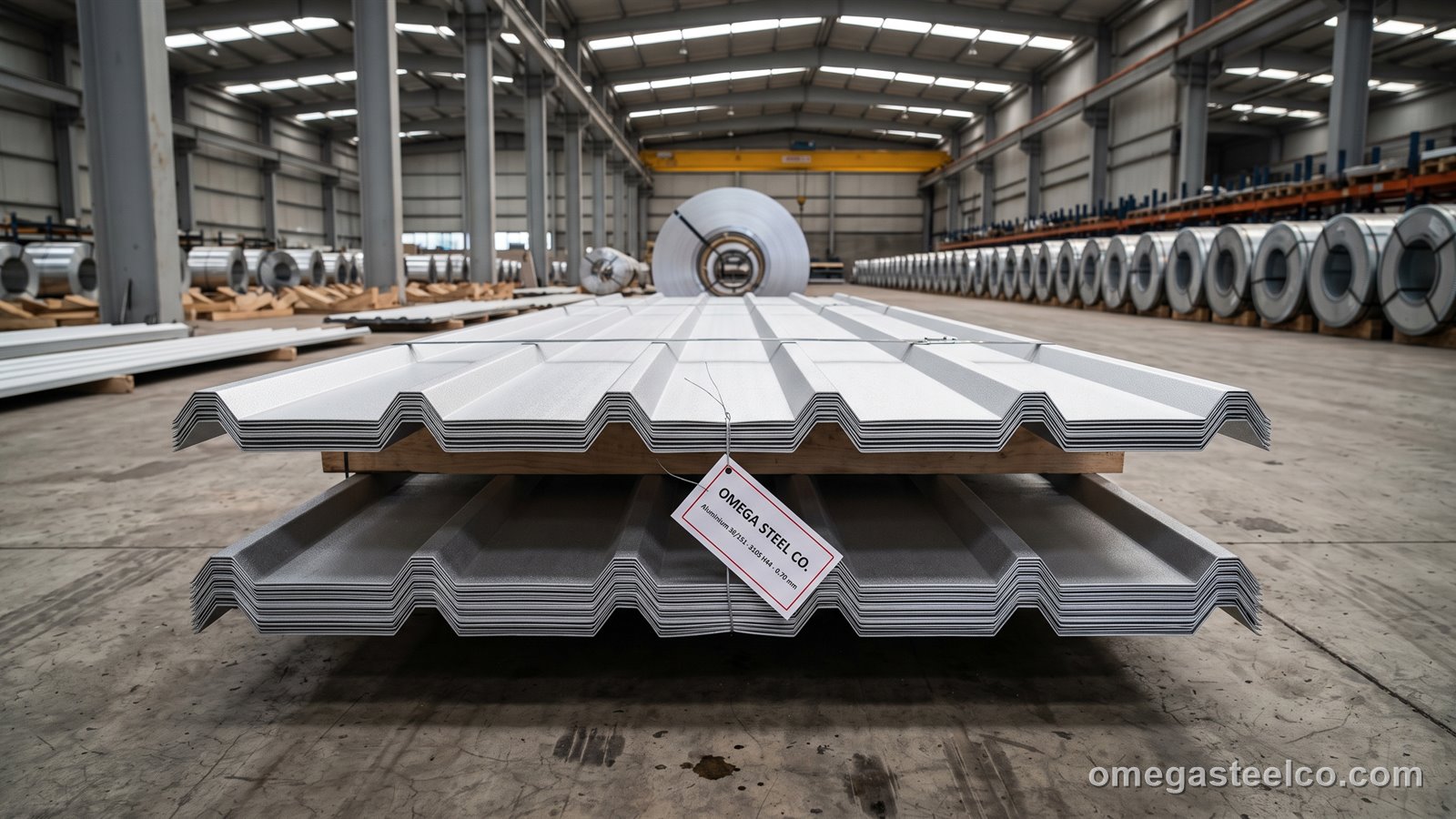
What is aluminium trapezoidal sheet?
Aluminium trapezoidal sheet is a self-supporting roofing and cladding profile roll-formed from aluminium alloy coil instead of galvanized steel. The alloys are the manganese-hardened roofing grades EN AW-3105 (AlMn0.5Mg0.5) and EN AW-3003 (AlMn1Cu) in the H44 or H46 temper — strong enough to hold a trapezoidal rib at 0.60–1.00 mm, ductile enough to roll and fold — and, for marine and chemical exposure, the magnesium alloy EN AW-5754 (AlMg3). The surface is left as rolled (mill finish, which weathers to a soft grey oxide), stucco-embossed (a pebble texture that hides oil-canning and scratches and is the standard for industrial roofs) or coil-coated to EN 1396 in polyester or PVDF on a chromate-free pretreatment. Against steel the sheet weighs about a third (2.7 kg/dm³ against 7.85), never rusts — aluminium forms its own protective oxide, so cut edges, screw holes and scratches do not corrode — is non-magnetic and non-sparking, and reflects 80–90 % of solar heat in mill finish. Its costs are a higher price per m² (about 2–3 times galvanized steel at equal thickness), a lower stiffness (Young's modulus 70 GPa against 210), which means closer purlins or a deeper profile, twice the thermal expansion (24 µm/m·°C), which the fixing detail must allow for, and the need to isolate it from copper, wet concrete and unprotected steel to prevent galvanic corrosion. We roll the 27/150, 38/151 and 45/333 trapezoidal profiles and the 18/76 corrugated in aluminium on our own lines from stocked 3105 H44 coil, cut to length to 12 m, and fold flashings, ridge caps, gutters and cappings from the same coil.
Profiles, dimensions and weight
| Profile | Rib height | Rib pitch | Cover width | Thickness | kg/m² (0.70 mm) | Use |
|---|---|---|---|---|---|---|
| 18/76 corrugated | 18 mm | 76 mm | 1 000 mm | 0.60–0.80 mm | ≈ 2.2 | sheds, fences, curved roofs — see the aluminium corrugated page |
| 27/150 | 27 mm | 150 mm | 1 050 mm | 0.60–0.80 mm | ≈ 2.1 | walls, canopies, light roofs, purlins ≤ 1.2 m |
| 38/151 | 38 mm | 151 mm | 906 mm | 0.70–1.00 mm | ≈ 2.4 | the standard roof profile, purlins 1.2–1.8 m |
| 45/333 | 45 mm | 333 mm | 1 000 mm | 0.70–1.00 mm | ≈ 2.3 | long-span roofs and walls, purlins 1.5–2.2 m |
| Fence / cladding 20/125 | 20 mm | 125 mm | 1 000 mm | 0.60–0.70 mm | ≈ 2.0 | screening, fences, kiosks |
Weight per m² covered = sheet weight × overlap factor; aluminium at 2.70 kg/dm³ (0.70 mm flat sheet = 1.89 kg/m²). Lengths to 12 m in one piece; sheets over 8 m are shipped flat-rack or on open trucks.
Alloys, tempers and surface finishes
| Alloy / temper | Rp0.2 (MPa) | Finish | Corrosion class | Choose for |
|---|---|---|---|---|
| EN AW-3105 H44 | ≥ 150 | mill, stucco, PE / PVDF coated | C3–C4 | the standard roofing coil — stocked |
| EN AW-3003 H44 / H46 | ≥ 145 / 165 | mill, stucco, coated | C3–C4 | roofing and cladding, good forming |
| EN AW-5754 H24 | ≥ 130 | mill, stucco | C5-M (marine) | coastal, offshore, chemical and fertiliser plants |
| EN AW-1050 H24 | ≥ 85 | mill, stucco | C4 | light cladding, fences, insulation jacketing |
| Coil-coated PE 25 µm (EN 1396) | — | any RAL, gloss / matt | C3 | coloured roofs and walls, 10–15-yr colour life |
| Coil-coated PVDF 25–35 µm | — | RAL and metallic | C4–C5 | architectural façades, 20–25-yr colour warranty |
Stucco embossing is applied to mill-finish coil before rolling; it stiffens thin sheet, hides scratches and diffuses glare. Coated coil is rolled with the protective film on.
Span, purlin spacing and load
| Profile / thickness | Single span | Multi span | Wall (wind 0.8 kN/m²) |
|---|---|---|---|
| 27/150 — 0.70 mm | 0.9 m | 1.1 m | 1.4 m |
| 27/150 — 0.80 mm | 1.0 m | 1.2 m | 1.6 m |
| 38/151 — 0.70 mm | 1.2 m | 1.5 m | 1.9 m |
| 38/151 — 0.80 mm | 1.4 m | 1.7 m | 2.1 m |
| 38/151 — 1.00 mm | 1.6 m | 2.0 m | 2.4 m |
| 45/333 — 0.80 mm | 1.5 m | 1.9 m | 2.3 m |
| 45/333 — 1.00 mm | 1.8 m | 2.2 m | 2.7 m |
Aluminium's modulus is one-third of steel's: for the same profile and thickness the purlin spacing is about 25–35 % closer than for steel sheet. Values are indicative; the project engineer designs to EN 1999-1-4 with the site's snow and wind loads.
Where aluminium beats galvanized steel
The economics turn on maintenance and life, not on the sheet price. A galvanized or PPGI steel roof in a C5 environment — a fertiliser plant, a desalination site, a fish-processing hall, a salt store, a pool hall, anywhere within a kilometre of the sea in the Gulf — starts to show white rust at cut edges and red rust at screw holes in three to seven years and is replaced in ten to fifteen; aluminium in the same place needs nothing for forty years. Aluminium also wins where weight matters (long spans on light structures, retrofit over an old roof, tall canopies, mobile and prefabricated buildings), where sparks or magnetism are a problem (ammunition, gas and grain stores), where a bright reflective roof reduces cooling load, and where a food, pharmaceutical or clean-water client wants a skin that sheds no zinc or iron. Steel keeps the advantage on cost, on stiffness (longer spans for the same profile), on fire rating of the bare sheet (aluminium softens at 250 °C), and wherever the roof is not attacked — a dry inland warehouse is better served by 0.50 mm PPGI.
Fixing, lapping and thermal movement
Aluminium sheet is fixed through the rib crests with stainless-steel (A2 / A4) or aluminium-shank self-drilling screws with EPDM-bonded washers — never with plain zinc-plated steel screws, which corrode the sheet galvanically. Side laps of one rib are sealed with butyl tape and stitched with stainless rivets at 500 mm; end laps 200 mm on roofs above 10° and 250 mm below, sealed. Because aluminium moves 2.4 mm per metre for a 100 °C swing, sheets over 8 m use oversized fixing holes or sliding clips at the intermediate purlins and fixed points at the ridge, and flashings are lapped rather than riveted along their length. Separate the sheet from wet concrete, mortar, timber preservatives, copper and bare steel purlins with a bituminous or PE tape, use aluminium or stainless flashings and gutters, and avoid run-off from copper pipes onto the roof. Cutting is by nibbler or fine-tooth circular saw — abrasive discs embed iron particles that rust-stain the surface.
Accessories rolled and folded from the same coil
- Ridge caps, hip and valley flashings, eaves and verge trims in matching alloy and finish
- Aluminium gutters, downpipes and fascias (0.80–1.00 mm)
- Wall corner, drip and sill flashings
- Profile fillers (closed-cell PE) and butyl sealing tape
- Stainless A2 / A4 self-drilling screws with EPDM washers, colour-capped
- Translucent polycarbonate rooflights in the same profile
Where it is used
- Coastal and marine buildings — ports, shipyards, fish halls, beach resorts
- Chemical, fertiliser, salt, sulphur and desalination plants
- Food, dairy, beverage and pharmaceutical plants (no zinc or iron shedding)
- Swimming-pool halls, spas and water-treatment works
- Cold stores and refrigerated logistics buildings
- Long-span canopies, stadium roofs and retrofit over old roofs
- Ammunition, gas and grain stores (non-sparking, non-magnetic)
Aluminium vs galvanized vs PPGI vs aluzinc trapezoidal
| Aluminium 3105 H44 | Galvanized Z275 | PPGI PE 25 µm | Aluzinc AZ150 | |
|---|---|---|---|---|
| Weight | ≈ 2.4 kg/m² | ≈ 4.5 kg/m² | ≈ 4.6 kg/m² | ≈ 4.4 kg/m² |
| Life in C5 marine | 40+ years | 5–10 years | 10–15 years | 15–20 years |
| Cut-edge corrosion | none | white / red rust | red rust under paint | slow |
| Purlin spacing (38/151) | 1.2–1.6 m | 1.8–2.2 m | 1.8–2.2 m | 1.8–2.2 m |
| Thermal expansion | 24 µm/m·°C | 12 | 12 | 12 |
| Solar reflectance | 80–90 % (mill) | 60 % | by colour | 70 % |
| Fire | softens 250 °C, melts 660 °C | A1 | A1 (paint limited) | A1 |
| Price per m² (index) | 2.0–3.0 | 1.0 | 1.2 | 1.3 |
| Choose for | coastal, chemical, weight-critical, 40-yr life | dry inland, budget | coloured roofs inland | coastal on a budget |
Aluzinc and galvanized steel are on the [trapezoidal hub](/products/roofing/trapezoidal-corrugated-sheet/); the steel profiles have their own pages for [27/150](/products/roofing/trapezoidal-sheet-27-150/), [38/151](/products/roofing/trapezoidal-sheet-38-151/) and [45/333](/products/roofing/trapezoidal-sheet-45-333/).
Price per m²
Aluminium trapezoidal sheet is priced per m² covered from the aluminium coil price (LME plus the mill's rolling and coating premium), which moves independently of steel: mill-finish 0.70 mm 3105 sits at roughly two to three times galvanized 0.50 mm steel per m², stucco adds a few percent, PE coating about 20 %, PVDF 40–50 %, and 5754 marine alloy 15–20 % over 3105. Flashings and gutters are priced per metre. Quotations are per project — send profile, thickness, finish, sheet lengths and m² for a firm FOB Istanbul or CIF price within a working day; aluminium bands are not on the monthly steel list.
Export and packing
Sheets are stacked 20–40 per pack with paper or foam between coated sheets, on timber bearers with edge boards, strapped and PE-wrapped against moisture — aluminium stains under trapped condensation, so packs are shipped dry with desiccant for sea freight. A 40' HC takes 3 000–4 000 m² of 6 m sheet (aluminium packs are light, so volume, not weight, fills the container); sheets over 12 m go flat-rack. Flashings and screws are boxed per roof. HS code 7606.12 (sheet) / 7610.90 (fabricated).
Certificates
Coil certificates EN 10204 3.1 (alloy, temper, mechanical properties, coating system for coated coil) per batch; our CE declaration of performance under EN 14782 for the rolled profile; load-span tables to EN 1999-1-4 on request; certificate of origin and destination conformity documents through the forwarder.
How to order
Specify the profile (27/150, 38/151, 45/333 or corrugated), alloy (3105 as standard, 5754 for marine), thickness, finish (mill / stucco / PE or PVDF with RAL), sheet lengths and count per length or the roof m² and slope, flashings and gutters, fixings, and the destination; we return a cutting schedule and price within a working day.
Standards
- EN 485 — wrought aluminium sheet, strip and plate (mechanical properties)
- EN 573-3 — chemical composition (EN AW-3105, 3003, 5754)
- EN 1396 — coil-coated aluminium sheet and strip
- EN 14782 — self-supporting metal sheet for roofing (CE marking)
- EN 1999-1-4 (Eurocode 9) — cold-formed aluminium structural sheeting
- EN 10204 3.1 — inspection certificates
Frequently asked questions
What alloy is aluminium roofing sheet made of?
EN AW-3105 or 3003 in H44 temper for standard roofing (≥ 150 MPa yield, good forming), EN AW-5754 (AlMg3) for marine and chemical sites; rolled from 0.60–1.00 mm coil.
How much does aluminium trapezoidal sheet weigh?
About 2.0–2.5 kg/m² covered at 0.70 mm — roughly one-third of a 0.50 mm steel sheet (4.5 kg/m²).
What purlin spacing does aluminium sheet need?
About 25–35 % closer than steel: 38/151 at 0.70 mm spans 1.2 m single / 1.5 m multi under 0.75 kN/m²; 1.00 mm reaches 1.6 / 2.0 m. The engineer designs to EN 1999-1-4.
Which screws for aluminium roofing?
Stainless A2 / A4 or aluminium-shank self-drillers with EPDM washers; never plain zinc-plated steel screws, and isolate the sheet from steel purlins, copper and concrete.
Does aluminium sheet expand more than steel?
Yes, twice as much (24 µm/m·°C): a 10 m sheet moves 24 mm over a 100 °C range. Use sliding fixings on long sheets and lapped flashings.
Is aluminium roofing more expensive than galvanized?
Per m² about 2–3 times at equal profile, but with a 40-year maintenance-free life in coastal and chemical environments where steel is replaced in 10–15 years.
Can you roll aluminium in colours?
Yes — coil-coated PE or PVDF aluminium in any RAL to EN 1396, rolled with the film on, from 500 m² per colour; mill and stucco finishes from stock.
Can aluminium trapezoidal sheet be curved?
Corrugated 18/76 crimp-curves to R ≥ 1.5 m and 27/150 to R ≥ 4 m on our line; aluminium curves more easily than steel.