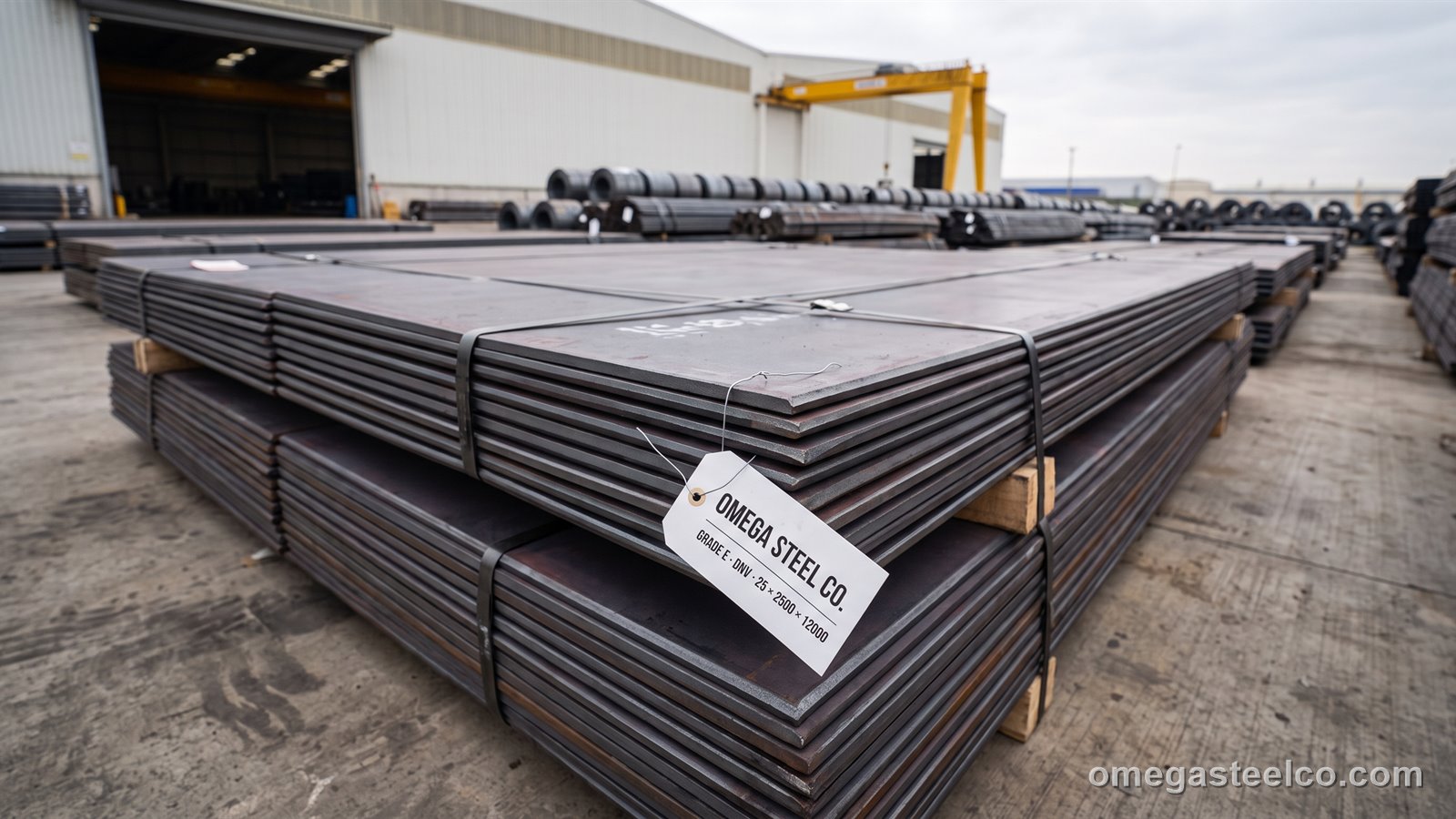
What is Grade E ship plate?
Grade E is Grade D pushed to −40 °C. The chemistry envelope is the same — carbon ≤ 0.21 %, manganese ≥ 0.60 %, killed, fine-grain treated — but the mill runs it leaner (carbon typically 0.10–0.15 %, sulphur ≤ 0.010 %) and normalises every plate, because the −40 °C guarantee through 60 mm is not reached as-rolled; TM rolling is allowed only where the mill's approval for Grade E covers it. In the IACS material tables the E grade is required for special members (sheer strake, deck stringer, bilge strake, hatch coamings) above about 30 mm, for primary members above 40–50 mm, throughout the ice belt of ships with ice-class notations, and for any structure whose design temperature is below −20 °C. Arctic supply vessels, icebreaking tugs, Baltic ferries, dredgers and fishing vessels built to mild-steel scantlings all carry Grade E in these positions; harbour and quayside structures in cold climates specify it when a class-certified 235 MPa plate is preferred to a structural S235J2 or S275NL. Where plates are loaded through thickness at cruciform joints, Grade E is ordered with Z35 (EN 10164) and ultrasonic testing. Plates are rolled at society-approved mills, stamped with mark, heat and grade and released on the surveyor's certificate.
Chemical composition
| Element | C | Si | Mn | P | S | Al |
|---|---|---|---|---|---|---|
| max. % (ladle) | ≤ 0.21 | 0.10–0.35 | ≥ 0.60 | ≤ 0.035 | ≤ 0.035 | ≥ 0.015 (total) |
Fully killed, fine-grain treated (Al total ≥ 0.015 % or equivalent). C + Mn/6 ≤ 0.40 %. Normalised (TM only under specific mill approval). Mills typically run C 0.10–0.15 %, S ≤ 0.010 % for Grade E.
Mechanical properties
| Property | Requirement | Typical value | Note |
|---|---|---|---|
| Yield strength ReH | ≥ 235 MPa | 255–300 MPa | |
| Tensile strength Rm | 400–520 MPa | 420–470 MPa | |
| Elongation A5 | ≥ 22 % | 28–34 % | |
| Charpy V, longitudinal | ≥ 27 J at −40 °C | 50–110 J | t ≤ 50 mm; 20 J transverse |
| Charpy V, t 50–70 mm | ≥ 34 J at −40 °C | — | |
| Bend test | 180°, 3 t | passes |
Equivalent grades
| System | Grade | Note |
|---|---|---|
| ASTM A131 | Grade E | identical |
| LR | Grade E | |
| DNV | NV E | |
| BV | Grade E | |
| ABS | Grade E | |
| GL (legacy) | GL-E | |
| EN 10025-3 (approx.) | S275NL | normalised, −50 °C; no class certificate |
| GOST 5521 (approx.) | E | CIS shipbuilding steel |
Ice class and design temperature
| Situation | Members | Grade required | Note |
|---|---|---|---|
| Open-water hull, special members | sheer strake, stringer, bilge strake, coamings > 30 mm | E | D below 30 mm |
| Open-water hull, primary members | strength deck, bottom shell > 40–50 mm | E | |
| Ice class 1A / 1A Super (Baltic) | ice-belt shell plating | D to 20–25 mm, E above | plus frames and stringers in the ice belt |
| Polar class PC5–PC7 | ice belt, bow and stern areas | E (or EH grades) | design temperature −30 to −40 °C |
| Design temperature below −20 °C (any notation) | all exposed plating | E | Arctic, Sakhalin, Northern Norway winter |
| Offshore / quayside at −40 °C | primary structure | E with Z35 and UT | or EH32 / EH36 for higher strength |
Thickness range and stock sizes
| Thickness | Widths × lengths | Availability |
|---|---|---|
| 10–20 mm | 2 000 / 2 500 × 6 000–12 000 | mill order 5–7 weeks; some class stock |
| 25–40 mm | 2 500 / 3 000 × 6 000–12 000 | mill order, normalised |
| 50–60 mm | 2 500 / 3 000 × 6 000–10 000 | mill order; UT recommended |
| Cut / bevelled | plasma to 60 mm; K / X bevels | from the nesting file |
Weight per m² and per plate
| Thickness | kg/m² | 1 500 × 6 000 (kg) | 2 000 × 6 000 (kg) | 2 500 × 12 000 (kg) |
|---|---|---|---|---|
| 10 mm | 78.5 | 707 | 942 | 2 355 |
| 12 mm | 94.2 | 848 | 1 130 | 2 826 |
| 15 mm | 117.8 | 1 060 | 1 413 | 3 533 |
| 20 mm | 157.0 | 1 413 | 1 884 | 4 710 |
| 25 mm | 196.3 | 1 766 | 2 355 | 5 888 |
| 30 mm | 235.5 | 2 120 | 2 826 | 7 065 |
| 40 mm | 314.0 | 2 826 | 3 768 | 9 420 |
| 50 mm | 392.5 | 3 533 | 4 710 | 11 775 |
| 60 mm | 471.0 | 4 239 | 5 652 | 14 130 |
Nominal weights — mill tolerance to EN 10029 class A adds up to +4 % on thin plate; invoiced on theoretical weight unless agreed otherwise.
Cutting, welding and shop primer
Plasma-cut with bevels from the nesting file. Welded with class-approved grade 4 consumables (−40 °C) by SMAW, FCAW or SAW; no preheat below 30 mm, 50 °C above or on highly restrained joints; interpass below 250 °C; heat input moderate (≤ 3.5 kJ/mm) so that the normalised structure and its −40 °C toughness survive in the HAZ — procedures are qualified with Charpy at −40 °C in weld and HAZ. Shop primer Sa 2½ plus class-approved zinc silicate 15–20 µm on request.
Where it is used
- Special and primary hull members above 30–50 mm in mild-steel hulls
- Ice-belt plating for Baltic ice class and Polar class
- Arctic and sub-Arctic supply vessels, icebreaking tugs, fishing vessels
- Dredgers and ferries for winter operation
- Cold-climate quayside and harbour structures with class certificate
Grade E vs Grade D vs EH36
Grade D is the same steel guaranteed at −20 °C and is sufficient for most cold-water plating; Grade E is required only where the material table or a design temperature below −20 °C demands it. EH36 gives 355 MPa at the same −40 °C and is the usual choice when the hull is designed to the H36 series or for offshore; EH32 covers H32 designs. Without class, S355NL reaches −50 °C as a structural grade.
Price
Grade E is priced per certificate lot: typically 10–15 % above Grade A for normalising, the −40 °C test and small lot sizes, plus survey and any Z35 / UT supplements. Send the plate list with society, condition and supplements for a firm price within a working day.
Bands from our weekly export list (September 2026), FOB Istanbul, full-container quantities, excluding freight and certificates. Firm price per project on RFQ within one working day.
Export and packing
We ship Grade E ship plate in strapped skid packs up to 5 t, each plate stencilled with its heat number so the certificate can be matched at the receiving end. Six-metre plate loads 24–25 t into a 40' HC. Plates longer than 6 m or heavier packs are booked on flat-racks or as breakbulk cargo out of Derince. Tariff heading 7208.51 / 7208.52.
| Term | Detail |
|---|---|
| MOQ | 10 t per thickness; a 20 t certificate lot is the practical minimum for a mill heat |
| Incoterms | FOB Istanbul · CIF / CFR Gulf, Africa · DAP EU, Balkans, Iraq, Caucasus · DAP Aktau |
| Lead time | Mill order 5–7 weeks; limited class stock 12–25 mm |
| Packing | Normalised plates stacked flat on hardwood bearers per heat, steel-banded and hard-stamped with grade, heat and society mark; primed plates separated by battens |
| Container / truck | 20' ≈ 20 t; 40' HC ≈ 24 t; 12 m and heavy plate breakbulk from Derince |
| Documents | Invoice, packing list, EN 10204 3.1 (3.2 on request), certificate of origin; SASO / SONCAP / PVoC on request |
| Payment | 30% advance, balance against B/L copy; L/C at sight for orders above 100 t |
Certificates and testing
Grade E ship plate ships with EN 10204 3.1 certificates cross-referenced to the stencilled heat numbers. Where the project requires it we arrange 3.2 certification with Lloyd's, BV, TÜV or SGS, ultrasonic examination to EN 10160 and Charpy testing at the temperature you specify.
How to order
Specify Grade E, the society, thickness × width × length or the nesting list, supplements (Z35, UT, extra Charpy), shop primer, quantity and port; give the ice-class notation or design temperature so the mill can confirm the heat.
Standards
- IACS UR W11
- LR / BV / DNV / ABS / RINA / TL rules
- ASTM A131 Grade E
- EN 10164 Z35 on request
- Society certificate (3.2 equivalent)
Grades
Grade data sheets (chemistry, mechanicals, equivalents) are on our reference site: Grade E · Grade D · EH36
Frequently asked questions
What is Grade E ship steel?
Normal-strength shipbuilding steel with 235 MPa yield and 400–520 MPa tensile, killed, fine-grain treated and normalised, impact-tested at −40 °C (27 J) and certified by a classification society — the E grade of the A/B/D/E series.
What is the difference between Grade D and Grade E?
Same strength and chemistry envelope; Grade E is tested at −40 °C instead of −20 °C and is always normalised. The rules require E for the thickest special members, ice belts and design temperatures below −20 °C.
Is Grade E required for ice class?
For Baltic 1A / 1A Super the ice belt is D up to about 20–25 mm and E above; Polar class and Arctic design temperatures require E (or EH grades) throughout the ice-strengthened areas.
Can Grade E be supplied with Z35 and ultrasonic testing?
Yes — EN 10164 Z35 and EN 10160 or society UT are ordered with the plate for through-thickness-loaded joints and offshore structures.
What is the lead time for Grade E?
Mostly mill order, 5–7 weeks; limited 12–25 mm class stock. Cutting and bevelling at Dilovası add 3–5 working days.