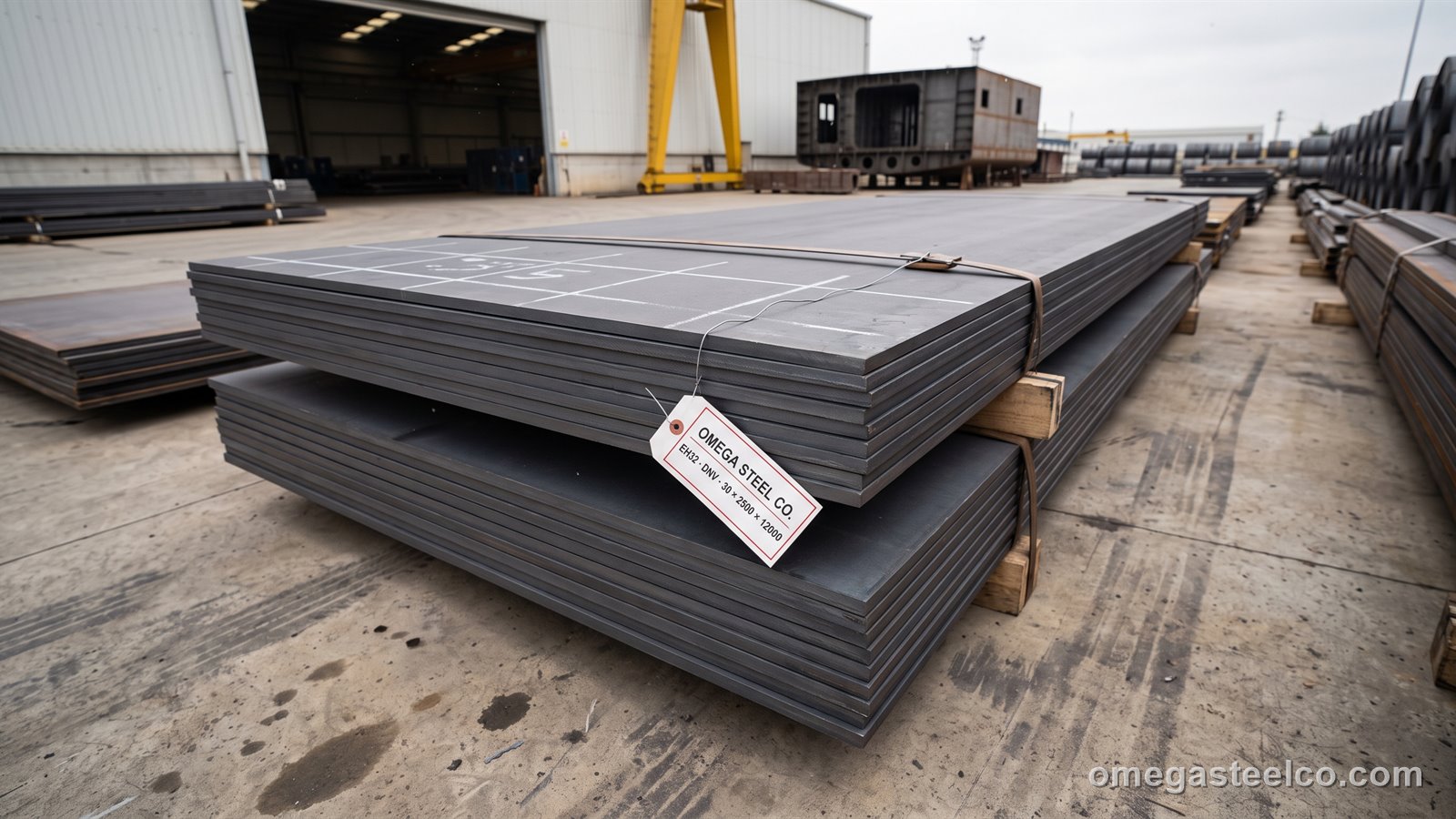
What is EH32 steel plate?
EH32 completes the H32 series at −40 °C. The chemistry limits are those of AH32 and DH32, but the mill controls it more tightly — carbon typically 0.10–0.14 %, sulphur ≤ 0.010 % on most heats, niobium-titanium fine-grain practice — and the delivery condition is normalised or TM-rolled with accelerated cooling, because 31 J at −40 °C through 80 mm is only reached with a uniformly fine ferrite grain. The E grade appears in the class material tables wherever a brittle fracture would be catastrophic: sheer strake and deck stringer above about 25–30 mm, bilge strake above 30 mm, hatch coamings and ice-belt plating of ships with Polar or Baltic ice notations, and throughout hulls with a design temperature below −20 °C. It is also the shipbuilding grade that offshore fabricators use for jack-up legs, modules and quayside structures at −40 °C design temperature when a 315 MPa steel with class certification is preferred over a structural S355NL. Because these plates carry through-thickness loads at cruciform joints, EH32 is often ordered with Z35 (EN 10164) lamellar-tearing resistance and 100 % ultrasonic testing. Plates are rolled at society-approved mills, stamped and released by the surveyor.
Chemical composition
| Element | C | Si | Mn | P | S | Al | Nb | V | Ti | Cu | Cr | Ni | Mo |
|---|---|---|---|---|---|---|---|---|---|---|---|---|---|
| max. % (ladle) | ≤ 0.18 | ≤ 0.50 | 0.90–1.60 | ≤ 0.035 | ≤ 0.035 | ≥ 0.015 (total) | 0.02–0.05 | 0.05–0.10 | ≤ 0.02 | ≤ 0.35 | ≤ 0.20 | ≤ 0.40 | ≤ 0.08 |
As for the H32 series; for EH32 the mills typically run C 0.10–0.14 %, S ≤ 0.010 % and Nb + Ti fine-grain practice to reach the −40 °C toughness at thickness. CEV ≤ 0.36 (TM) / ≤ 0.40 (N).
Mechanical properties
| Property | Requirement | Typical value | Note |
|---|---|---|---|
| Yield strength ReH | ≥ 315 MPa | 335–380 MPa | |
| Tensile strength Rm | 440–570 MPa | 460–520 MPa | |
| Elongation A5 | ≥ 22 % | 26–32 % | |
| Charpy V, longitudinal | ≥ 31 J at −40 °C | 60–120 J | t ≤ 50 mm; 22 J transverse |
| Charpy V, t 50–70 mm | ≥ 38 J at −40 °C | — | 50 J above 70 mm |
| Bend test | 180°, 3 t | passes | transverse |
Equivalent grades
| System | Grade | Note |
|---|---|---|
| ASTM A131 | EH32 | identical |
| LR | EH32 | |
| DNV | NV E32 | |
| BV | EH32 | |
| ABS | EH32 | |
| GL (legacy) | GL-E32 | |
| EN 10025-3 (approx.) | S275NL | normalised structural, −50 °C; no class certificate |
| EN 10225 (offshore) | S355G-series | higher strength, offshore certified |
Through-thickness and ultrasonic options
| Option | Standard | What it guarantees | When to specify |
|---|---|---|---|
| Z35 through-thickness | EN 10164 / society rules | reduction of area ≥ 35 % in the thickness direction | plates ≥ 20 mm loaded through thickness at cruciform and T joints |
| Ultrasonic testing | EN 10160 class S2/E3 or society UT | freedom from laminations and internal defects | all E-grade plates in primary structure; offshore |
| Extra Charpy at −60 °C | society / project | toughness margin below the grade minimum | Polar class, Arctic offshore |
| CTOD testing | BS 7910 / project spec | fracture toughness of plate and HAZ | offshore primary structure |
| Shop primer | class-approved zinc silicate | Sa 2½ + 15–20 µm | yard delivery, stamps preserved |
Thickness range and stock sizes
| Thickness | Widths × lengths | Availability |
|---|---|---|
| 10–20 mm | 2 000 / 2 500 × 6 000–12 000 | mill order 5–7 weeks; some class stock |
| 25–40 mm | 2 500 / 3 000 × 6 000–12 000 | mill order, N or TM |
| 50–80 mm | 2 500 / 3 000 × 6 000–10 000 | mill order, normalised; UT recommended |
| Cut / bevelled | plasma to 80 mm; K / X bevels | from the nesting file |
Weight per m² and per plate
| Thickness | kg/m² | 1 500 × 6 000 (kg) | 2 000 × 6 000 (kg) | 2 500 × 12 000 (kg) |
|---|---|---|---|---|
| 10 mm | 78.5 | 707 | 942 | 2 355 |
| 12 mm | 94.2 | 848 | 1 130 | 2 826 |
| 15 mm | 117.8 | 1 060 | 1 413 | 3 533 |
| 20 mm | 157.0 | 1 413 | 1 884 | 4 710 |
| 25 mm | 196.3 | 1 766 | 2 355 | 5 888 |
| 30 mm | 235.5 | 2 120 | 2 826 | 7 065 |
| 40 mm | 314.0 | 2 826 | 3 768 | 9 420 |
| 50 mm | 392.5 | 3 533 | 4 710 | 11 775 |
| 60 mm | 471.0 | 4 239 | 5 652 | 14 130 |
| 80 mm | 628.0 | 5 652 | 7 536 | 18 840 |
Nominal weights — mill tolerance to EN 10029 class A adds up to +4 % on thin plate; invoiced on theoretical weight unless agreed otherwise.
Cutting, welding and shop primer
Plasma to 80 mm with bevels from the nesting file. Welding uses class-approved grade 4Y consumables (−40 °C) — SMAW low-hydrogen, FCAW rutile-basic or SAW basic flux — with preheat of 50–75 °C from 30 mm and interpass below 250 °C; heat input on TM plate limited (typically ≤ 3.0 kJ/mm) to keep HAZ toughness, and every procedure qualified with Charpy at −40 °C in weld and HAZ. Shop primer Sa 2½ plus class-approved zinc silicate 15–20 µm; stamps and heat numbers re-marked under survey.
Where it is used
- Sheer strake, deck stringer and bilge strake above 25–30 mm in H32 hulls
- Ice-belt plating for Baltic, Polar and Arctic notations
- Hatch coamings and heavy tank stringers
- Offshore modules, jack-up legs and quayside structures at −40 °C
- Cold-climate tugs, icebreaking supply craft and fishing vessels
EH32 vs DH32 vs EH36
DH32 is the same steel tested at −20 °C — sufficient for most hull members; EH32 is required only where the class table or a design temperature below −20 °C asks for it. EH36 delivers 355 MPa at the same −40 °C for H36 hulls and is the more usual offshore grade; where a structural code applies instead of class, S355NL covers −50 °C without a society certificate.
Price
EH32 is priced per certificate lot: typically 8–15 % above AH32 for the normalising / TM route, the −40 °C test and the smaller lot sizes, plus survey and any Z35 or UT supplements. Send the plate list with society and supplements for a firm price within a working day.
Bands from our weekly export list (September 2026), FOB Istanbul, full-container quantities, excluding freight and certificates. Firm price per project on RFQ within one working day.
Export and packing
We ship EH32 steel plate in strapped skid packs up to 5 t, each plate stencilled with its heat number so the certificate can be matched at the receiving end. A 40' HC takes 24–25 t of 6 m plate. Plates longer than 6 m or heavier packs are booked on flat-racks or as breakbulk cargo out of Derince. Tariff heading 7208.51 / 7208.52.
| Term | Detail |
|---|---|
| MOQ | 10 t per size; 20 t per certificate lot |
| Incoterms | FOB Istanbul · CIF / CFR Gulf, Africa · DAP EU, Balkans, Iraq, Caucasus · DAP Aktau |
| Lead time | Mill order 5–7 weeks; limited class stock 12–30 mm |
| Packing | Plates on bearers, banded, stamped; primed plates with separators |
| Container / truck | 20' ≈ 20 t; 40' HC ≈ 24 t; 12 m and heavy plate breakbulk from Derince |
| Documents | Invoice, packing list, EN 10204 3.1 (3.2 on request), certificate of origin; SASO / SONCAP / PVoC on request |
| Payment | 30% advance, balance against B/L copy; L/C at sight for orders above 100 t |
Certificates and testing
Documentation for EH32 steel plate: EN 10204 3.1 mill certificate as standard (heat number, analysis, tensile, Charpy, condition); 3.2 with an independent inspector, EN 10160 UT reports and additional low-temperature Charpy tests are available on plates above 8 mm at order.
How to order
Specify EH32, the society, thickness × width × length or the nesting list, delivery condition (N / TM), supplements (Z35, UT, extra Charpy), shop primer, quantity and port; give the design temperature if it is below −40 °C so the mill can offer a Polar-class heat.
Standards
- IACS UR W11
- LR / BV / DNV / ABS / RINA / TL rules
- ASTM A131 Grade EH32
- EN 10164 Z35 (through-thickness) on request
- Society certificate (3.2 equivalent)
Grades
Grade data sheets (chemistry, mechanicals, equivalents) are on our reference site: EH32 · DH32 · EH36
Frequently asked questions
What is EH32 steel?
A higher-strength shipbuilding steel with 315 MPa yield and 440–570 MPa tensile, impact-tested at −40 °C (31 J), normalised or TM-rolled and certified by a classification society — the E grade of the H32 series.
What is the difference between EH32 and EH36?
Strength: 315 against 355 MPa yield. Both are −40 °C grades; EH36 is the usual choice for H36 hulls and offshore, EH32 for H32-series designs and where a lower yield ratio is wanted.
When does the class require EH32?
For the most critical members (sheer strake, deck stringer, coamings) above about 25–30 mm, ice-belt plating with ice-class notations, and throughout hulls or structures with a design temperature below −20 °C.
Can EH32 be supplied with Z35 and UT?
Yes — EN 10164 Z35 through-thickness and EN 10160 or society ultrasonic testing are ordered with the plate; both are standard for offshore primary structure.
What is the lead time for EH32?
Mostly mill order, 5–7 weeks; some 12–30 mm class stock exists. Cutting and bevelling at Dilovası add 3–5 working days.