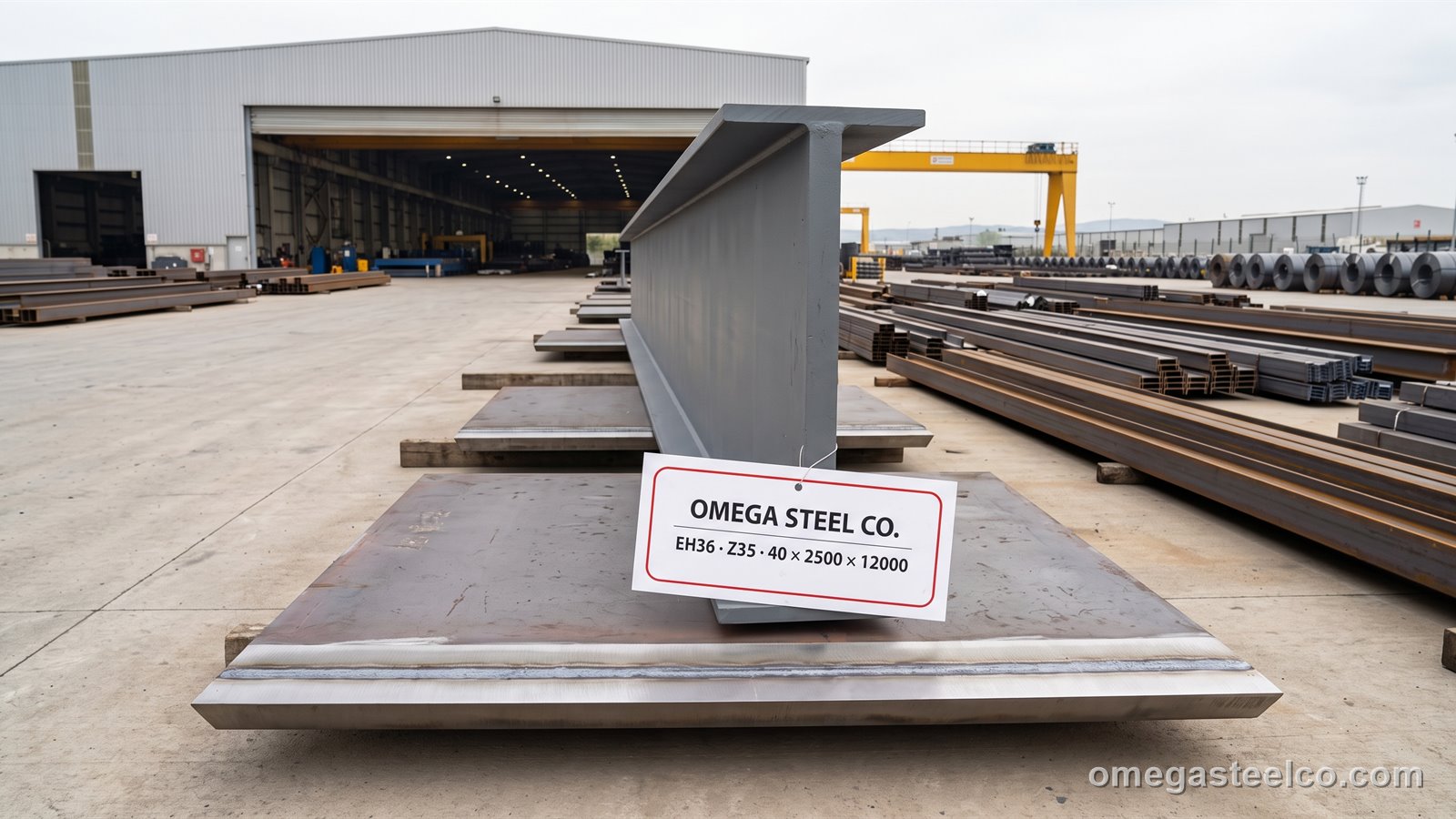
What is EH36 steel plate?
EH36 is the third toughness grade of the 355 MPa hull steels, guaranteeing 34 J longitudinal (24 J transverse) Charpy energy at −40 °C, and the societies allow it only in the normalised, normalised-rolled or thermomechanically rolled condition — never as rolled — with full killing, aluminium fine-grain treatment and micro-alloying. That processing gives a uniform fine ferrite–pearlite (N) or bainitic (TM) structure with a low ductile-to-brittle transition temperature even at 80–100 mm, and it is what lets a thick plate stop a running crack instead of feeding it. The rules assign EH36 to the highest material class at the greatest thicknesses — sheer strake, stringer, bilge and hatch-corner plates of large container ships and tankers above roughly 30–50 mm — and to all exposed structure of vessels with design temperatures of −20 °C and below under the ice-class and Polar Code rules. In the offshore codes (DNV-OS-B101, ABS MODU, NORSOK M-120 by equivalence) EH36 and its offshore twin NV E36 are the general grade for jack-up legs and spud cans, platform primary structure, crane pedestals and foundations, and wind-turbine installation vessels, often ordered with through-thickness (Z35) properties for cruciform joints. Welding practice is the same as DH36 with Grade 3Y consumables and heat-input limits from the mill; TM plate must not be normalised or hot-formed above 600 °C after delivery. ASTM A131 EH36 is identical; S355NL / S355ML (EN 10025-3/-4) are the structural equivalents with −50 °C impact.
Chemical composition
| Element | C | Si | Mn | P | S | Al | Nb | V | Ti | Cu | Cr | Ni | Mo |
|---|---|---|---|---|---|---|---|---|---|---|---|---|---|
| max. % (ladle) | ≤ 0.18 | ≤ 0.50 | 0.90–1.60 | ≤ 0.035 | ≤ 0.035 | ≥ 0.015 (total) | 0.02–0.05 | 0.05–0.10 | ≤ 0.02 | ≤ 0.35 | ≤ 0.20 | ≤ 0.40 | ≤ 0.08 |
Fine-grain and killed mandatory; offshore orders often restrict P, S ≤ 0.010–0.020 and specify Z35 through-thickness ductility. CEV ≤ 0.38 (TM) / ≤ 0.40 (N).
Mechanical properties
| Property | Requirement | Typical value | Note |
|---|---|---|---|
| Yield strength ReH | ≥ 355 MPa | 370–420 MPa | |
| Tensile strength Rm | 490–630 MPa | 510–560 MPa | |
| Elongation A5 | ≥ 21 % | 24–30 % | |
| Charpy V longitudinal | ≥ 34 J at −40 °C | > 150 J | |
| Charpy V transverse | ≥ 24 J at −40 °C | > 100 J | |
| Delivery condition | N, NR or TM only | as rolled not permitted | |
| Z-quality (option) | Z35: RA ≥ 35 % | through-thickness, offshore |
Equivalent grades
| System | Grade | Note |
|---|---|---|
| IACS / all societies | EH36 | LR EH36, BV EH36, DNV NV E36, ABS EH36, RINA EH36, TL EH36, NK KE36 |
| ASTM | A131 Grade EH36 | identical |
| EN 10025-3 | S355NL (approx.) | −50 °C impact, no class |
| EN 10025-4 | S355ML (approx.) | TM |
| Offshore | NV E36 / ABS EH36 MODU | offshore rules |
| GB 712 | EH36 | Chinese |
Society and offshore-code certification
EH36 is ordered under the ship rules (LR, BV, DNV, ABS, RINA, TL, NK) or under the offshore rules (DNV-OS-B101, ABS MODU) and the certificate reflects which: the offshore version adds through-thickness Z35 testing, ultrasonic examination to EN 10160 and often tighter P/S limits. In both cases the mill is society-approved, the tests are witnessed, and each plate is stamped with the society mark, grade, heat and delivery condition (N or TM). We confirm the approved mill for the named society and code before quoting; approvals are not interchangeable between societies. For structures outside class we supply the same plate with a 3.1 certificate, plus 3.2 witnessing by Lloyd\'s, BV or TÜV on request.
Delivery condition — N vs TM
| Aspect | Normalised (N / NR) | TM-rolled (TM) |
|---|---|---|
| Structure | fine ferrite–pearlite | fine ferrite–bainite, lower carbon |
| Carbon equivalent | ≈ 0.38–0.42 | ≈ 0.32–0.38 |
| Preheat for welding | from ≈ 30 mm | rarely below 50 mm |
| Heat input limit | generous | per mill data (typ. ≤ 5 kJ/mm) |
| Hot forming / normalising after delivery | permitted (re-normalise) | not permitted (> 600 °C) |
| Thickness availability | to 150 mm | to ≈ 100 mm |
| Price | base | similar; leaner alloy |
The yard's welding procedures are qualified per condition — state N or TM on the order if the WPS requires it.
Thickness range and stock sizes
| Thickness | Widths × lengths | Availability |
|---|---|---|
| 10–20 mm | 2 500 / 3 000 × 6 000 / 12 000 | mill order, limited stock |
| 25–50 mm | 2 500 / 3 000 × 6 000 / 12 000 | mill order |
| 60–100 mm | 2 500 / 3 000 × 6 000 / 10 000 | mill order, breakbulk |
| Z35 / offshore | as above with UT to EN 10160 S1E2 | on request |
Weight per m² and per plate
| Thickness | kg/m² | 1 500 × 6 000 (kg) | 2 000 × 6 000 (kg) | 2 500 × 12 000 (kg) |
|---|---|---|---|---|
| 10 mm | 78.5 | 707 | 942 | 2 355 |
| 12 mm | 94.2 | 848 | 1 130 | 2 826 |
| 15 mm | 117.8 | 1 060 | 1 413 | 3 533 |
| 20 mm | 157.0 | 1 413 | 1 884 | 4 710 |
| 25 mm | 196.3 | 1 766 | 2 355 | 5 888 |
| 30 mm | 235.5 | 2 120 | 2 826 | 7 065 |
| 40 mm | 314.0 | 2 826 | 3 768 | 9 420 |
| 50 mm | 392.5 | 3 533 | 4 710 | 11 775 |
| 60 mm | 471.0 | 4 239 | 5 652 | 14 130 |
| 80 mm | 628.0 | 5 652 | 7 536 | 18 840 |
| 100 mm | 785.0 | 7 065 | 9 420 | 23 550 |
Nominal weights — mill tolerance to EN 10029 class A adds up to +4 % on thin plate; invoiced on theoretical weight unless agreed otherwise.
Welding, cutting and fabrication
Approved Grade 3Y (or 4Y for −40 °C weld-metal impact) consumables; no preheat to about 30 mm (N) or 50 mm (TM), 75–100 °C above; heat input within the mill\'s limits for TM plate; interpass ≤ 250 °C. Plasma / oxy-cutting and bevelling standard; heavy plate is cut with preheat in cold weather. Cold forming at ≥ 3 × t; line heating for fairing below 600 °C (TM) / 650 °C (N); no hot forming or normalising of TM plate after delivery. Offshore cruciform joints in Z35 plate are UT-tested after welding.
Where it is used
- Thickest sheer strake, stringer and bilge plates of large container ships and tankers
- Ice-class and Polar Code vessel hulls
- Jack-up legs, spud cans and platform primary structure
- Crane pedestals, foundations and heavy-lift structures
- Wind-turbine installation vessels and offshore wind substructures
- LNG carrier deck and hull structure
EH36 vs DH36 vs S355NL
DH36 covers most thick-plate work at −20 °C; EH36 adds the −40 °C guarantee and mandatory N/TM processing for the thickest and coldest service. Outside class, S355NL and S355ML are the −50 °C structural equivalents with a 3.1 certificate, used for the same offshore and crane structures when no society approval is required.
Price
Quoted per lot on request; EH36 is priced above DH36 for the mandatory normalising or TM route, with the society certificate, plate size, Z-quality and UT entering the offer. Send the plate list for a firm price within a working day.
Bands from our weekly export list (September 2026), FOB Istanbul, full-container quantities, excluding freight and certificates. Firm price per project on RFQ within one working day.
Export and packing
EH36 steel plate leaves Dilovası on timber skids in packs of up to 5 t, steel-strapped with corner protectors and the heat number stencilled on every plate. Container loading: 40' HC ≈ 24–25 t of 6 m plate, 20' ≈ 20 t of short plate. 12 m and heavy plate go by flat-rack or breakbulk from Derince port. Customs code 7208.51 / 7208.52.
| Term | Detail |
|---|---|
| MOQ | 5 t per size; 20 t per certificate lot |
| Incoterms | FOB Istanbul · CIF / CFR Gulf, Africa · DAP EU, Balkans, Iraq, Caucasus · DAP Aktau |
| Lead time | Mill order 5–8 weeks; limited stock 15–30 mm |
| Packing | Plates on bearers, banded, stamped; primed plates with separators |
| Container / truck | 40' HC ≈ 24 t of 6 m plate; 12 m and heavy plate breakbulk from Derince |
| Documents | Invoice, packing list, EN 10204 3.1 (3.2 on request), certificate of origin; SASO / SONCAP / PVoC on request |
| Payment | 30% advance, balance against B/L copy; L/C at sight for orders above 100 t |
Certificates and testing
Every lot of EH36 steel plate carries an EN 10204 3.1 inspection certificate listing heat, chemistry, mechanical and impact results. On request we add 3.2 witnessing by a classification society or inspector, EN 10160 ultrasonic testing and supplementary impact tests at the customer's design temperature.
How to order
Specify EH36, the society (and offshore code if applicable), thickness × width × length list, quantity, delivery condition (N / TM), Z35 and UT requirements, shop primer, and the project reference.
Standards
- IACS UR W11
- LR / BV / DNV / ABS / RINA / TL rules; DNV-OS-B101 / ABS MODU for offshore
- ASTM A131 Grade EH36
- Society certificate (3.2 equivalent)
Grades
Grade data sheets (chemistry, mechanicals, equivalents) are on our reference site: EH36 · DH36 · S355NL
Frequently asked questions
What is EH36 steel?
Higher-strength shipbuilding and offshore steel with 355 MPa minimum yield and 34 J Charpy impact at −40 °C, always normalised or TM-rolled — used for the thickest hull plates, ice-class vessels and offshore structures.
What is the difference between EH36 and DH36?
Same strength and chemistry; EH36 guarantees toughness at −40 °C (DH36 at −20 °C) and may only be delivered normalised or TM-rolled.
What is the equivalent of EH36?
ASTM A131 EH36 and DNV NV E36 are the same grade; S355NL / S355ML (EN 10025) are the structural equivalents without class certification.
Is EH36 used offshore?
Yes — it is the general primary-structure grade for jack-ups, platforms, crane pedestals and wind-installation vessels under DNV and ABS offshore rules, often with Z35 through-thickness properties.
Can EH36 be hot-formed?
Normalised plate can be hot-formed and re-normalised; TM plate must stay below 600 °C after delivery, so it is cold-formed only.