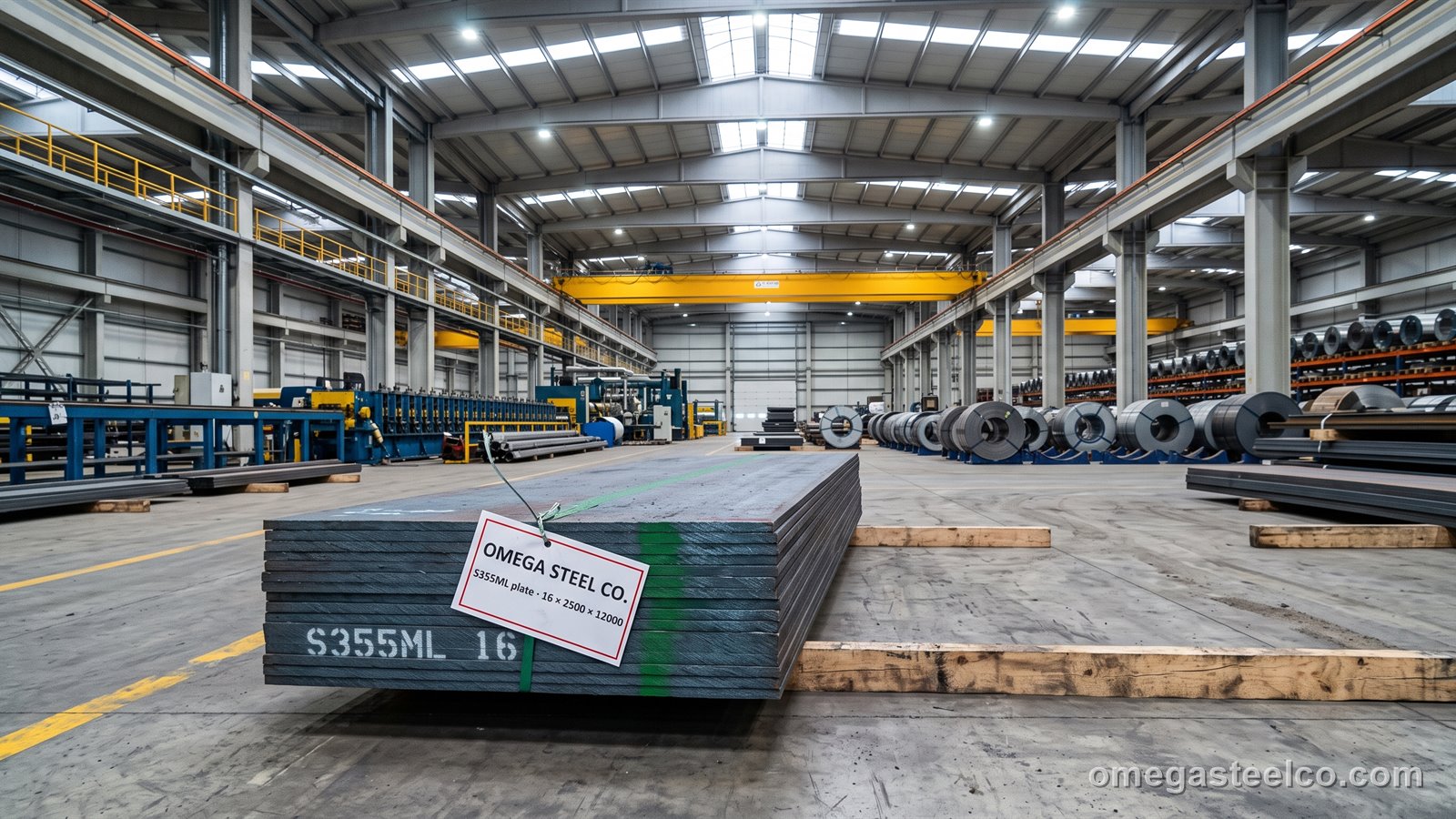
What is S355ML steel plate?
EN 10025-4 is the thermomechanical (M) counterpart of EN 10025-3: the same fine-grain philosophy, but the grain is refined by controlled rolling and cooling rather than by normalising, which allows a leaner chemistry — carbon ≤ 0.14 %, and a carbon equivalent capped at 0.39 % up to 40 mm. S355ML is the −50 °C impact grade (S355M is −20 °C). Its tensile range is slightly lower (450–610 MPa) than the N grades because the microstructure is different, but the yield, the toughness and the weldability are excellent; it is widely used for offshore structures, heavy welded frames and structural pipe and plate in cold climates. The constraint of every M steel: heating above about 600 °C (hot forming, normalising, prolonged flame straightening) destroys the rolling-induced structure, so the plate must be cold-formed and welded with controlled heat input.
Chemical composition
| Element | C | Si | Mn | P | S | Nb | V | Al | Ti | Ni | Cr | Mo | N |
|---|---|---|---|---|---|---|---|---|---|---|---|---|---|
| max. % (ladle) | 0.14 | 0.50 | 1.60 | 0.025 | 0.020 | 0.05 | 0.10 | ≥ 0.020 | 0.05 | 0.50 | 0.30 | 0.10 | 0.015 |
Cu ≤ 0.55. CEV max 0.39 (≤ 16 mm), 0.39 (16–40), 0.40 (40–63), 0.45 (63–120).
Mechanical properties
| Thickness | Yield ReH min (MPa) | Tensile Rm (MPa) | Elongation A min | Impact KV (long.) |
|---|---|---|---|---|
| ≤ 16 mm | 355 | 470–630 | 22 % | 27 J at −50 °C |
| > 16–40 mm | 345 | 470–630 | 22 % | 27 J at −50 °C |
| > 40–63 mm | 335 | 450–610 | 22 % | 27 J at −50 °C |
| > 63–80 mm | 325 | 440–600 | 21 % | 27 J at −50 °C |
Equivalent grades
| System | Grade | Note |
|---|---|---|
| EN 10025-4 | S355M | −20 °C version |
| EN 10025-3 | S355NL | normalised −50 °C |
| ASTM | A633 Gr. C / A709 Gr. 50W (near) | |
| API | 2W Gr. 50 | offshore TMCP |
| GB/T 1591 | Q355E (TMCP) |
Thickness range and stock sizes
| Thickness | Widths × lengths | Availability |
|---|---|---|
| 6–20 mm | 2 000 / 2 500 × 6 000–12 000 | to order 4–6 weeks |
| 25–50 mm | 2 500 / 3 000 × 6 000–12 000 | to order 5–8 weeks |
| 60–80 mm | 2 500 × 6 000–8 000 | to order 6–8 weeks, UT standard |
Weight per m² and per plate
| Thickness | kg/m² | 1 500 × 6 000 (kg) | 2 000 × 6 000 (kg) | 2 500 × 12 000 (kg) |
|---|---|---|---|---|
| 6 mm | 47.1 | 424 | 565 | 1 413 |
| 8 mm | 62.8 | 565 | 754 | 1 884 |
| 10 mm | 78.5 | 707 | 942 | 2 355 |
| 12 mm | 94.2 | 848 | 1 130 | 2 826 |
| 15 mm | 117.8 | 1 060 | 1 413 | 3 533 |
| 20 mm | 157.0 | 1 413 | 1 884 | 4 710 |
| 25 mm | 196.3 | 1 766 | 2 355 | 5 888 |
| 30 mm | 235.5 | 2 120 | 2 826 | 7 065 |
| 40 mm | 314.0 | 2 826 | 3 768 | 9 420 |
| 50 mm | 392.5 | 3 533 | 4 710 | 11 775 |
| 60 mm | 471.0 | 4 239 | 5 652 | 14 130 |
| 80 mm | 628.0 | 5 652 | 7 536 | 18 840 |
Nominal weights — mill tolerance to EN 10029 class A adds up to +4 % on thin plate; invoiced on theoretical weight unless agreed otherwise.
Welding, cutting and forming
The low CEV means no preheat up to 40–50 mm in a dry shop and 50 °C beyond; basic low-hydrogen consumables with −50 °C toughness (nickel-bearing where required), heat input 0.8–2.0 kJ/mm — stay at the lower end on thin plate to avoid HAZ softening, which is the failure mode of TM steels. Interpass ≤ 200 °C. Cold bending 2 × t; no hot forming; flame straightening only briefly below 600 °C; PWHT generally not applicable — use S355NL if stress relief is mandatory.
Where it is used
- Offshore jackets, decks and mooring structures
- Welded heavy frames and machinery in cold regions
- Structural pipe and node plates for pipelines
- Wind-turbine monopiles and transition pieces
- Bridges with welded-only fabrication
- Low-temperature tank supports (welded, not heat-treated)
S355ML vs S355NL
Same strength and −50 °C guarantee. NL is normalised: leaner rolling schedule, richer chemistry, tolerates hot forming and PWHT, CEV ≈ 0.40–0.43. ML is thermomechanical: leaner chemistry, CEV ≤ 0.39, easier welding and cheaper, but cold-work only. Choose ML for welded-only fabrication and NL when the part will be hot-formed, normalised after forming or stress-relieved. See S355NL.
Price
S355ML is priced like S355NL — about 200 USD/t over the S235JR base — as an imported fine-grain plate. UT and 3.2 inspection added per ton. Indicative FOB Istanbul band below.
Bands from our weekly export list (September 2026), FOB Istanbul, full-container quantities, excluding freight and certificates. Firm price per project on RFQ within one working day.
Export and packing
Packing for S355ML steel plate: plates banded on hardwood skids (max 5 t per pack), edges protected, heat numbers marked; Container loading: 40' HC ≈ 24–25 t of 6 m plate, 20' ≈ 20 t of short plate. Over-length plate is loaded flat-rack, and heavy plate above 25 t per piece travels breakbulk from Derince. HS 7208.51 / 7208.52.
| Term | Detail |
|---|---|
| MOQ | 20 t (mill lot) |
| Incoterms | FOB Istanbul · CIF / CFR Gulf, Africa · DAP EU, Balkans, Iraq, Caucasus · DAP Aktau |
| Lead time | Imported to order 4–8 weeks |
| Packing | Loose on bearers, bundles ≤ 10 t |
| Container / truck | ≤ 6 m: 40' HC 24–25 t; longer flat-rack |
| Documents | Invoice, packing list, EN 10204 3.1 (3.2 on request), certificate of origin; SASO / SONCAP / PVoC on request |
| Payment | 30% advance, balance against B/L copy; L/C at sight for orders above 100 t |
Certificates and testing
S355ML steel plate is delivered with the mill certificate EN 10204 3.1 — heat number, ladle analysis, tensile and impact results and the delivery condition. Third-party 3.2 certification (Lloyd's, BV, TÜV, SGS), ultrasonic testing to EN 10160 and extra Charpy tests at a lower temperature are ordered per lot.
How to order
Specify sizes, tonnage, design temperature, UT / Z-quality, certificate level and confirm that no hot forming or PWHT is planned (otherwise we quote S355NL).
Standards
- EN 10025-4:2019 — S355ML, 1.8834
- EN 10160 UT
- EN 10164 Z-quality
- EN 10029 class A/B
Grades
Grade data sheets (chemistry, mechanicals, equivalents) are on our reference site: S355ML · S355M · S355NL
Frequently asked questions
What is the difference between S355ML and S355NL?
Both give 355 MPa and 27 J at −50 °C; ML is thermomechanically rolled (EN 10025-4, lower carbon equivalent, easier welding, cold-work only), NL is normalised (EN 10025-3, tolerates hot forming and heat treatment).
What does M mean in S355ML?
M = thermomechanically rolled delivery condition; L = low-temperature impact test (−50 °C).
Can S355ML be hot formed?
No — heating above about 600 °C destroys the fine grain created by rolling and the yield strength drops; use S355NL where hot forming or normalising is required.
Does S355ML need preheat for welding?
Not up to 40–50 mm in dry conditions thanks to CEV ≤ 0.39; use low-hydrogen consumables and moderate heat input.