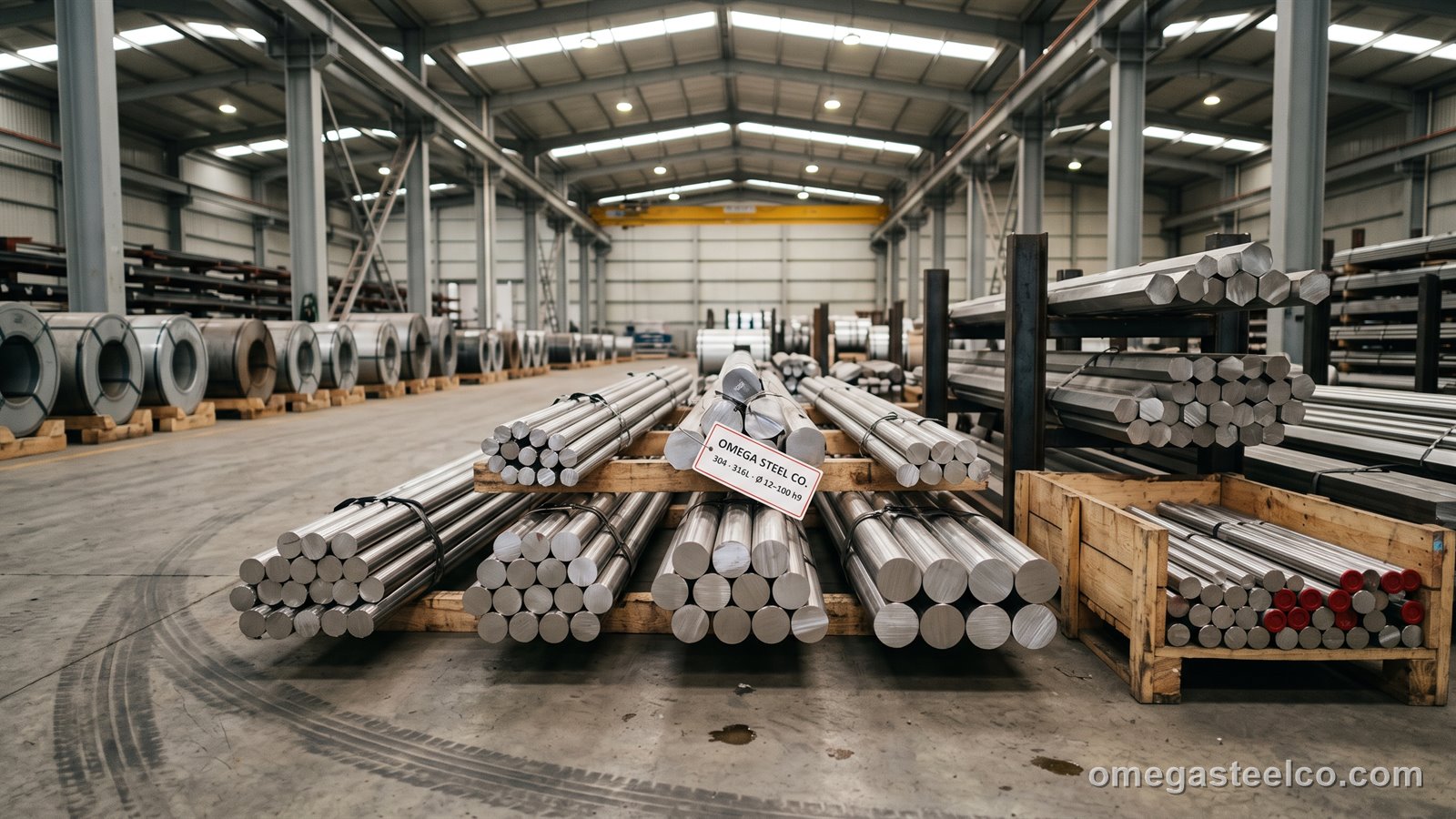
What is stainless round bar?
Stainless bar is the long product for parts that are turned, milled, threaded or ground: shafts, pins, bolts and studs, valve and pump components, fittings, fasteners, handrail posts and architectural spindles. It is made by hot rolling a billet to a round, hexagon or square, then either bright drawing (cold-drawn through a die, giving a smooth surface and an h9 / h10 tolerance up to about Ø 60 mm — the bar a lathe can hold in a collet), peeling and polishing (turned to size and roller-burnished, h11, for Ø 60–300 mm) or leaving it hot-rolled and pickled (black bar, 1D, for forging and rough machining). The grades follow the sheet grades: 304 / 304L (1.4301 / 1.4307) for general parts, food and water; 316L (1.4404) where chlorides, sea water or acids are present; 303 (1.4305), the sulphur-bearing free-machining version of 304 for automatic lathes and high-volume fasteners; 431 (1.4057) and 17-4 PH (1.4542) martensitic and precipitation-hardening bars for shafts, pump spindles and parts needing 800–1 300 MPa; 430F (1.4104) as the magnetic free-machining grade. We stock 304, 316L and 303 in the diameters that account for most machining work and source the rest to order.
Sizes, tolerances and weight per metre
| Diameter | Finish | Tolerance | kg/m | Stock grades | Length |
|---|---|---|---|---|---|
| Ø 3 – 5 mm | bright drawn | h9 | 0.06 – 0.15 | 304, 303 | 3 m |
| Ø 6 mm | bright drawn | h9 | 0.22 | 304, 316L, 303 | 3 m |
| Ø 8 mm | bright drawn | h9 | 0.40 | 304, 316L, 303 | 3 m |
| Ø 10 mm | bright drawn | h9 | 0.62 | 304, 316L, 303 | 3 m |
| Ø 12 mm | bright drawn | h9 | 0.89 | 304, 316L, 303 | 3 / 6 m |
| Ø 16 mm | bright drawn | h9 | 1.58 | 304, 316L, 303 | 3 / 6 m |
| Ø 20 mm | bright drawn | h9 | 2.48 | 304, 316L, 303 | 3 / 6 m |
| Ø 25 mm | bright drawn | h9 | 3.88 | 304, 316L, 303 | 3 / 6 m |
| Ø 30 mm | bright drawn | h9 | 5.58 | 304, 316L | 3 / 6 m |
| Ø 40 mm | bright drawn | h9 | 9.93 | 304, 316L | 3 / 6 m |
| Ø 50 mm | bright drawn / peeled | h9 / h11 | 15.5 | 304, 316L | 3 / 6 m |
| Ø 60 mm | peeled, polished | h11 | 22.3 | 304, 316L | 3 / 6 m |
| Ø 80 mm | peeled, polished | h11 | 39.7 | 304, 316L, 431 | 3 / 6 m |
| Ø 100 mm | peeled, polished | h11 | 62.0 | 304, 316L, 431 | 3 / 6 m |
| Ø 120 mm | peeled, polished | h11 | 89.3 | 304, 316L | 3 m |
| Ø 150 – 300 mm | peeled or black (1D) | h11 / EN 10060 | 140 – 558 | to order | 3 m |
kg/m = 0.00620 × Ø² (mm) for density 7.9; 316L is 0.6 % heavier. Bright bar straightness ≤ 1 mm/m; h9 = +0/−0.052 mm at Ø 40. Intermediate sizes (Ø 14, 18, 22, 28, 32, 35, 45, 55, 65, 70, 90, 110) on request.
Hexagon and square bar
| Section | Sizes | kg/m (examples) | Use |
|---|---|---|---|
| Hexagon (AF = across flats) | AF 6, 8, 10, 12, 13, 14, 17, 19, 22, 24, 27, 30, 32, 36, 41, 46, 50, 55, 60 mm | AF 13: 1.16 · AF 24: 3.94 · AF 36: 8.87 · AF 50: 17.1 | nuts, plugs, fittings, valve bodies on automatic lathes (303 preferred) |
| Square | 10, 12, 15, 20, 25, 30, 40, 50, 60, 80, 100 mm | 20: 3.16 · 30: 7.11 · 50: 19.8 | keys, machine parts, architectural spindles, balustrade infill |
| Flat bar (see stainless flat) | 20 × 3 to 200 × 20 mm | 40 × 8: 2.53 | brackets, trims, strips |
Hexagon kg/m = 0.00684 × AF²; square kg/m = 0.0079 × a². Bright h11, 3 m lengths; 316L hexagon from AF 10 to order.
Grades and where each bar is used
| Grade | EN | Condition | Yield / tensile (MPa) | Machinability | Choose for |
|---|---|---|---|---|---|
| 304 / 304L | 1.4301 / 1.4307 | annealed, bright | ≥ 190 / 500–700 | moderate | general parts, food, water, architecture |
| 316L | 1.4404 | annealed, bright | ≥ 190 / 500–700 | moderate | chlorides, sea water, chemical, pharma, pools |
| 303 | 1.4305 | annealed, bright | ≥ 190 / 500–750 | excellent (S ≥ 0.15 %) | automatic lathes, fasteners, fittings — not for welding or marine |
| 430F | 1.4104 | annealed, bright | ≥ 250 / 430–630 | excellent | magnetic free-machining parts, solenoids |
| 431 | 1.4057 | QT800 (quenched and tempered) | ≥ 600 / 800–950 | fair | shafts, pump spindles, bolts needing strength and corrosion resistance |
| 17-4 PH | 1.4542 | solution-annealed / H1150–H900 | ≥ 720–1 170 / 930–1 310 | fair | valve stems, gears, aerospace and pump parts |
| 2205 duplex | 1.4462 | annealed | ≥ 450 / 650–880 | hard | brine, desalination pump shafts |
Cutting, machining and finishing
Bars are cut to length on band saws (±1 mm, or ±0.5 mm with facing) in any quantity from one piece, deburred and bundled per length; we supply blanks for CNC lathes at the customer's cut length plus allowance, and can chamfer ends. Machining notes: 304 and 316L work-harden — use sharp carbide, positive rake, firm feeds and flood coolant, and avoid dwelling; 303 cuts at 30–50 % higher speeds with short chips and is the choice for volume turning, but its sulphur reduces corrosion resistance and weldability; 431 and 17-4 PH are machined in the annealed or H1150 condition and hardened afterwards. Bright bar can be threaded, knurled and polished directly; peeled bar is turned to size. Welding of 304L and 316L bar follows the sheet grades (308L / 316L filler); 303 should not be welded.
Where it is used
- Shafts, pins, spindles and axles in pumps, valves, food machinery and conveyors
- Bolts, studs, nuts and threaded rod (A2 = 304, A4 = 316 classes)
- Fittings, plugs, nozzles and instrument parts turned from hexagon bar
- Handrail posts, balustrade spindles and architectural fixings
- Marine and pool hardware in 316L; chemical-plant parts
- Blanks for CNC machining and forging
304 vs 316L vs 303 bar
304 bar is the default for anything that must not rust and does not see salt; 316L bar costs about 30–40 % more and is worth it wherever chlorides, sea water, pool chemicals or acids are present; 303 is 304 with sulphur added for machinability — 30–50 % faster on the lathe, but it pits sooner, welds badly and is not for marine use. For strength, 431 (800 MPa) and 17-4 PH (to 1 300 MPa) replace carbon-steel shafts where corrosion resistance is also needed. Tube and profile for the same jobs are on the stainless tube page.
Price per kg and per metre
Stainless bar is priced per kg on the stainless list, nickel-driven like sheet: bright-drawn 304 bar in stock sizes is the base, 316L about 30–40 % above, 303 5–10 % above 304, 431 and 17-4 PH per quotation; small diameters (Ø 3–8) and hexagon carry a drawing premium. Cutting is charged per cut. Per metre = kg/m × price per kg. Send the size list for a firm FOB Istanbul price within a working day.
Export and packing
Bars in bundles of 50–500 kg, wrapped in PE and paper, strapped on timber bearers with end caps on bright bar; cut blanks in wooden boxes on pallets; every bundle tagged with grade, size, heat and length. 3 m bars load in 20' containers, 6 m in 40'; mixed with sheet and tube in one container. HS code 7222.11 / 7222.19 (bars, hot-rolled) and 7222.20 (bars, cold-finished).
Certificates
EN 10204 3.1 per heat (chemistry, tensile, hardness, condition), dual EN 10088-3 / ASTM A276 where the mill provides it; 3.2, PMI (positive material identification) and ultrasonic testing on large bars on request; certificate of origin.
How to order
Specify grade, section (round Ø / hexagon AF / square), finish and tolerance (bright h9 / h11 / peeled / black), length (3 m / 6 m / cut length and pieces), quantity in kg or pieces, and any test requirements; reply within one working day.
Standards
- EN 10088-3 — stainless bars, semi-finished products
- ASTM A276 / A479 — stainless bars and shapes
- EN 10278 — dimensions and tolerances of bright steel products (h9, h10, h11)
- EN 10060 / 10059 — hot-rolled round and square bar dimensions
- EN 10204 3.1
Grades
Grade data sheets (chemistry, mechanicals, equivalents) are on our reference site: 1.4301 · 1.4404 · 1.4305 · 1.4057
Frequently asked questions
What sizes of stainless round bar do you stock?
304, 316L and 303 from Ø 6 to 120 mm bright-drawn (h9 to Ø 50, peeled h11 above), Ø 3–5 and 150–300 mm to order; hexagon AF 6–60 mm and square 10–100 mm; 3 m and 6 m or cut to length.
What is the difference between bright bar and peeled bar?
Bright bar is cold-drawn to h9 / h10 with a smooth surface, up to about Ø 60 mm — ready for collets and threading; peeled bar is turned and burnished to h11 for larger diameters. Black (1D) bar is hot-rolled and pickled for forging and rough machining.
Which grade for a shaft in sea water?
316L for moderate loads; 2205 duplex for pump shafts in brine or hot sea water; 431 or 17-4 PH only where strength governs and the chloride exposure is limited.
Is 303 stainless as corrosion-resistant as 304?
No — the sulphur that makes it free-machining creates inclusions where pitting starts; 303 is for indoor, dry or lightly wet machined parts and should not be welded or used in marine service.
How much does stainless round bar weigh per metre?
kg/m = 0.0062 × Ø² for round (Ø 20 = 2.48, Ø 50 = 15.5, Ø 100 = 62), 0.00684 × AF² for hexagon, 0.0079 × a² for square; 316L is 0.6 % heavier than 304.
Can you cut bars to length?
Yes — band-sawn to ±1 mm (±0.5 mm with facing) from one piece upward, deburred, chamfered on request, boxed as CNC blanks.
What is the price of stainless bar per kg?
Priced per kg on the nickel-driven stainless list: bright 304 bar is the base, 316L 30–40 % more, 303 slightly above 304; firm FOB Istanbul price per size list within a working day.