What is a standing seam roof?
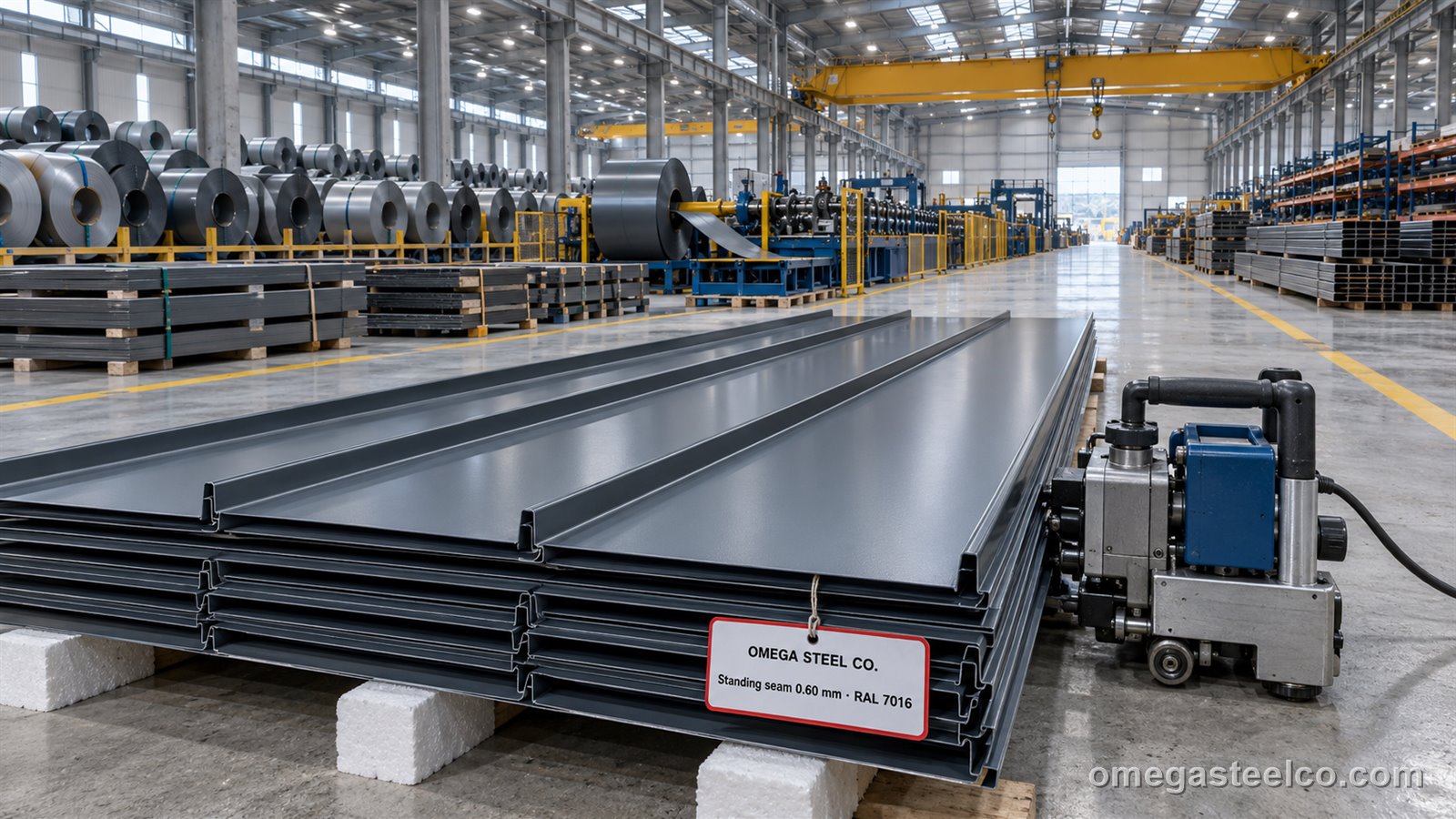
A standing seam roof is made of long metal pans whose edges are turned up and joined above the water line — the seam "stands" 25–38 mm proud of the pan. The pans are not screwed through: concealed clips fixed to the deck or purlins hold the seam and let each panel slide as it expands, so there are no holes, no washers to age and no thermal buckling on 20 m runs. Two seam types: snap-lock, where the male edge clicks over the clip and female edge by hand (fast, pitch ≥ 7°), and double-lock (mechanically seamed), where a seaming machine folds the seam 180° twice for a watertight joint at pitches down to 3°, in high wind and on very long or curved roofs. Standing seam is the system for architectural roofs, stadiums, terminals, mosques, schools, hotels, curved canopies and re-roofing over old metal or membrane roofs.
Systems and profiles
| System | Seam | Pan width | Material / thickness | Min. pitch | Clip | Typical use |
|---|---|---|---|---|---|---|
| Snap-lock 25 | 25 mm, click | 300 / 400 / 500 mm | PPGI 0.60–0.70, alu 0.7–0.9 | 7° | Fixed / sliding clip | Villas, schools, commercial, fast install |
| Double-lock 25 | 25 mm, 180° seamed | 400 / 500 / 600 mm | PPGI/PPGL 0.60–0.80, alu 0.8–1.0 | 3° | Sliding clip | Low-pitch roofs, long runs, wind zones |
| Double-lock 38 | 38 mm, seamed | 400 / 500 mm | PPGI/PPGL 0.70–0.80, alu 0.9–1.0 | 3° | Sliding clip on thermal halter | Large roofs, stadiums, terminals, curved |
| Snap-lock 38 striated | 38 mm, click, striated pan | 400 / 500 mm | PPGI 0.60–0.70 | 5° | Fixed / sliding | Flat-looking pans without oil-canning |
| Curved / tapered | Any of the above | 300–500 mm | 0.70–0.80 | 3° | Sliding | Barrel-vault roofs, conical roofs (site-curved) |
Striations (mini-ribs) in the pan reduce oil-canning; pencil ribs and flat pans on request.
Materials and finishes
| Material | Thickness | Coating | Life | Where |
|---|---|---|---|---|
| PPGI (galvanized Z275 + PVDF 35 µm) | 0.60–0.80 mm | PVDF, any RAL, matt or metallic | 30–40 yr | Standard for projects — colour stability |
| PPGI polyester | 0.60–0.70 mm | PE 25 µm | 15–20 yr | Budget roofs, inland |
| PPGL (aluzinc AZ150 + PVDF) | 0.60–0.80 mm | PVDF | 35–45 yr | Coastal, humid, longest steel life |
| Aluminium 3105 / 5754 | 0.7–1.0 mm | PVDF, mill, anodised look | 50+ yr | Coastal, curved roofs, lightest (2–3 kg/m²) |
| Zinc-magnesium ZM310 + PVDF | 0.60–0.80 mm | PVDF | 40+ yr | Cut-edge protection, 40-year warranties |
Clips, substructure and thermal movement
Panels are fixed only through clips: fixed clips at the ridge (or mid-length on long panels) and sliding clips elsewhere, screwed to a plywood/OSB deck, a steel liner deck, or directly to purlins with thermal halters (polyamide feet) that break the thermal bridge. Panel length is unlimited in principle — 40–60 m runs are common — because each panel slides on its clips; expansion is 1.2 mm per metre per 100 °C for steel, twice that for aluminium, taken up at the eave and ridge details. Clip spacing 400–600 mm per wind-uplift calculation (EN 1991-1-4); corner and edge zones get closer spacing.
Weight, lengths and packing
0.70 mm PPGI panel with 500 mm pan: about 6.5 kg/m² of roof; aluminium 0.9 mm: 3.3 kg/m². Factory lengths to 13.5 m (11.8 m for a 40' HC); longer panels are roll-formed on site from coil with our mobile machine (container-mounted, 3-phase power) — the standard approach for stadiums, terminals and any roof over 12 m rafter. Panels are film-protected, nested in crates of 20–40 with foam spacers, and lifted with spreader bars.
Details and accessories
- Ridge: vented or sealed ridge cap on Z closures with foam / metal fillers
- Eave: drip edge with clip strip, gutter behind fascia or box gutter
- Verge / gable: seam-hook or cover flashing
- Penetrations: seam clamps for snow guards, solar rails, walkways (no drilling)
- Curbs and flashings for vents, rooflights, chimneys
- Underlay: vapour-permeable membrane on deck; anti-condensation fleece on purlin systems
- Seaming machines (double-lock) supplied on rental with the project
Standing seam vs trapezoidal vs membrane
| Standing seam | Trapezoidal sheet | Single-ply membrane | |
|---|---|---|---|
| Fixings | Hidden clips | Screws through crest | Adhered / mechanically fixed |
| Min. pitch | 3° (double-lock) | 5–8° | 1° |
| Panel length | Unlimited (site-formed) | ≤ 13.5 m, end laps | Rolls |
| Look | Architectural, clean lines | Industrial | Flat |
| Life | 30–50 yr | 20–30 yr | 15–25 yr |
| Cost per m² (material) | 1.8–2.5 | 1.0 | 1.2–1.8 |
| Best for | Public, commercial, curved, low-pitch | Industrial, agricultural | Flat roofs |
Standing seam price per m²
Priced per m² per project: as a guide, 0.70 mm PVDF PPGI double-lock 25 mm panels with clips run 2–2.5× the trapezoidal-sheet band per m² FOB Istanbul (see the trapezoidal sheet page), aluminium about 1.4–1.6× the steel panel; site roll-forming, flashings and underlay are quoted per project. Firm price per roof plan within two working days.
Bands from our weekly export list (September 2026), FOB Istanbul, full-container quantities, excluding freight and certificates. Firm price per project on RFQ within one working day.
Export and packing
Crates of 20–40 panels with foam spacers and film, max 11.8 m in a 40' HC (≈ 2 000–3 000 m²); coil plus mobile roll-former for site production of long panels. HS code 7210.70 (steel) / 7606.12 (aluminium) / 7308.90 (system parts).
| Term | Detail |
|---|---|
| MOQ | 800 m² (one project); best freight from 1 × 40' HC |
| Incoterms | FOB Istanbul · CIF / CFR Gulf, Africa · DAP EU, Balkans, Iraq, Caucasus · DAP Aktau / Almaty |
| Lead time | 10–15 working days from drawing approval; site roll-forming scheduled per project |
| Packing | Crates 20–40 panels, foam spacers, film; spreader-bar lifting |
| Container / truck | 40' HC ≈ 2 000–3 000 m² (≤ 11.8 m) · coil + mobile roll-former for longer panels |
| Documents | Invoice, packing list, EN 10204 3.1, coating certificate, CE (EN 14782), clip test reports, certificate of origin |
| Payment | 30% advance, balance against B/L copy; L/C at sight via London office; project terms per contract |
Certificates
EN 10204 3.1 for coil, coating certificate, CE to EN 14782, wind-uplift clip test reports, certificate of origin; SASO, SONCAP, EAC on request; installer training and site supervision available.
How to order
Send the roof drawings (plan, pitches, rafter lengths, deck or purlin substructure), material and colour, seam type, and port. We return the panel layout, clip plan and a quote per m² with crates, weights and lead time (10–15 working days), or the site roll-forming option for long roofs.
Standards
- EN 14782 (self-supporting metal sheet for roofing)
- EN 10169 (pre-painted steel), EN 10346 (galvanized / aluzinc substrate)
- EN 485 / EN 1396 (aluminium sheet and coil-coated aluminium)
- EN 1991-1-4 (wind uplift design of clip systems)
- EN 508-1/-2 (profiled sheet, steel and aluminium)
Grades
Grade data sheets (chemistry, mechanicals, equivalents) are on our reference site: DX51D+Z · S280GD
Frequently asked questions
What is the difference between snap-lock and mechanically seamed standing seam?
Snap-lock panels click together by hand over the clips (fast, pitch ≥ 7°); mechanically seamed (double-lock) panels are folded 180° twice by a seaming machine for a watertight joint at 3° pitch, in high wind and on long or curved roofs.
What is the minimum pitch for a standing seam roof?
3° (about 5%) for double-lock seamed panels with sealed seams, 7° for snap-lock; below 3° use a membrane.
How much does a standing seam metal roof cost?
Material about 2–2.5× a trapezoidal sheet per m² (0.70 mm PVDF steel with clips), aluminium 1.4–1.6× the steel panel; plus flashings, underlay and installation. Firm price per roof plan within two working days.
How long can the panels be?
13.5 m from the factory (11.8 m in a container); on site our mobile roll-former makes panels of any length from coil — 40–60 m runs are common on stadiums and terminals.
Steel or aluminium?
PVDF-coated steel (PPGI/PPGL) for most projects — stiffer, cheaper, 30–40 years; aluminium for coastal sites, curved roofs and the lightest weight, 50+ years at 40–60% more.
Can solar panels be fixed to a standing seam roof?
Yes — with seam clamps that grip the seam without drilling, which is one of the main reasons the system is chosen for solar-ready roofs.
Do you supply the seaming machine and installer support?
Yes — seaming machines on rental, clip and layout drawings, installer training and site supervision on request.
Do you manufacture the panels yourselves?
Yes — roll-formed on our own line in Dilovası, or on site with our mobile machine, from our PPGI, aluzinc and aluminium coil stock.