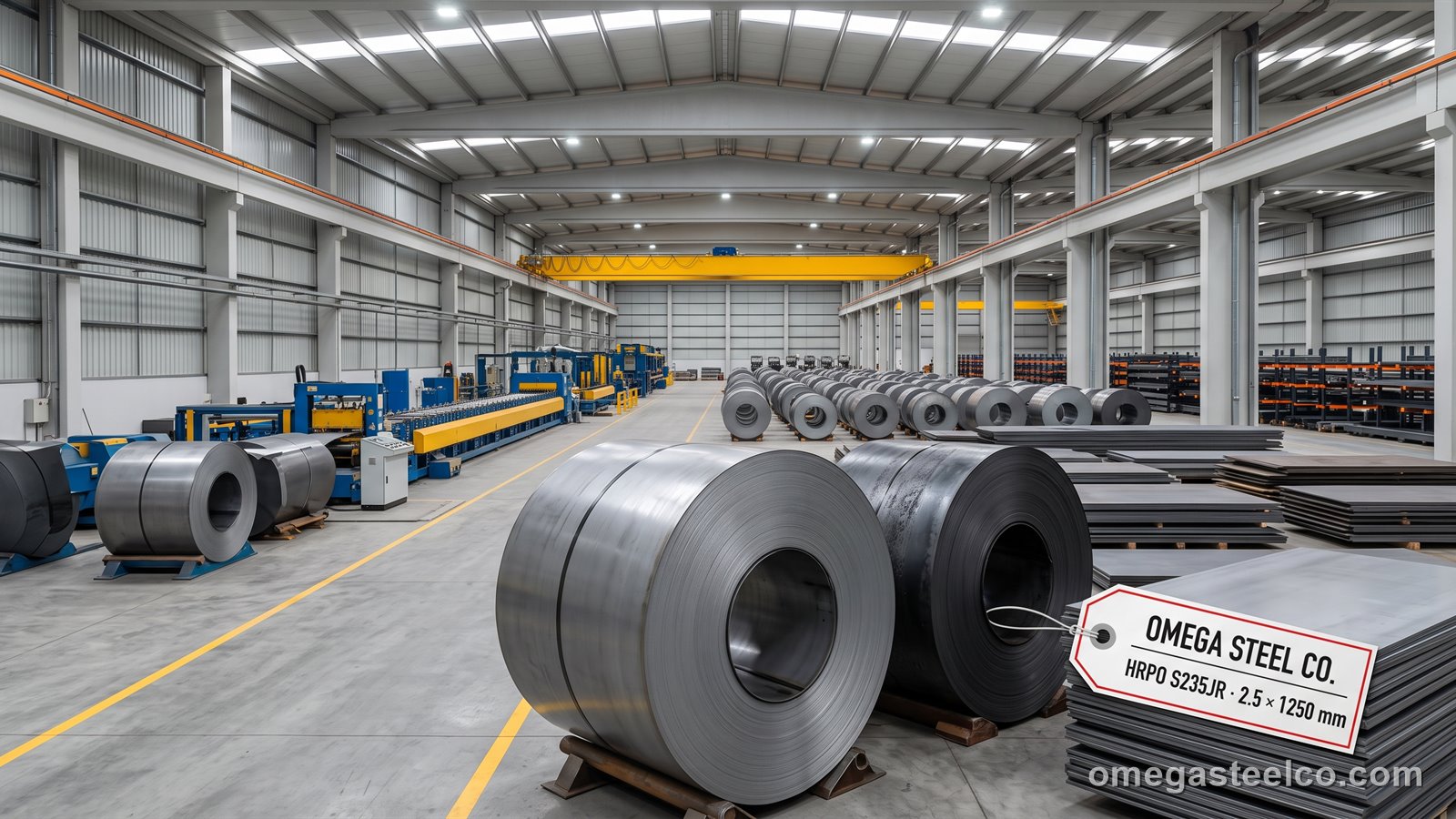
What is HRPO pickled and oiled steel?
HRPO — hot-rolled, pickled and oiled — is a surface condition, not a steel grade. Hot-rolled coil leaves the mill covered with a blue-black oxide scale; the coil is uncoiled through a hydrochloric-acid pickling line that dissolves the scale, rinsed, dried, given a thin rust-preventive oil film and recoiled. What comes out is the same S235JR or DD11 steel with a uniform grey-metallic surface, ready for forming or painting. Three things follow. The scale that would crack off in a press brake or a roll-former, damaging tools and the part, is gone. Paint and powder adhere after simple degreasing — no shot-blasting. And the thickness tolerance is unchanged from hot-rolled (EN 10051), so HRPO is not a substitute for cold-rolled where gauge precision matters, but between 1.5 and 6 mm it is the economical clean sheet: cheaper than cold-rolled, cleaner than black. Tube mills run HRPO strip almost exclusively; so do roll-formers making C/Z profiles, trailer and body builders pressing brackets and cross-members, and enclosure makers in the thicker gauges. The substrate grade is chosen by use: S235JR (ST37) for general fabrication and tubes, DD11 for bending and forming, DD13/DD14 for drawing, and S355MC–S700MC for high-strength parts. All are available pickled from Turkish mills and stocked in the common gauges at Dilovası.
Chemical composition
| Element | S235JR: C | S235JR: Mn | S235JR: P / S | DD11: C | DD11: Mn | DD11: P / S |
|---|---|---|---|---|---|---|
| max. % (ladle) | 0.17 | 1.40 | 0.035 / 0.035 | 0.12 | 0.60 | 0.045 / 0.045 |
Pickling does not change the chemistry; the certificate carries the substrate grade with the note "pickled and oiled".
Mechanical properties of the substrates
| Substrate | Yield (MPa) | Tensile (MPa) | Elongation | Use |
|---|---|---|---|---|
| S235JR (ST37) | ≥ 235 | 360–510 | ≥ 26 % (A5) / 19 % (A80) | general, tubes, welded parts |
| DD11 | 170–340 | ≤ 440 | ≥ 28 % (A80) | bending, roll-forming |
| DD12 | 170–320 | ≤ 420 | ≥ 30 % | drawing |
| DD13 | 170–310 | ≤ 400 | ≥ 33 % | deep drawing |
| DD14 | 170–290 | ≤ 380 | ≥ 36 % | extra-deep drawing |
| S355MC | ≥ 355 | 430–550 | ≥ 19 % | high-strength forming |
Equivalent grades
| System | Grade | Note |
|---|---|---|
| Trade | HRPO / P&O / HRP / asitli sac | same condition |
| ASTM | A1011 HRPO (CS / DS / SS grades) | US designation |
| JIS | SPHC-P / SPHD-P | pickled hot-rolled |
| EN | S235JR+P&O, DD11+P&O | certificate wording |
| Cold-rolled | DC01 | cleaner, tighter gauge, thinner, dearer |
Pickling, oiling and surface
| Condition | Process | Surface | Best for |
|---|---|---|---|
| Black (HR, as-rolled) | none — mill scale left on | blue-black oxide, 10–40 µm, flakes when bent | welded structures, plate to be blasted, hidden parts |
| HRPO (pickled & oiled) | HCl pickling of coil, rinse, light oil | uniform grey-metallic, scale-free, Ra ≈ 1–3 µm | forming, painting, roll-forming, tube making, visible parts |
| HRP / HRPO skin-passed | pickling + temper pass | flatter, tighter gauge, no Lüders lines | pressing, blanking, precision parts |
| Dry (pickled, unoiled) | pickling, no oil | bare, rusts within days | immediate galvanizing or welding only |
Turkish trade names: siyah sac = black hot-rolled, HRP / asitli sac = pickled & oiled. The steel grade (S235JR, DD11 …) is the same under both surfaces; only the finish differs.
Thickness range and stock sizes
| Thickness | Widths × lengths | Availability |
|---|---|---|
| 1.35–2.0 mm | coil 1 000 / 1 250 / 1 500 mm; sheet to 3 000; slit strips | stock S235JR, DD11 |
| 2.5–4.0 mm | coil 1 250 / 1 500 mm; sheet 2 500 / 3 000 / 6 000 | stock S235JR |
| 5.0–6.0 mm | coil 1 500 mm; sheet 1 500 × 6 000 | stock, limited |
| 8–12 mm pickled | coil / sheet | to order 2–3 weeks |
| MC grades pickled | coil 1 250 / 1 500 mm | to order 2–3 weeks |
Weight per m² and per sheet
| Thickness | kg/m² | 1 000 × 2 000 (kg) | 1 250 × 2 500 (kg) | 1 500 × 3 000 (kg) |
|---|---|---|---|---|
| 1.35 mm | 10.60 | 21.2 | 33.1 | 47.7 |
| 1.5 mm | 11.78 | 23.6 | 36.8 | 53.0 |
| 1.8 mm | 14.13 | 28.3 | 44.2 | 63.6 |
| 2 mm | 15.70 | 31.4 | 49.1 | 70.7 |
| 2.5 mm | 19.63 | 39.3 | 61.3 | 88.3 |
| 3 mm | 23.55 | 47.1 | 73.6 | 106.0 |
| 4 mm | 31.40 | 62.8 | 98.1 | 141.3 |
| 5 mm | 39.25 | 78.5 | 122.7 | 176.6 |
| 6 mm | 47.10 | 94.2 | 147.2 | 212.0 |
Uncoated; tolerances to EN 10051 (e.g. ±0.17 mm at 2.0 mm, 1 250 wide). Oil film ≈ 1 g/m² per side, not weighed.
Forming, welding and painting
Bends at 1 × t (S235JR) or 0.5 × t (DD11) without scale cracking; roll-forms and tube-welds cleanly — the clean edge is why ERW mills insist on pickled strip. Punching and laser cutting are cleaner than on black sheet (no scale spatter). Welds like the substrate grade; wipe the oil near the joint. Painting: alkaline degrease, then primer or powder — no blasting needed; phosphating for e-coat. The oil film protects for 3–6 months indoors; store dry and use in rotation.
Where it is used
- ERW tube and hollow-section strip (slit to width)
- C, Z, sigma and omega roll-formed profiles
- Trailer, truck-body and agricultural pressings
- Enclosures, cabinets and machine covers in 1.5–4 mm
- Laser-cut and punched parts for painting
- Wheel rims, drums and formed automotive parts (DD grades)
HRPO vs black hot-rolled vs cold-rolled
Black (HR) is cheapest and fine for welded structures and anything blasted before paint — see hot-rolled coil and sheet. HRPO adds 15–25 USD/t for pickling and gives a clean, formable, paintable surface in 1.35–6 mm. Cold-rolled (DC01) is thinner (0.4–3 mm), flatter, with a finer surface and tighter gauge, at 60–100 USD/t more. Rule: hidden and welded → black; formed or painted, 1.5–6 mm → HRPO; thin, precise or visible → cold-rolled.
Price
HRPO is priced at the hot-rolled coil list plus the pickling charge; the bands below are the month's indicative FOB Istanbul ranges for the thin and thick stock. DD grades add 10–30 USD/t by level; slitting and cut-to-length per ton.
Bands from our weekly export list (September 2026), FOB Istanbul, full-container quantities, excluding freight and certificates. Firm price per project on RFQ within one working day.
Export and packing
HRPO pickled and oiled steel ships as coil — eye-to-sky on a wooden cradle, 5–25 t per coil, VCI paper and steel strapping — or as cut sheet on skids of 2–3 t with paper interleaving and edge protectors. A 20' takes one coil up to 20 t; a 40' HC two coils or 24 t of sheet. HS 7210 / 7209 / 7208 by product.
| Term | Detail |
|---|---|
| MOQ | One coil (10–25 t) or 5 t of sheet |
| Incoterms | FOB Istanbul · CIF / CFR Gulf, Africa · DAP EU, Balkans, Iraq, Caucasus · DAP Aktau |
| Lead time | Stock 1.35–6.0 mm: 3–5 working days; slit strip and cut blanks 5–8 days |
| Packing | Coil eye-to-sky, VCI paper; sheet on skids ≤ 3 t, interleaved; slit coils on pallets |
| Container / truck | 20' one coil ≤ 20 t; 40' HC two coils or 24 t sheet |
| Documents | Invoice, packing list, EN 10204 3.1 (3.2 on request), certificate of origin; SASO / SONCAP / PVoC on request |
| Payment | 30% advance, balance against B/L copy; L/C at sight for orders above 100 t |
Certificates and testing
Every lot of HRPO pickled and oiled steel carries an EN 10204 3.1 inspection certificate listing heat, chemistry, mechanical and impact results. On request we add 3.2 witnessing by a classification society or inspector, EN 10160 ultrasonic testing and supplementary impact tests at the customer's design temperature.
How to order
Specify substrate grade (S235JR / DD11 / DD13 …), thickness × width (or slit widths / sheet length), oiling (standard light oil, heavy oil for long storage, dry for immediate galvanizing), coil weight limit and tonnage.
Standards
- EN 10025-2 S235JR / EN 10111 DD11–DD14 (substrate)
- EN 10051 — dimensions and tolerances of hot-rolled strip
- EN 10163-2 — surface class
- EN 10204 3.1
Grades
Grade data sheets (chemistry, mechanicals, equivalents) are on our reference site: S235JR · DD11 · S355MC
Frequently asked questions
What is HRPO steel?
Hot-Rolled Pickled and Oiled — hot-rolled sheet or coil whose mill scale has been removed by acid pickling and which is lightly oiled against rust; a surface condition available on S235JR, DD11–DD14 and MC grades.
What is the difference between HRPO and HRC?
HRC (hot-rolled coil, black) still carries its mill scale; HRPO has been pickled clean and oiled. Same steel and tolerances; HRPO costs 15–25 USD/t more and is used for forming, tubes and painting.
What is the difference between HRPO and cold-rolled?
Cold-rolled (DC01) is rolled again after pickling to a thinner gauge with a smoother surface and tighter tolerance; HRPO keeps hot-rolled gauge and tolerances. HRPO covers 1.35–6 mm, cold-rolled 0.4–3 mm.
What is asitli sac / HRP sac?
The Turkish names for pickled-and-oiled hot-rolled sheet — the same product as HRPO.
Can HRPO be painted without blasting?
Yes — after alkaline degreasing it takes primer, powder or e-coat directly; that is its main advantage over black sheet.
What HRPO thicknesses are in stock?
1.35–6.0 mm in 1 000–1 500 mm widths as coil, sheet and slit strip at Dilovası; thicker and MC grades pickled to order.